
Basenji: The Complete Guide to the “Barkless” Dog
Basenji
The Basenji is famous for something no other widely known breed can claim: it doesn’t bark. That doesn’t mean it’s silent — Basenjis communicate with a distinctive yodel-like sound nicknamed the “barroo,” a direct result of an unusually shaped larynx. Traced to Central Africa’s Congo Basin and depicted in Egyptian tomb art roughly 4,500 years old, the Basenji reached AKC recognition in 1943. This guide covers the breed’s ancient history, exactly why it doesn’t bark, its genuinely important Fanconi syndrome health concern, and an honest look at whether its independent, cat-like temperament suits your household.
Basenji Quick Facts
The Basenji belongs to the AKC Hound Group [Internal Link], recognized in 1943, and the FCI Group 5, Section 6 (Primitive Type – Hunting Dogs).
| Attribute | Detail |
| AKC Group | Hound Group; recognized 1943 |
| FCI Group | Group 5, Section 6 (Primitive Type – Hunting Dogs) |
| Country of Origin | Central Africa (Congo Basin) |
| Height | 16–17 in at the shoulder |
| Weight | 22–24 lb |
| Lifespan | 12–14 years |
| Coat | Short, fine, close-lying |
| Colors | Red, black, tricolor, or brindle, all with white |
| Temperament | Independent, intelligent, alert, curious |
What Is a Basenji?
Ancient Origins in Central Africa
The Basenji originates from hunting stock in Central Africa’s Congo Basin, where local hunters used the breed’s keen sight and scenting ability to drive game toward nets. The breed’s ancient lineage is well documented: dogs with curled tails, erect ears, and a build strikingly similar to the modern Basenji appear in Egyptian tomb art dating back roughly 4,500 years, associated with a breed called the Tesem. That visual continuity across millennia is part of why the FCI classifies the Basenji among “primitive types” — breeds whose form and function have changed remarkably little compared to most modern breeds shaped by more recent selective breeding.
Western fanciers did not successfully establish foundation stock until the 1930s, and the AKC officially recognized the breed in 1943. Animal importer Henry Trefflich played a significant role in establishing the breed in the United States, following earlier, less successful attempts by other fanciers to bring the breed to Europe.
Why Doesn’t a Basenji Bark?
Key Fact: Basenjis have an unusually shaped larynx that physically prevents the sustained, sharp bark typical of most dogs. Instead they vocalize with a distinctive yodel-like sound often called a “barroo,” along with growls, whines, and other expressive noises. The breed is not silent — it simply doesn’t bark the way most dogs do.
AKC and FCI Recognition
The FCI classifies the Basenji under Group 5, Section 6, among primitive-type hunting dogs, a category that groups breeds with deep, largely unaltered ancestral lineages. The AKC placed the Basenji in the Hound Group upon its 1943 recognition, reflecting its historical role hunting alongside people in dense Central African terrain.
Basenji vs. Pharaoh Hound vs. Ibizan Hound

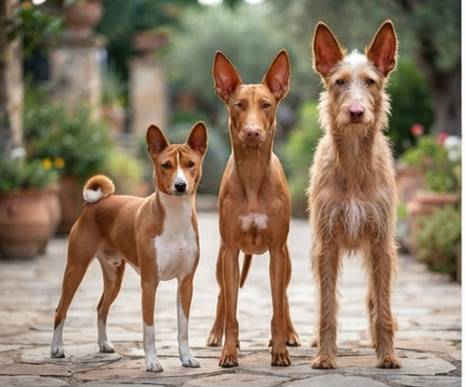
These three breeds are sometimes grouped together in searches as ancient, primitive-type hunting dogs with a similarly lean, alert build. Here’s how the Basenji compares to the Pharaoh Hound [Internal Link] and the Ibizan Hound [Internal Link].
| Attribute | Basenji | Pharaoh Hound | Ibizan Hound |
| Origin | Central Africa (Congo Basin) | Malta | Spain (Balearic Islands) |
| Coat | Short, fine, close-lying | Short, glossy | Smooth or wirehaired |
| Build | Compact, wrinkled forehead, tightly curled tail | Tall, lean, blushes visibly when excited | Tall, lean, large upright ears |
Unlike the taller Pharaoh Hound and Ibizan Hound, the Basenji is notably smaller and more compact, with a distinctive wrinkled forehead and tightly curled tail that set it apart at a glance.
Appearance

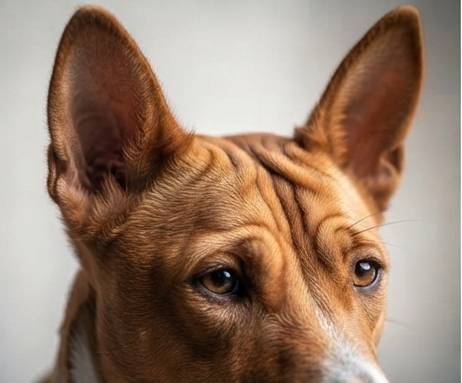
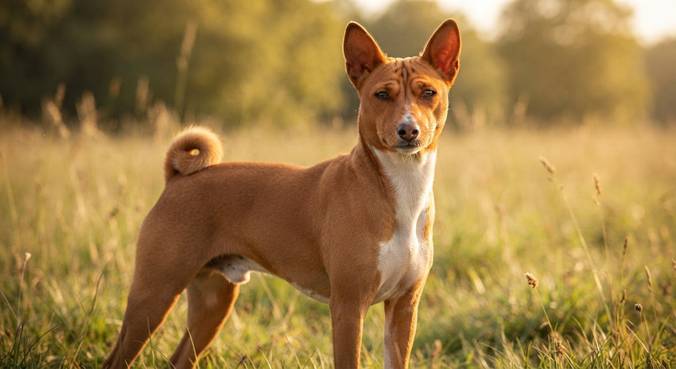
The Basenji has a compact, elegant build with a short, fine coat, a tightly curled tail carried over the back, and a distinctively wrinkled forehead that gives the breed an alert, quizzical expression. Coat colors include red, black, tricolor, and brindle, always paired with white markings.
Temperament
The Basenji is often described as combining feline independence with canine loyalty — genuinely affectionate with its own family while retaining a strong streak of self-sufficiency that can surprise owners used to more conventionally eager-to-please breeds. Basenjis are intelligent, curious, and athletic, but that intelligence comes paired with real stubbornness, and the breed is widely regarded as one of the more challenging Hound Group members to train consistently. Many owners describe living with a Basenji as closer to living with a cat than a conventional dog — affectionate on the dog’s own terms, rather than constantly seeking approval the way many other breeds do.
Is a Basenji Right for You?

Families and Children
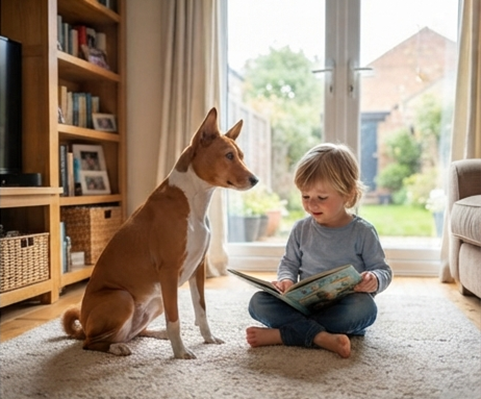
Basenjis can do well with children in households that respect the breed’s independent nature and don’t expect constant, dog-like eagerness to please; supervision and mutual respect matter more with this breed than with more conventionally biddable ones.
Other Pets
With early socialization, Basenjis can coexist with other dogs, though their hunting-driven prey instinct means introductions to small pets like cats or rodents require real care.
First-Time Owners
This is a genuinely difficult breed for true beginners. The combination of real stubbornness, high intelligence used just as often for mischief as for obedience, and a strong independent streak means the Basenji tends to do best with owners who have prior experience training strong-willed dogs.
Training
Basenjis are intelligent but notably independent, and traditional repetition-based training methods often fail with this breed. Short, engaging, reward-based sessions tend to work better than long drilling, and consistency matters enormously — Basenjis are quick to find and exploit any inconsistency in a training routine.
Exercise Needs

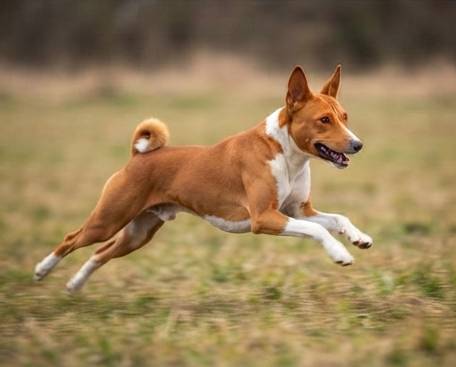
Basenjis are athletic and energetic, bred to run down game across open terrain, and they need real daily exercise — brisk walks, secure off-leash running, or structured activities like lure coursing suit the breed well. A bored, under-exercised Basenji is considerably more likely to find its own, often destructive, entertainment. Mental stimulation matters just as much as physical exercise — puzzle toys and short, engaging training games help channel the breed’s natural cleverness productively.
Grooming
The short, fine coat is remarkably low-maintenance, and Basenjis are famous for a cat-like fastidiousness about self-cleaning that results in minimal “doggy odor” compared to most breeds. Standard nail trims, ear checks, and dental care round out the routine.
Health and Lifespan


Most Basenjis live between 12 and 14 years. The breed is generally healthy, but one condition in particular deserves close attention.
| Condition | What It Is | What Owners Should Watch For |
| Fanconi syndrome | A kidney disorder affecting the reabsorption of nutrients | Excessive thirst and urination, glucose in the urine |
| Progressive retinal atrophy | Gradual, inherited vision loss | Night blindness progressing to full vision loss |
| Hip dysplasia | Malformation of the hip joint | Difficulty rising, reluctance to jump, altered gait |
Understanding Fanconi Syndrome
Fanconi syndrome [Internal Link] affects roughly 7% of Basenjis and is the breed’s single most important health concern. The condition impairs the kidneys’ ability to reabsorb glucose and other nutrients, and if caught early through routine urine screening, it can be managed effectively for years with proper veterinary care. The Basenji Club of America recommends regular at-home urine glucose testing for the breed specifically because early detection makes such a meaningful difference in outcomes. Progressive retinal atrophy [Internal Link] is a separate, unrelated concern worth screening for as well.
Nutrition
A high-quality, medium-breed active-dog formula suits the Basenji well. Given the breed’s Fanconi syndrome risk, owners should work with a veterinarian familiar with the condition to establish a baseline and monitoring routine early in the dog’s life.
Cost and Adoption

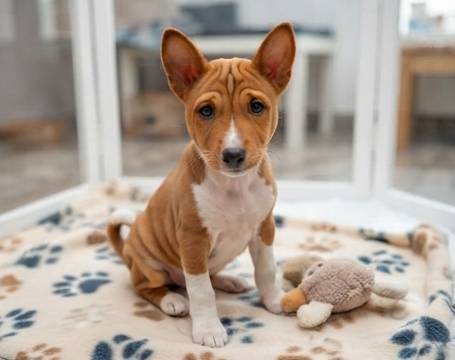
Basenji puppies are available through breeders across the US, though prospective owners should prioritize breeders who screen for Fanconi syndrome and other known conditions as part of a genuinely responsible breeding [Internal Link] program. Basenji-specific rescue organizations exist and are a worthwhile option for owners open to an adult dog, which can also sidestep some of the more demanding puppy-training years for this independent breed. Connecting with the Basenji Club of America is a genuinely useful step for both breeder referrals and ongoing health-testing guidance.
Frequently Asked Questions
What is a Basenji?
The Basenji is an ancient Central African hunting breed known for not barking, recognized by the AKC’s Hound Group in 1943.
Why doesn’t a Basenji bark?
An unusually shaped larynx physically prevents the sustained bark typical of most dogs, so Basenjis vocalize with other sounds instead.
What sound does a Basenji make?
A distinctive yodel-like sound nicknamed the “barroo,” along with growls, whines, and other expressive vocalizations — the breed is not silent.
Are Basenjis good for first-time owners?
Generally not recommended. Their independence and stubbornness make consistent training genuinely challenging for inexperienced owners.
What is Fanconi syndrome?
A kidney disorder affecting roughly 7% of Basenjis that impairs nutrient reabsorption; early detection through routine urine screening significantly improves outcomes.
Are Basenjis good family dogs?
They can be, particularly in households that respect their independent nature rather than expecting constant eagerness to please.
How much does a Basenji cost?
Pricing varies by breeder and health-testing practices; prioritizing Fanconi syndrome screening is worth any added cost.
Conclusion
The Basenji is a genuinely ancient breed with a documented lineage stretching back thousands of years, famous today for a trait no explanation fully prepares you for until you hear it: the yodel-like barroo of a dog that simply doesn’t bark. Between its cat-like independence, real training challenges, and the Fanconi syndrome risk worth taking seriously, the Basenji rewards owners who do their homework — and remains one of the most genuinely distinctive breeds in the Hound Group.