
Doberman Pinscher Guide: Temperament & Heart Health
Quick Facts
| Attribute | Detail |
| Group | AKC Working Group / FCI Group 2 |
| Height | 24–28 in |
| Weight | 60–100 lb |
| Lifespan | 10–13 years |
| Coat | Short, smooth |
| Colors | Black, red, blue, fawn, with rust markings |
| Temperament | Loyal, alert, intelligent, deeply attached to family |
| Best suited for | Engaged owners who want an athletic, trainable companion |
The Doberman Pinscher is a sleek, muscular working breed built for protection, and that original purpose still shows in its alertness and intense loyalty to family. The breed’s reputation has swung between “vicious guard dog” and “gentle velcro dog” depending on the decade, and neither extreme is quite right. What matters more for a prospective owner is the breed’s real health picture, starting with a heart condition that affects a striking share of the breed, and a temperament that is shaped far more by training and socialization than by any inherited menace.


History: A Tax Collector’s Guard Dog
The Doberman Pinscher has an unusually specific origin story for a dog breed: it was developed by one man for one purpose. Karl Friedrich Louis Dobermann worked as a tax collector in Apolda, Germany, in the 1880s, a job that reportedly took him through unsafe areas while carrying money, and he wanted a capable, intimidating companion for protection on his rounds. As the local dog-pound overseer, Dobermann had access to a wide range of dogs and is believed to have crossed several local Pinscher-type breeds with others thought to include the Rottweiler, German Pinscher, and Greyhound, though the exact mix was never formally documented and remains somewhat uncertain even among breed historians. What he produced was a dog built for speed, strength, and unwavering focus on its handler.
Dobermann died in 1894, and much of the breed’s further refinement fell to Otto Goeller, a fellow German breeder who continued shaping the dog’s temperament and structure and founded the National Doberman Pinscher Club in Germany. The breed crossed the Atlantic not long after, and the American Kennel Club recognized the Doberman Pinscher in 1908. Its early 20th-century reputation as a serious, capable protection dog carried it into police and military work, particularly during World War II, when Dobermans served prominently as US Marine Corps war dogs in the Pacific. That working history is a large part of why the breed’s public image swung so hard toward “guard dog,” even as most Dobermans today live as household companions rather than protection animals.
Popular culture cemented that reputation further through the mid-to-late 20th century, when Dobermans appeared repeatedly as menacing antagonists in films and television. That portrayal outlived its accuracy by decades: modern breeders have selected deliberately for a more even, family-friendly temperament for generations, and the dog most owners bring home today bears little resemblance to the snarling movie stereotype. Understanding that gap between cultural image and modern reality is genuinely useful context before evaluating the breed’s actual temperament, covered in more detail below.
Doberman Pinscher vs. Rottweiler vs. Belgian Malinois
Buyers comparing serious working and guardian breeds often land on these three. All are highly trainable, loyal, and capable of real protection work, but their drive levels, coat maintenance, and typical household temperament differ in ways worth understanding before choosing.
| Attribute | Doberman Pinscher | Rottweiler | Belgian Malinois |
| Origin | Germany | Germany | Belgium |
| Weight | 60–100 lb | 80–135 lb | 40–80 lb |
| Original purpose | Personal protection | Cattle droving, guarding | Herding, police/military work |
| Energy level | High | Moderate | Very high |
| Coat maintenance | Minimal | Minimal | Moderate |
See our full guides to the Rottweiler, the Belgian Malinois, and the German Shepherd Dog for a broader working-breed comparison.
European vs. American Doberman: Two Distinct Types
Prospective buyers researching breeders will quickly run into the terms “European” and “American” Doberman, and it’s worth understanding that these describe type variations within a single breed, not two separate breeds. European, or working-line, Dobermans tend to be larger-boned, more heavily muscled, and bred with higher working drive, closer to the structure and intensity of the original protection dog. American, or show-line, Dobermans have generally been bred over recent decades with more emphasis on a leaner, more refined conformation-ring appearance and, often, a somewhat softer household temperament. Neither type is more “correct” than the other, but the practical difference matters: a buyer wanting a low-key family companion and a buyer wanting a serious working or protection dog may want to look at different lines, and asking a breeder directly which type their program favors is a reasonable, informed question.

Appearance
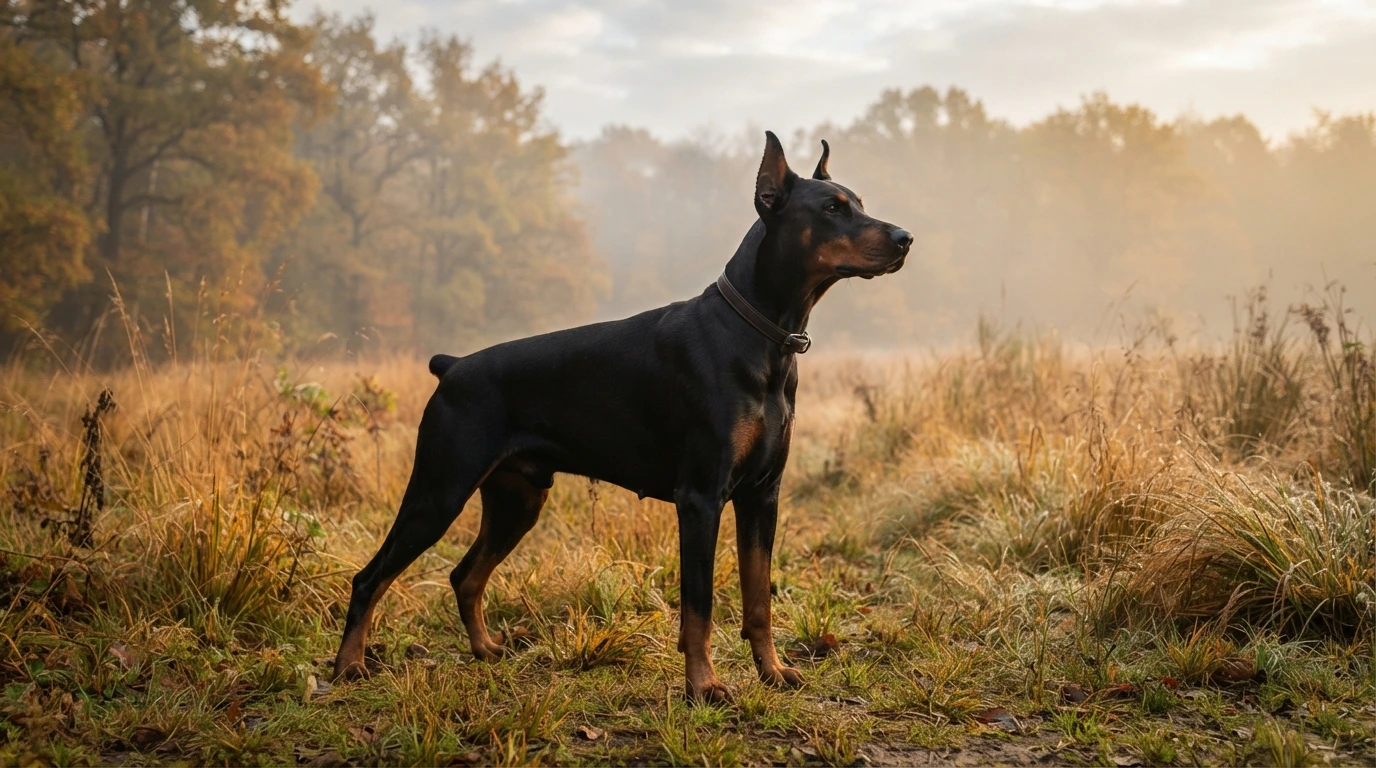
The Doberman’s silhouette is compact, muscular, and athletic, built for speed and endurance rather than bulk. The short, smooth coat comes in black, red, blue, or fawn, each with rust markings above the eyes, on the muzzle, chest, legs, and beneath the tail. Ears were traditionally cropped to stand erect and the tail docked short, both cosmetic procedures rather than health or breed-standard necessities, and both are increasingly restricted or discouraged in parts of Europe. A growing number of breeders and owners now keep ears natural, floppy, and uncropped, and a natural-eared Doberman is just as correct an example of the breed as a cropped one.
Temperament
The Doberman’s “vicious guard dog” reputation is largely a relic of mid-20th-century media portrayal rather than an accurate description of the modern breed. A well-socialized Doberman is intensely loyal, often shadowing its owner from room to room closely enough to earn the nickname “velcro dog,” and forms deep attachments to its family. Alertness toward strangers and unfamiliar situations is a real and intentional part of the breed’s temperament, but that watchfulness is meant to express itself as discernment, not automatic aggression. As with any breed selectively developed for protection work, an under-socialized Doberman can become fearful or reactive rather than simply “extra protective,” which is exactly why early, broad socialization matters so much for this breed specifically, not because the dog is inherently dangerous, but because training gaps in a strong, fast, intelligent dog carry higher consequences than they would in a smaller, less capable breed.
Is a Doberman Right for You?
A Doberman thrives with an owner who wants an engaged, athletic companion rather than a low-maintenance pet. This is not a “set it and forget it” breed: Dobermans need consistent training, real daily exercise, and close companionship, and they tend to struggle, both behaviorally and emotionally, when left alone for long stretches or under-stimulated. With proper socialization, Dobermans are frequently excellent family dogs, affectionate and patient with children they’ve grown up around, though as with any large, powerful breed, interactions with small children should always be supervised. If you want a dog that will happily go on a five-mile run, learn advanced obedience quickly, and stay close to you indoors, the Doberman is an excellent match. If you’re looking for an independent, low-engagement companion, this isn’t that breed.
Training
Dobermans are among the most trainable breeds in existence, ranking consistently near the top of working-intelligence assessments, and they generally pick up commands and routines quickly. That intelligence cuts both ways: a bored, under-trained Doberman will find its own entertainment, often in ways an owner won’t appreciate. Positive reinforcement methods tend to produce the most reliable results, since the breed responds well to a trusting, motivated training relationship rather than heavy-handed correction. Early socialization to a wide range of people, environments, and other animals, started as early as possible and continued deliberately through the first year, meaningfully shapes long-term temperament in a dog this size and drive.
Exercise Needs
This is a genuinely high-energy breed. Dobermans typically need 60 minutes or more of vigorous daily exercise, ideally combining physical activity like running or structured play with mental engagement such as obedience work, scent games, or advanced training. A Doberman confined mostly to a yard without real exercise and mental stimulation is far more likely to develop anxious or destructive behavior than one given a genuine outlet for its energy and intelligence.
Grooming
Grooming needs are minimal. The short, smooth coat sheds moderately and is easily managed with a weekly brush, and the breed has no undercoat to speak of, which limits shedding volume compared to double-coated breeds of similar size. Routine nail trims, ear checks, and dental care round out the maintenance routine.
Health and Lifespan: The Heart Is the Real Story
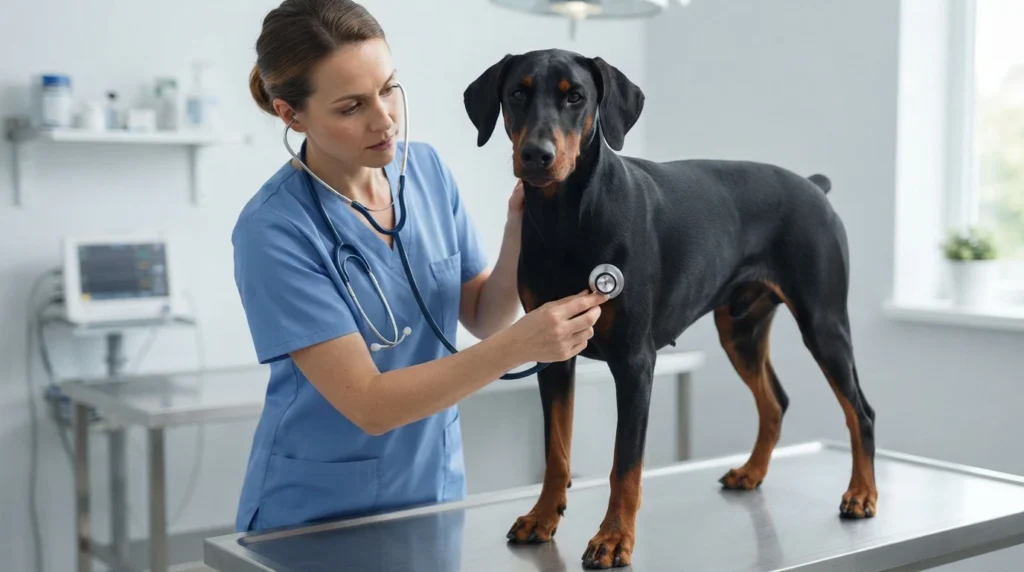
If there is one health fact every prospective Doberman owner needs to understand clearly, it’s this: dilated cardiomyopathy, or DCM, is the leading cause of death in the breed, and published research estimates that a very large share of Dobermans, by some studies more than half over a lifetime, develop some degree of the disease. DCM is a progressive weakening and enlargement of the heart muscle that reduces its ability to pump blood effectively, and it frequently develops silently for months or years before visible symptoms like exercise intolerance, coughing, or fainting appear. Genetic research has identified a mutation in the PDK4 gene strongly associated with DCM risk in the breed, and reputable breeders increasingly test breeding stock for this marker, though a clear genetic test doesn’t eliminate risk entirely since other genetic and environmental factors also contribute. Cardiologists generally recommend Dobermans begin annual screening, typically an echocardiogram combined with a 24-hour Holter monitor to catch irregular heart rhythms, starting around age 3 and continuing for life, since early detection meaningfully changes treatment options and outcomes.
Two other genetic conditions are worth understanding. Von Willebrand disease is an inherited bleeding disorder that impairs normal blood clotting, appearing with notable frequency in Dobermans and typically screened for with a simple blood test before any surgery. Wobbler syndrome, or cervical vertebral instability, involves compression of the spinal cord in the neck, most often affecting the vertebrae’s alignment and causing an unsteady, “wobbly” gait, weakness, or neurological symptoms, and it appears more frequently in large, fast-growing breeds like the Doberman. With cardiac screening, appropriate genetic testing in breeding stock, and routine veterinary care, many Dobermans live a full 10 to 13 years, but buyers should treat cardiac screening as a non-negotiable, ongoing part of ownership rather than an optional extra.
Nutrition
Doberman puppies benefit from a large-breed puppy formula that controls growth rate rather than maximizing it, since rapid early growth in a large, fast-growing breed can affect skeletal development. On the adult side, the relationship between grain-free diets and DCM risk is an active area of veterinary research, and some cardiologists currently recommend caution with grain-free and boutique exotic-ingredient diets in breeds already predisposed to DCM, though the science is still evolving and owners should discuss diet choices directly with their veterinarian or a veterinary cardiologist rather than relying on marketing claims either way.

Cost and Ownership Reality
A Doberman puppy from a reputable breeder who health-tests for DCM markers, von Willebrand disease, and hip dysplasia typically costs $1,500 to $3,500, with well-bred working or show-line dogs sometimes exceeding that range. Annual costs, including food, routine veterinary care, and training, generally run $1,200 to $2,000, and that figure should realistically include the cost of annual cardiac screening, an echocardiogram and Holter monitor combination typically runs several hundred dollars per year, which is a genuine and ongoing budget line for this breed rather than an occasional expense. As with other large guardian breeds, buyers should also research homeowner’s or renter’s insurance restrictions and any local breed-specific legislation before committing, since Dobermans are sometimes included on restricted-breed lists alongside other guardian-type dogs.
Common Buyer Mistakes
- Skipping cardiac screening because the dog “seems fine.” DCM frequently has no visible symptoms until the disease is advanced; annual screening starting around age 3 is the only reliable way to catch it early.
- Buying without understanding European vs. American type. A buyer wanting a calm family companion who ends up with a high-drive working-line dog, or vice versa, is often mismatched with expectations set by the breeder relationship rather than the dog itself.
- Assuming a natural-eared, natural-tailed Doberman is somehow less “real.” Ear cropping and tail docking are cosmetic choices, not requirements, and increasingly restricted in parts of Europe.
- Underestimating exercise needs. A Doberman confined to yard time alone, without real daily exercise and mental engagement, is prone to anxiety and destructive behavior.
- Choosing grain-free food without a cardiologist’s input. Given the breed’s DCM predisposition, diet decisions deserve professional guidance rather than marketing-driven assumptions.
- Underestimating the breed’s attachment needs. Dobermans bond intensely and generally don’t do well left alone for long stretches; this is not an independent, low-contact breed.
FAQ
Are Dobermans dangerous?
Not inherently. The breed’s mid-20th-century “vicious guard dog” reputation is largely outdated; a well-socialized, well-trained Doberman is loyal and discerning rather than reflexively aggressive. As with any large, powerful breed, training gaps carry higher consequences.
Why do Dobermans get their ears cropped?
Ear cropping is a cosmetic tradition, not a health necessity, historically tied to the breed’s alert, erect-eared show appearance. It’s increasingly restricted or discouraged in parts of Europe, and many owners today keep ears natural.
How common is heart disease in Dobermans?
Dilated cardiomyopathy is the leading cause of death in the breed, with research estimating that more than half of Dobermans may develop some degree of the disease over their lifetime, making annual cardiac screening a genuine ownership priority.
What’s the difference between a European and American Doberman?
They’re the same breed, not separate ones. European (working) lines tend to be larger-boned and higher-drive; American (show) lines are typically leaner with a somewhat softer temperament, refined more for conformation showing.
How much exercise does a Doberman need?
A significant amount — generally 60 minutes or more of vigorous daily activity, combined with mental engagement like training or scent work.
Are Dobermans good with children?
Often yes, within a well-socialized household, though their size and strength mean supervision around small children is essential, as with any large breed.
How much does a Doberman cost to own?
Expect $1,500 to $3,500 for a health-tested puppy and roughly $1,200 to $2,000 annually thereafter, including the recurring cost of cardiac screening.
Conclusion
The Doberman Pinscher is a purpose-built protection dog that has settled comfortably into modern family life, but its history and health profile both deserve honest treatment. The breed’s outdated “vicious” reputation has far more to do with training and socialization than with anything inherent to the dog, while its very real cardiac disease risk deserves the opposite treatment: direct, unromanticized attention and a lifelong screening commitment. Buyers who go in prepared for both the exercise and attachment needs and the cardiac-screening responsibility tend to find exactly what the breed has always promised — an intelligent, deeply loyal companion built to stay close.