
Cane Corso: The Complete Breed, Health & Safety Guide
Quick Facts
| Attribute | Detail |
| Group | AKC Working Group / FCI Group 2 |
| Height | 23.5–27.5 in |
| Weight | 88–120 lb |
| Lifespan | 9–12 years |
| Coat | Short, stiff, dense |
| Colors | Black, gray, fawn, red, brindle |
| Temperament | Loyal, watchful, intelligent, reserved with strangers |
| Best suited for | Experienced owners with time for structured training |
The Cane Corso is a large Italian guardian breed built for presence as much as function: a short, dense coat, a broad head, and a working structure descended from Italy’s old Molosser lines. It is not a casual first dog, and this guide treats that fact as central rather than incidental — the breed’s size, strength, and protective instincts make early training and honest self-assessment the two most important parts of ownership.

History: Italy’s Ancient Molosser
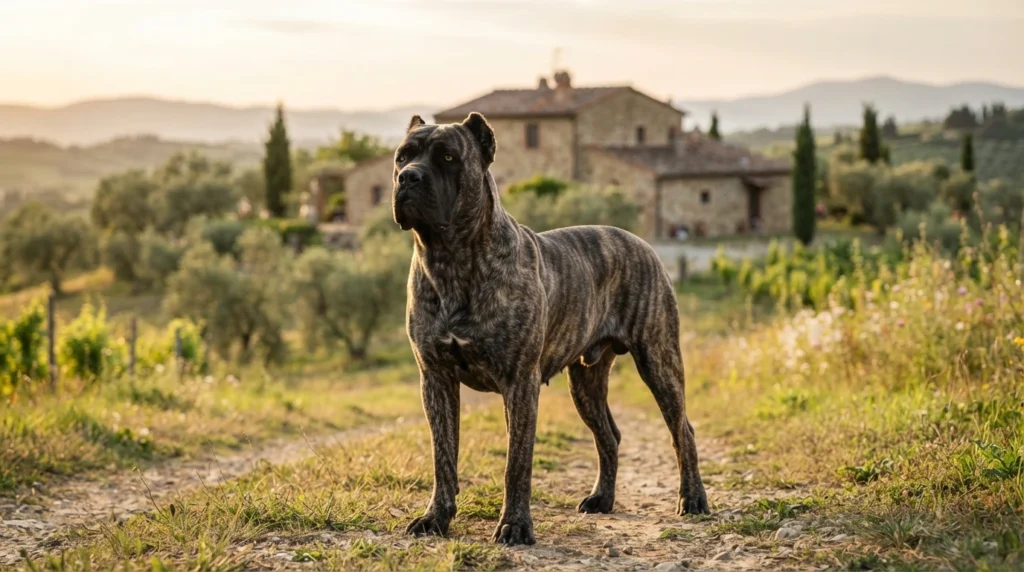
The Cane Corso’s ancestry is usually traced to the old Molosser-type dogs of the Roman Empire, and some historical accounts connect it to the *Canis Pugnax*, a war and guard dog referenced in Roman-era writing. That lineage claim is widely repeated but difficult to verify with certainty across nearly two thousand years, and it is worth treating as plausible historical framing rather than settled fact. What is much better documented is the breed’s more recent past: for centuries, Cane Corsos worked the farms of southern Italy, particularly Puglia, guarding property, driving livestock, and occasionally assisting in boar hunting. They were a working dog in the fullest sense, valued for utility rather than appearance.
By the mid-20th century, mechanized farming and two World Wars had pushed the breed to the edge of extinction. Only a small, scattered population of working-type Corsi survived in rural Italy, largely unrecognized by any formal kennel club. The breed’s revival began in the 1970s and 1980s, when a group of Italian enthusiasts, most notably Dr. Paolo Breber, actively sought out and documented the remaining dogs, establishing a breeding program to rebuild the population from that narrow founding stock. The Società Amatori Cane Corso formed in 1983 to formalize the effort, and the FCI granted the breed provisional recognition in 1996 under breed standard #343. The American Kennel Club followed with full recognition in 2010, and the breed has grown rapidly in US popularity since, driven partly by demand for capable guardian dogs and partly by the breed’s imposing, photogenic presence.
Cane Corso vs. Neapolitan Mastiff: Not the Same Molosser
Italy produced two distinct mastiff breeds, and they are frequently confused with one another. The Neapolitan Mastiff is the heavier, more wrinkled, loose-skinned cousin — a breed built for slow, deliberate guarding rather than athletic work, with a distinctly different silhouette and a much lower exercise tolerance. The Cane Corso is the athletic counterpart: a leaner, more mobile working dog capable of covering ground, historically used for active guarding and hunting rather than stationary sentry duty. If you’ve seen both side by side without knowing the history, the size difference alone can be misleading — the Cane Corso is typically lighter and visibly more muscular and mobile than the looser-built Neapolitan Mastiff.
[FUTURE LINK: Neapolitan Mastiff breed guide]
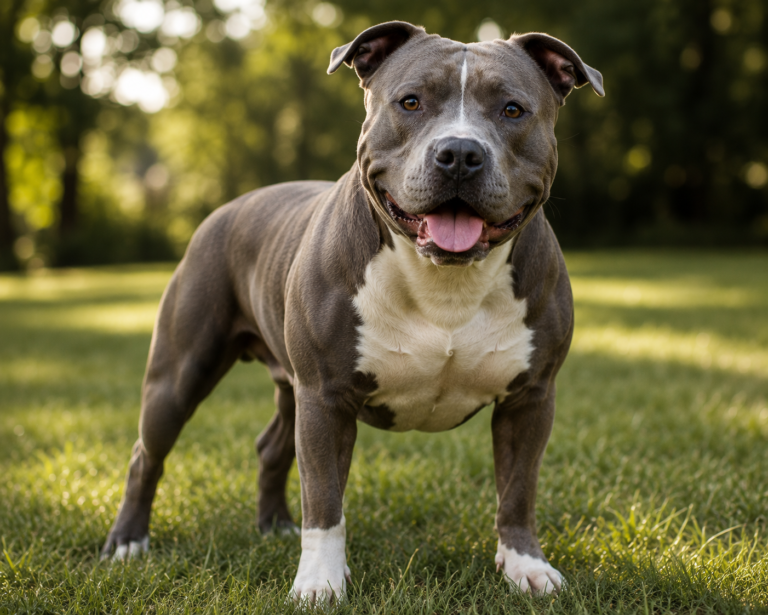
Cane Corso vs. Rottweiler vs. American Pit Bull Terrier
Prospective owners comparing large guardian and working breeds often narrow their search to these three. All are capable, loyal, and require serious training investment, but their working histories and typical temperaments diverge in ways that matter for a buying decision.
| Attribute | Cane Corso | Rottweiler | American Pit Bull Terrier |
| Origin | Italy | Germany | United States |
| Weight | 88–120 lb | 80–135 lb | 30–60 lb |
| Original purpose | Farm guarding, hunting | Cattle droving, guarding | Farm work, companionship |
| Guarding instinct | Strong, watchful | Strong, confident | Low to moderate |
| Energy level | Moderate–high | Moderate | High |
See our full guides to the Rottweiler, the American Pit Bull Terrier, and the German Shepherd Dog for a broader working-breed comparison.

Appearance
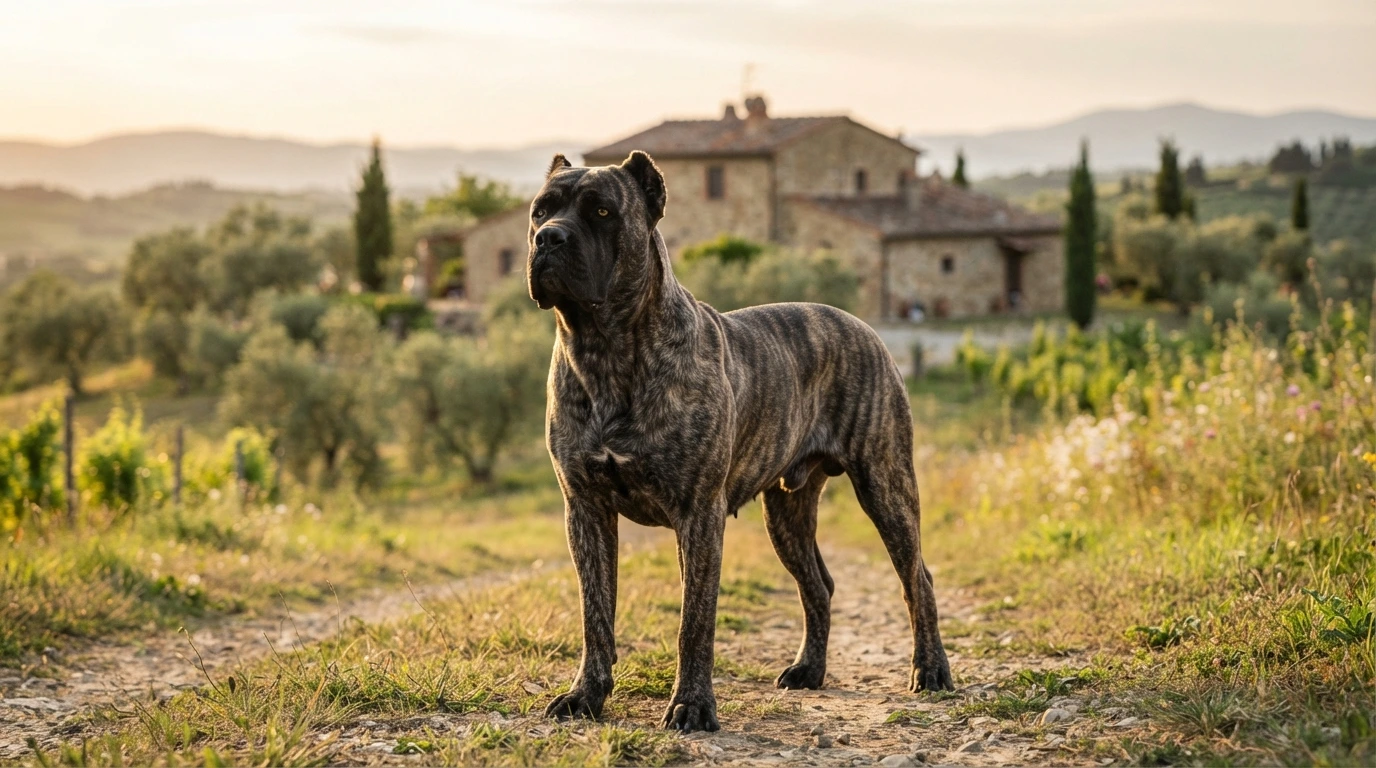
The Cane Corso’s most defining physical feature is its head: broad, heavy, and slightly wedge-shaped, with a strong muzzle roughly a third the length of the skull. The coat is short, stiff, and dense, offered in black, gray, fawn, red, and brindle, sometimes with a black or gray mask. Ears were traditionally cropped short and standing in much of Europe and the US show ring, but ear cropping is a cosmetic procedure that is increasingly restricted or banned outright in parts of Europe, and a growing number of breeders and owners now leave ears natural. Tail docking follows a similar pattern of shifting legality and attitudes. Neither procedure is required for the dog to be a correct, healthy example of the breed.
Temperament
Cane Corsos are deeply bonded, watchful dogs, not reflexively aggressive ones. The breed’s guarding instinct expresses itself as reserve and alertness toward strangers rather than automatic hostility — a well-socialized Cane Corso reads unfamiliar people and situations carefully rather than reacting on impulse. That instinct is precisely why early, extensive socialization matters so much: an under-socialized Cane Corso doesn’t become “more protective,” it becomes anxious and unpredictable, which is a dangerous combination in a dog this size and strength. With their own family, Corsi are typically affectionate, calm indoors, and highly attentive, often described as shadowing their owner from room to room. They have low tolerance for being ignored, under-exercised, or left without a job, and boredom in this breed tends to show up as destructive or pushy behavior rather than quiet withdrawal.
Is a Cane Corso Right for You?
This is not a breed for a first-time dog owner, and reputable breeders will generally say so directly. A Cane Corso needs a handler who is confident, consistent, and willing to commit serious time to structured training in the first one to two years, not just basic obedience. Housing matters too: a securely fenced yard is close to essential, apartment living is workable only with a very committed exercise and enrichment routine, and households should think honestly about visitors, delivery workers, and other dogs before bringing one home. Because this is a large, strong, and commonly restricted breed, prospective owners should also research homeowner’s or renter’s insurance policies and any local breed-specific legislation before committing — a step covered in more detail in the cost section below. If you can offer structure, exercise, and an experienced hand, a Cane Corso can be an extraordinarily loyal companion. If you’re looking for a low-maintenance first dog, this is not that breed.
Training and Socialization: Why the First Year Matters Most
Every puppy has a primary socialization window, typically described as closing somewhere around 12 to 16 weeks of age, during which positive exposure to new people, animals, environments, and sounds shapes lifelong temperament far more efficiently than anything done later. That science applies to every breed, but the stakes are different for a dog that will weigh 90 to 120 pounds as an adult. A poorly socialized Chihuahua that reacts fearfully to strangers is a management problem. A poorly socialized adult Cane Corso with the same fear response is a serious liability, both physically and legally. This is the single most important reason breed-specific guides for large guardian dogs need to say more than “socialize your puppy” — the margin for error shrinks as the dog’s size and strength grow.
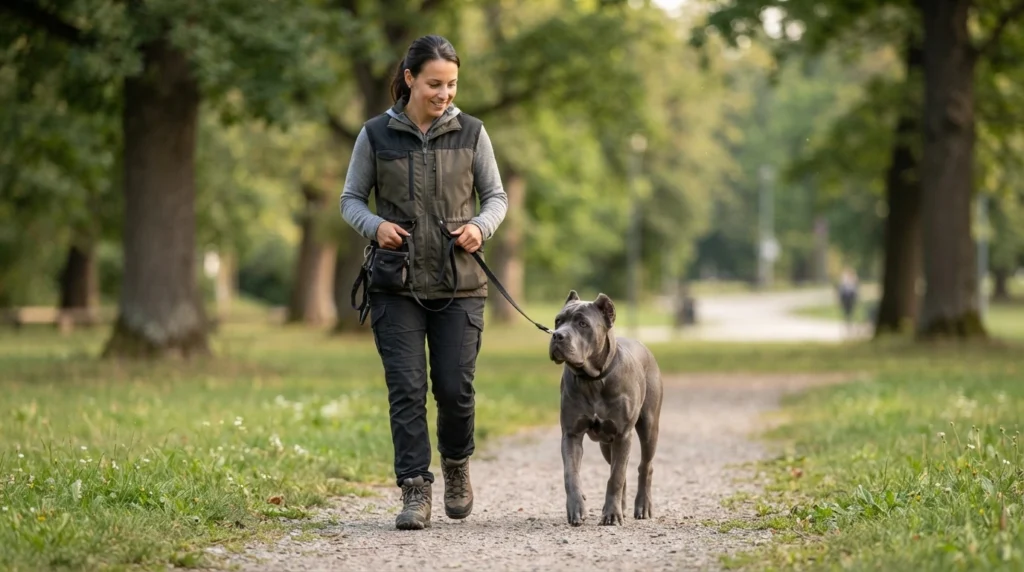
In practice, that means structured exposure to a wide range of people (different ages, appearances, and mobility aids), other dogs, handling by strangers such as veterinary staff, and everyday environments like car rides, elevators, and busy streets, ideally started the week a puppy comes home and continued deliberately through at least six months of age. Bite inhibition work — teaching a soft mouth through supervised play and calm correction — should begin early and continue throughout puppyhood. Most reputable trainers and behaviorists recommend professional obedience instruction for this breed, not because the dog is inherently unmanageable, but because consistent, confident handling from day one prevents the small mistakes that become much harder to correct in an adult dog with this much physical strength. Positive reinforcement methods generally produce more reliable, better-adjusted results in guardian breeds than purely correction-based approaches, since a dog that trusts its handler is easier to redirect in genuinely challenging situations.
Exercise Needs
Cane Corsos need moderate to high physical activity, but the quality of that activity matters more than raw volume. Structured walks, controlled off-leash time in a securely fenced area, and mentally engaging work — tracking games, obedience drills, puzzle feeders — tend to satisfy this breed better than unstructured yard time alone. A bored, under-exercised Cane Corso is considerably more likely to develop pushy or destructive behavior than one given a job to do, even if that “job” is simply a consistent daily training routine.
Grooming
Grooming demands are low. The short, stiff coat sheds moderately year-round with a heavier seasonal shed, and a weekly brush with a rubber curry or bristle brush is typically sufficient to manage loose hair. Routine nail trims, ear checks, and dental care round out the maintenance routine — this is one of the breed’s more owner-friendly traits relative to its size.

Health and Lifespan
As a large, deep-chested, rapidly growing breed, the Cane Corso carries a predictable cluster of structural and size-related health risks. Hip and elbow dysplasia are the most significant orthopedic concerns, caused by joint malformation that worsens with uncontrolled growth-rate and weight gain in puppyhood — OFA or PennHIP hip screening is standard practice among reputable breeders, and buyers should ask to see documentation rather than take a breeder’s word for it. Bloat, or gastric dilatation-volvulus (GDV), is a life-threatening emergency in which the stomach fills with gas and can twist on itself, and deep-chested breeds like the Cane Corso carry elevated risk; feeding multiple smaller meals rather than one large one, avoiding strenuous exercise immediately after eating, and using slow-feed bowls are common mitigation practices, and any sudden unproductive retching or visible abdominal distension warrants immediate emergency veterinary care. Cherry eye, a prolapse of the third eyelid’s tear gland, appears with some regularity in the breed and is corrected surgically when it occurs. Dilated cardiomyopathy, a weakening of the heart muscle, has also been documented in the breed at rates worth a baseline cardiac exam, particularly for dogs entering a breeding program. With appropriate screening, weight management, and routine veterinary care, most Cane Corsos live a full 9 to 12 years.
Nutrition
Puppies should be fed a large-breed-specific puppy formula formulated to control growth rate rather than maximize it — rapid early growth is directly linked to higher rates of hip and elbow dysplasia in large breeds, making this one of the more consequential nutrition decisions an owner makes. Adult Cane Corsos need portion control and regular weight checks, since excess weight compounds joint stress in a breed already predisposed to orthopedic issues.
Cost and Ownership Reality: Insurance and Restrictions
A Cane Corso puppy from a reputable, health-tested breeder typically costs $1,500 to $3,000, with well-bred working or show-line dogs sometimes exceeding that range. Annual costs, including food, routine veterinary care, and training, generally run $1,200 to $2,000, before factoring in the higher-than-average food volume this breed requires. What often catches first-time large-guardian-breed buyers off guard isn’t the purchase price — it’s insurance and housing logistics. Many homeowner’s and renter’s insurance policies restrict or add surcharges for breeds commonly perceived as guardian or “bully” type, and some municipalities maintain breed-specific legislation that can affect ownership, housing, or liability coverage. Policies and local ordinances vary significantly by insurer and jurisdiction, so this is not a detail to leave until after adoption — verify your specific insurance policy and local regulations before bringing a Cane Corso home, not after.
Common Buyer Mistakes
- Choosing a Cane Corso for protection alone. A dog acquired purely as a deterrent, without a genuine training and socialization commitment, is far more likely to become a liability than an asset.
- Underestimating the socialization timeline. Skipping or rushing the early exposure window is the single most common root cause of adult behavioral problems in this breed.
- Skipping breeder health documentation. Buying from a breeder who can’t produce OFA hip or cardiac screening results significantly raises the odds of costly orthopedic or cardiac problems later.
- Overfeeding the puppy for faster growth. Rapid early growth directly worsens joint outcomes in large breeds; slow, controlled growth is healthier even though it looks less impressive.
- Not researching insurance or local ordinances first. Discovering a breed restriction after adoption creates an entirely avoidable crisis for both the family and the dog.
- Assuming size alone deters bad behavior in the dog itself. An untrained 100-pound dog is not “naturally well-behaved” simply because of its presence — training is not optional at this size.
- Underestimating the exercise-boredom link. Owners who provide only yard access without structured activity are often surprised by destructive behavior that a job or routine would have prevented.
FAQ
Is a Cane Corso dangerous?
Not inherently. Like any large, powerful breed, a poorly socialized or poorly trained Cane Corso can pose real risk, but a well-socialized, well-trained one is a loyal, manageable companion. The size and strength of the breed simply mean that training mistakes carry higher consequences than they would with a smaller dog.
How is a Cane Corso different from a Rottweiler?
Both are capable guardian breeds, but Rottweilers were bred primarily for cattle droving and cart-pulling in addition to guarding, while the Cane Corso’s history centers more on farm protection and hunting assistance. Temperament and trainability overlap significantly between the two.
How much exercise does a Cane Corso need?
Moderate to high, generally 45 to 60 minutes of structured activity daily, with mental engagement mattering as much as physical exertion.
Are Cane Corsos good with children?
Often yes, within a well-socialized, well-supervised household, but their size alone means interactions with small children should always be supervised, as with any large breed.
How big does a Cane Corso get?
Adults typically stand 23.5 to 27.5 inches at the shoulder and weigh 88 to 120 pounds, with males generally larger than females.
Do Cane Corsos need their ears cropped?
No. Ear cropping is a cosmetic choice, not a health or breed-standard requirement, and it is increasingly restricted or discouraged in parts of Europe. Many owners now keep ears natural.
How much does a Cane Corso cost to own?
Expect $1,500 to $3,000 for a health-tested puppy and roughly $1,200 to $2,000 annually thereafter, plus the need to confirm insurance and local ordinance compatibility before adoption.
Conclusion
The Cane Corso is a capable, deeply loyal Italian guardian breed whose reputation depends almost entirely on the owner behind it. The dog’s history as a working Molosser, its structural health risks as a large deep-chested breed, and its need for an unusually early and thorough socialization window all point to the same conclusion: this is a breed that rewards preparation and experience, and punishes shortcuts. Buyers who go in with realistic expectations about training investment, health screening, and insurance logistics tend to end up with exactly what the breed promises — a watchful, devoted companion built to look after the people it loves.