
Australian Kelpie: The Complete Breed Guide for US Owners
Introduction
If you’ve ever watched Bluey with your kids and wondered what kind of dog Rusty is, you’ve already met an Australian Kelpie. It’s a medium-sized Australian sheepdog developed in the 1800s to herd livestock across vast, harsh terrain, and today it’s classified in the Herding Group. This guide walks you through everything a prospective or new US owner needs to know — temperament, size, health, training, cost, and whether this hardworking dog actually fits your life.
Quick Facts
| 📋 Quick Facts Box: Scan this table for the essentials before diving into the full guide — every figure below is explained in detail in its own section further down the page. |
The Australian Kelpie’s numbers vary more than most breeds because working lines and show lines are bred to different standards. Here’s the honest, complete picture.
| Attribute | Detail |
| Breed Group | Herding Group |
| Origin | Australia (New South Wales/Victoria, 1870s) |
| Height | 15–20 in (Show line); 17–25 in (Working line) |
| Weight | 29–42 lb (Show line); 28–60 lb (Working line, wide functional range) |
| Life Expectancy | 10–14 years (commonly cited); 12-year median per a 2024 UK study |
| Temperament | Intelligent, loyal, alert, independent, eager to work |
| Energy Level | Very high |
| Trainability | High, with consistent positive reinforcement |
| Shedding | Moderate year-round; heavy seasonal “coat blow” |
| Grooming | Low-to-moderate; weekly brushing |
| Good With Children | Yes, in active, training-committed homes |
| Good With Dogs | Yes, with socialization |
| Good With Cats | Case-by-case; prey drive requires management |
| Apartment Friendly | Challenging, not impossible, with serious commitment |
| Climate Adaptability | Good in heat; moderate cold tolerance via double coat |
| Beginner Friendly | Better for experienced or highly committed novice owners |
| Working Role | Sheep and cattle droving, mustering, yard work |
| AKC Recognition | Foundation Stock Service (FSS) — not full conformation status |
| FCI Group | Not formally standardized for this breed (verify at time of reading) |

Breed Overview
The Australian Kelpie is, at its core, a working dog first and a companion second — even the pet-line dogs sold in the US today carry that working identity in their bones. Bred for stamina rather than speed, Kelpies were developed to cover enormous distances on Australian sheep and cattle stations, thinking independently while still following a handler’s direction. That combination of intelligence, drive, and loyalty is what defines the breed.
The breed remains uncommon in the United States compared to popular herding breeds like the Border Collie or Australian Shepherd, but interest is growing. Some of that comes from the dog-sport community, where Kelpies excel at agility and flyball; some of it comes from pop culture, thanks to Bluey’s high-energy dog dad, Rusty. Whatever brought you here, understanding what this breed actually needs is the first step toward deciding if it’s right for you.
History and Origin
The Australian Kelpie’s story begins in the 1870s in the pastoral districts of New South Wales and Victoria, where settlers needed a dog capable of working sheep across country far larger and harsher than anything in the UK. Scottish immigrants brought collie-type working dogs with them, and those dogs formed the genetic base for what would become the Kelpie.
One of the most-cited origin stories centers on Jack Gleeson, a grazier who acquired a black-and-tan collie-type pup from a litter bred near Warrock Station. According to the traditional account, that pup — named “Kelpie” after a shape-shifting water spirit from Scottish Gaelic folklore — grew into an exceptional working dog, and her name eventually came to describe the entire breed she helped establish.
For over a century, a persistent myth claimed Kelpies carry dingo blood, supposedly explaining their stamina and independence. It’s a good story, but it isn’t accurate.
| 🐾 Did You Know? A 2019 genomic study led by Claire Wade, PhD, at the University of Sydney, examined Kelpie DNA and found no meaningful evidence supporting the long-standing dingo-ancestry folk tale. The Kelpie’s toughness comes from selective breeding of collie-type working stock under brutal Australian conditions — not from wild dingo blood. |
This history also sets up a distinction that matters enormously for US buyers: from early on, Kelpies developed along two paths — dogs bred purely for working ability, and dogs bred toward a consistent show/conformation standard. That split, covered in full later in this guide, still shapes what you’ll find on the US market today.
Appearance
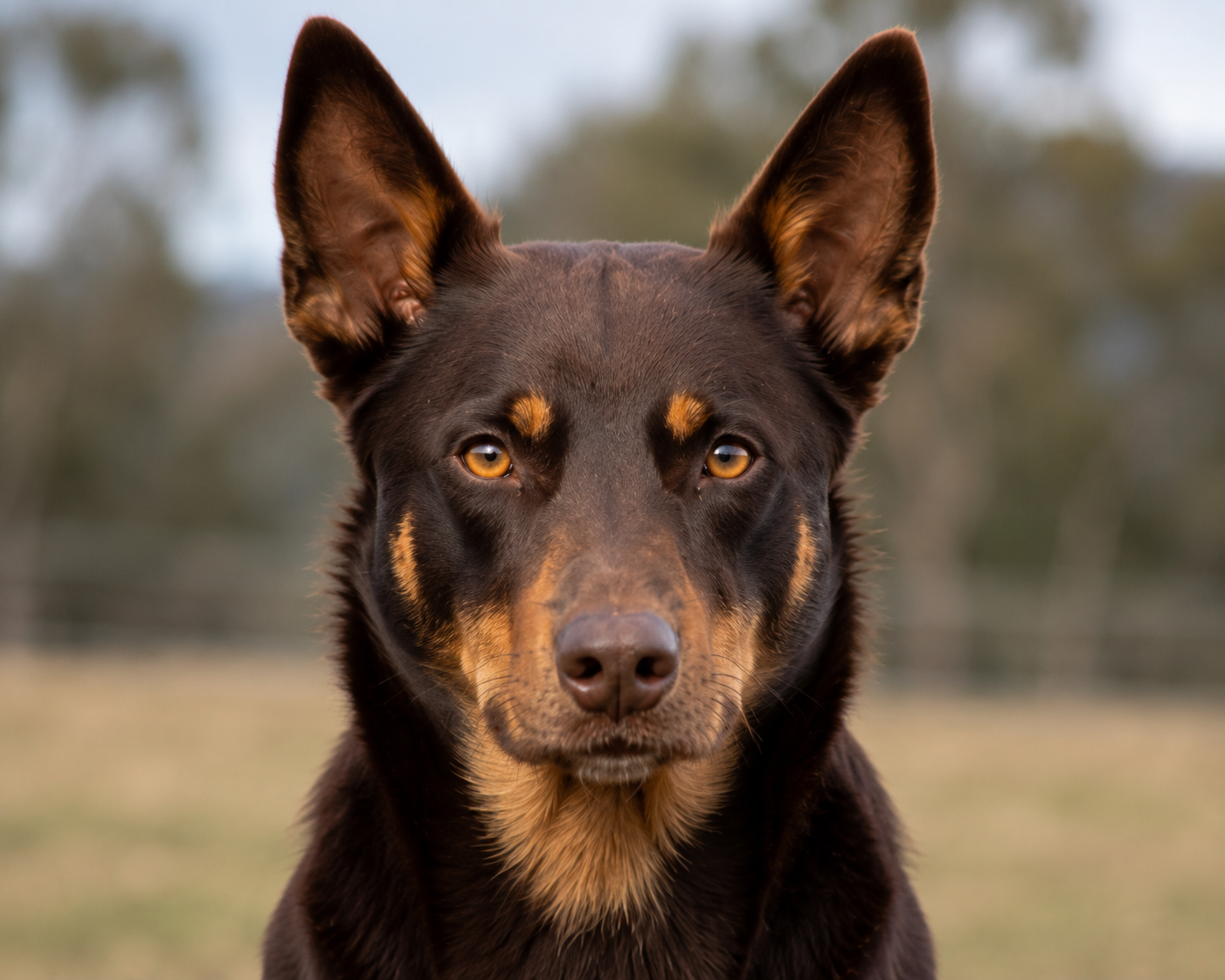
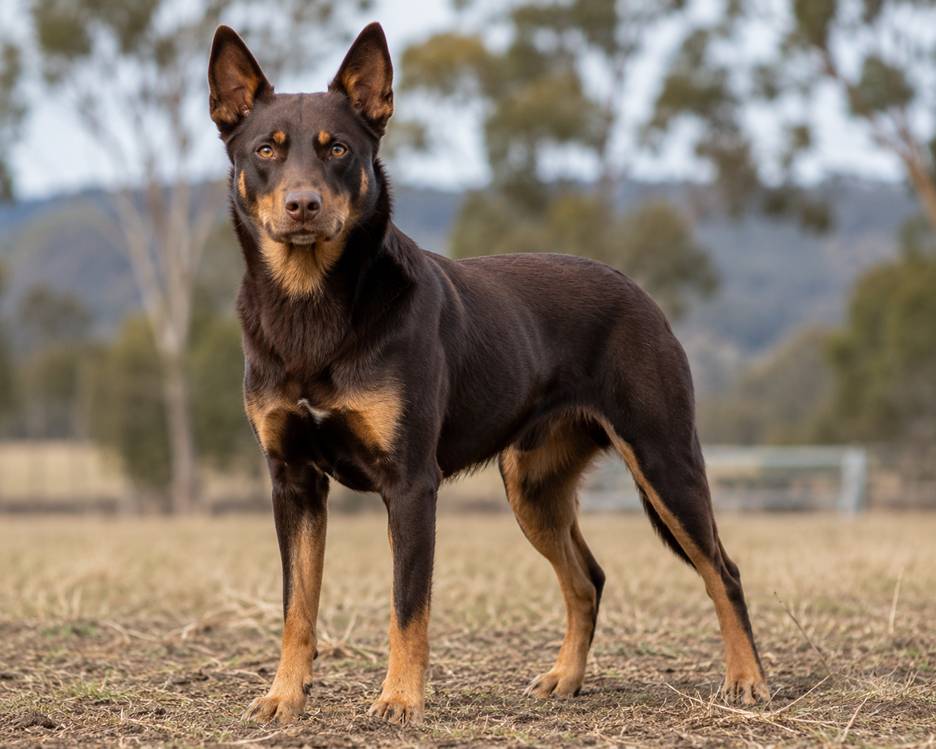
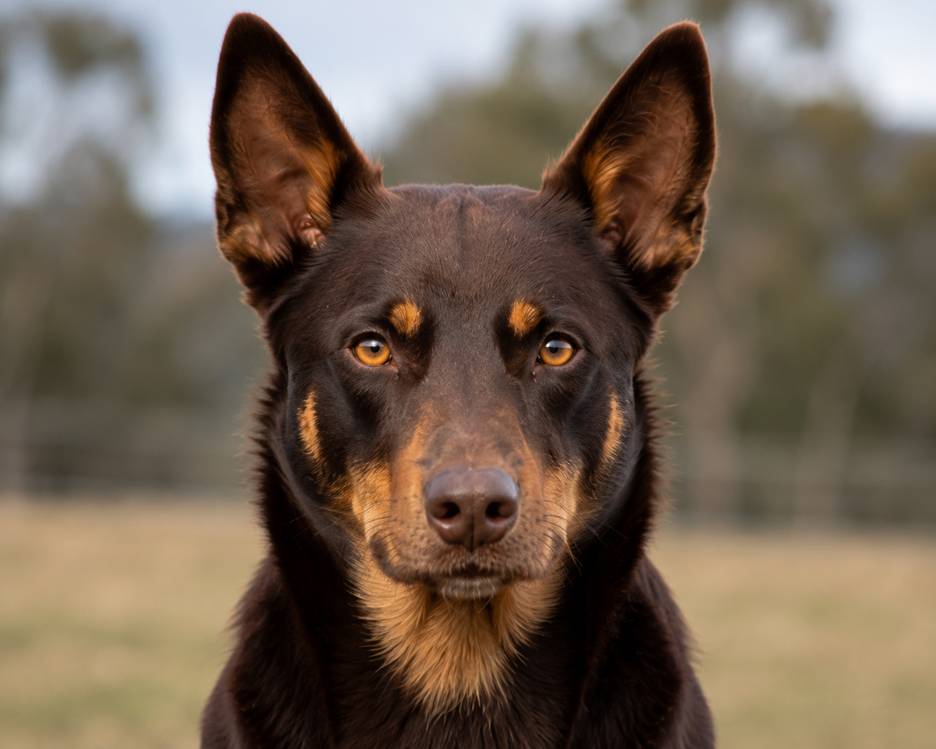
The Kelpie’s whole build serves a purpose: nothing about this dog is decorative. Every feature — from the wedge-shaped head to the springy gait — exists to support a dog that works long hours in tough terrain. The result is a lithe, muscular, alert-looking animal with a distinctly fox-like expression.
Body
Kelpies are medium-sized and slightly longer than they are tall, with a lean, athletic frame built for endurance rather than sprinting. The chest is deep but not overly broad, giving the dog efficient lung capacity for a full day’s work.
Head
The head is proportionate to the body, wedge-shaped, with a strong jaw and a clean, intelligent expression that many owners describe as fox-like.
Eyes
Almond-shaped and alert, Kelpie eyes are usually some shade of brown, with the exact tone often complementing the coat color.
Ears
Pricked and erect, the Kelpie’s ears sit high and swivel constantly — a functional trait that helps the dog stay alert to sounds and commands while working at a distance.
Tail
The tail is moderate in length, carried low in a slight curve at rest, and lifted when the dog is active, alert, or excited.
Coat
The Kelpie has a short, dense double coat — a weatherproof outer layer over a soft, insulating undercoat — designed to handle both scorching Australian summers and cold nights. Some working lines carry a slightly harsher or marginally longer coat texture, though this isn’t a formally separate variety.
Colors
The Australian National Kennel Council (ANKC) standard recognizes black, black and tan, red, red and tan, chocolate, fawn, and smoky blue; working lines sometimes include additional shades, including cream, which falls outside the official show standard. The full color breakdown is covered in the Coat Colors section below.
Unique Physical Traits
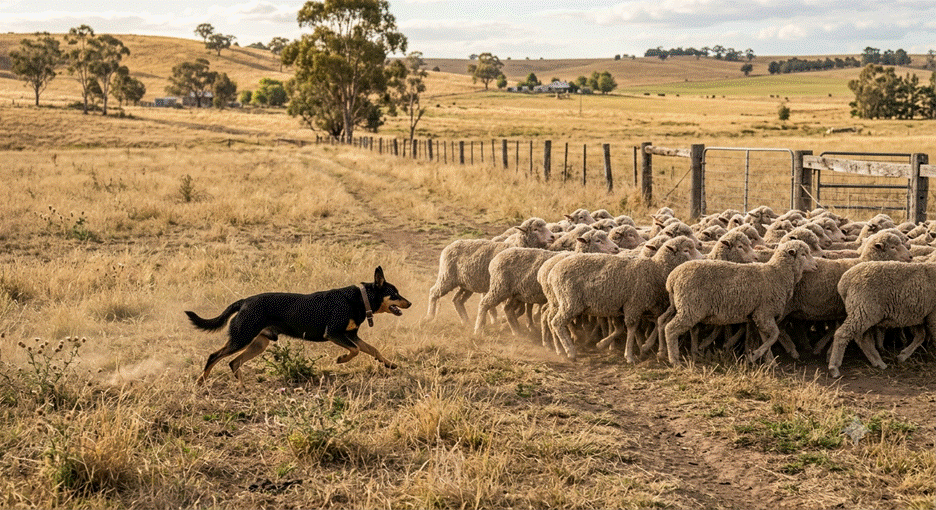
- Exceptional jumping ability — working Kelpies are famous for literally running along sheep’s backs across a crowded pen, a maneuver called “backing.”
- A weatherproof coat suited to temperature extremes, from outback heat to cold mornings.
- A functional, no-frills build where every physical trait ties back to the working role.

Size
Because working Kelpies are bred for function rather than a uniform look, their size range is noticeably wider than show-line Kelpies. Show-standard Kelpies (per the ANKC breed standard) typically stand 15 to 20 inches at the shoulder, while Working Kelpie Council lines can range from 17 to 25 inches. Males tend to run slightly larger and more heavily built than females across both lines.
If a website or breeder gives you a single, narrow height range as “the” Kelpie standard, take it with a grain of salt — the honest answer depends heavily on whether you’re looking at a working-line or show-line dog.
Weight
Weight figures for the Kelpie vary across sources more than almost any other breed statistic, and it’s worth addressing that head-on rather than picking one number and hoping it’s right. Show-line Kelpies, per the commonly cited Wikipedia-sourced standard, typically weigh 29 to 42 pounds. Working-line Kelpies have a documented range as wide as 28 to 60 pounds, reflecting decades of breeding purely for stamina and ability on the job rather than a consistent look.
| Category | Height | Weight |
| Show Kelpie (ANKC standard) | 15–20 in | 29–42 lb |
| Working Kelpie | 17–25 in | 28–60 lb |
| Males (general) | Upper end of range | Upper end of range |
| Females (general) | Lower-to-mid range | Lower-to-mid range |
Coat Types
The Kelpie carries a single coat style — a short, dense double coat — but you’ll notice texture variation between individual dogs, especially between working and show lines. The outer coat is straight and slightly harsh to the touch, which helps shed dirt, water, and burrs. Underneath, a soft, insulating undercoat regulates body temperature in both directions, keeping the dog cooler in summer heat and warmer on cold nights. Some working-line Kelpies have a marginally longer or coarser outer coat than the classic smooth show standard, though the AKC and ANKC don’t recognize this as a separate, named coat variety.
Coat Colors
The ANKC breed standard recognizes seven official colors for show Kelpies, while working lines — bred without regard to a show ring — accept a somewhat broader palette.
| Color | ANKC Standard Status | Description |
| Black | Standard | Solid black, sometimes with minor white markings |
| Black and Tan | Standard | Black base with tan points on legs, chest, and face |
| Red | Standard | Solid rich red-brown |
| Red and Tan | Standard | Red base with lighter tan points |
| Chocolate | Standard | Warm brown, lighter than black |
| Fawn | Standard | Pale, sandy tan tone |
| Smoky Blue | Standard | Diluted blue-gray shade, relatively uncommon |
| Cream | Non-standard (working lines only) | Pale cream, not accepted in ANKC show ring |
Temperament
Kelpies are intelligent, independent, and deeply loyal — a combination that makes them wonderful working partners and occasionally challenging pets. This is a dog that wants a job, wants to be near its person, and thinks for itself when given the chance. Many owners describe their Kelpie as a “velcro dog” that follows them from room to room, yet the breed is also naturally reserved around strangers rather than instantly friendly to everyone it meets.
That wariness isn’t aggression — it’s a watchful, evaluating temperament shaped by generations of dogs bred to guard livestock and property. Early, consistent socialization goes a long way toward raising a Kelpie that’s confident and polite around new people rather than anxious or standoffish.
Herding instinct and prey drive run deep in this breed, even in dogs several generations removed from actual stock work. A Kelpie may try to herd children at a backyard party — circling, nudging, or nipping at heels — simply because fast-moving, unpredictable motion triggers that instinct. The same drive can extend to bikes, joggers, cars, and small animals.
| ⚠️ Warning: Never leave a Kelpie unsupervised with small children, small pets, or livestock until you’ve done real, consistent training around impulse control. Herding behavior can escalate to nipping when a dog is excited, bored, or hasn’t been taught an alternative response. |
Personality
Beyond the working drive, Kelpies are affectionate, playful, and often quite funny once they trust you. They bond tightly with their family and tend to prefer being included in daily life over being left alone in a yard. Expect a dog that wants a task, whether that’s a formal job, a training session, or a game of fetch — idle time isn’t this breed’s strength.
Intelligence
Among working and herding breeds, Kelpies rank near the top for problem-solving ability and trainability. That intelligence is a double-edged sword: a mentally engaged Kelpie is a joy to live with, while a bored one will find its own “job,” which often means digging, chewing, escaping, or herding the household cat. Mental stimulation — puzzle feeders, scent games, training sessions — is just as necessary as physical exercise for this breed.
Trainability
Kelpies are highly trainable, but “trainable” doesn’t mean “easy.” This is a sensitive, independent-minded dog that responds best to confident, consistent handling paired with positive reinforcement — food, toys, and praise, not correction-heavy methods.
Difficulty level
Moderate to advanced for a first dog, straightforward for an experienced or highly committed handler.
Positive reinforcement works because
Kelpies are naturally motivated to work for a reward and to please a handler they trust. Harsh corrections tend to backfire, making a sensitive Kelpie shut down or become more guarded rather than more compliant.
Common mistakes
include inconsistent rules between family members, skipping structured training once basic obedience is “good enough,” and assuming the dog will self-regulate its energy without a job or outlet.
Training timeline
Basic obedience (sit, stay, recall, loose-leash walking) is achievable within 8-12 weeks of consistent short sessions. Impulse control around triggers like other animals or fast movement typically takes several months of ongoing reinforcement, and many owners continue structured training or a dog sport well into adulthood to keep the dog engaged.
| 🎓 Expert Tip: Keep training sessions short, frequent, and reward-based — five to ten focused minutes, several times a day, beats one long session. Kelpies lose interest in repetition but stay engaged when a session feels like a game they’re winning. |
Exercise Needs
That intelligence and drive need an outlet — which is where a serious exercise routine comes in. Adult Kelpies generally need 60 to 90+ minutes of vigorous physical activity daily, split across one or two sessions, plus dedicated mental stimulation on top of that. Working-line dogs, in particular, may need even more.
- Puppies (under 12 months): Short, frequent bursts of play and structured exercise, avoiding repetitive high-impact activity (like long runs or jumping drills) that stresses developing growth plates.
- Adults: High-intensity daily exercise — running, hiking, structured play, and dog sports — combined with mental enrichment.
- Seniors: Moderated but still meaningful daily activity, adjusted for joint health and stamina.
Dog sports are an excellent match for this breed’s build and brain: agility, flyball, dock diving, and rally obedience all give a Kelpie a legitimate “job” to channel its energy into.
Grooming Guide
Compared to its exercise needs, the Kelpie’s grooming routine is refreshingly low-maintenance. The short, weatherproof coat sheds dirt easily and doesn’t tend to hold odor the way longer or oilier coats do.
Brushing
Once a week is typically enough to manage loose hair and distribute natural oils. During seasonal “coat blow” — usually spring and fall — daily brushing with a deshedding tool helps keep loose undercoat under control.
Bathing
Kelpies don’t need frequent baths; every 6-8 weeks, or as needed after a muddy adventure, is usually sufficient.
Nails
Trim every 3-4 weeks, or whenever you hear nails clicking on hard floors.
Ears
Prick ears are naturally well-ventilated and low-maintenance, but a quick weekly check for dirt or odor is still good practice.
Dental care
Brush teeth several times a week (daily is ideal) to prevent tartar buildup and support long-term health.
Seasonal shedding
Expect moderate shedding year-round with two heavier seasonal blowouts. A good deshedding brush during those windows makes a real difference in the amount of hair around the house.
Grooming supply checklist
- Deshedding tool/undercoat rake
- Slicker brush
- Nail clippers or grinder
- Dog-specific toothbrush and toothpaste
- Ear-cleaning solution (as needed)
Nutrition
Because Kelpies are so active and driven, their diet needs to keep pace. Look for a complete and balanced, AAFCO-compliant food formulated for an active or working breed, with quality protein as a primary ingredient.
Puppies
need a puppy-formulated (or all-life-stages) diet that supports steady, controlled growth — rapid growth spikes from over-feeding can stress developing joints. Adults generally do well on an active-breed adult formula, portioned by weight and true activity level rather than a generic bag guideline. Seniors may benefit from a lower-calorie formula with joint-supporting nutrients as activity naturally decreases.
Water needs
Fresh water should always be available, with extra attention during hot weather or after intense exercise sessions.
Treats
Because Kelpies are so food-motivated, they make excellent training partners — but that same drive makes overfeeding easy. Use small, low-calorie treats for training and factor them into the daily calorie total.
Foods to avoid
Chocolate, grapes and raisins, onions and garlic, xylitol (found in some sugar-free products), and cooked bones all pose real risks and should never be fed.
| Life Stage | Approx. Daily Food Amount | Feeding Frequency | Key Notes |
| Puppy (2-6 months) | Per puppy-formula label, weight-based | 3-4 meals/day | Controlled growth; avoid over-supplementing |
| Puppy (6-12 months) | Per puppy-formula label, weight-based | 2-3 meals/day | Watch weight gain vs. skeletal growth |
| Adult (1-7 years) | 1.5-3 cups, activity-dependent | 2 meals/day | Protein-rich, active-breed formula |
| Senior (7+ years) | Slightly reduced from adult | 2 meals/day | Lower calorie density, joint support nutrients |
Health
The Kelpie is a generally hardy, healthy working breed, but like all purebred dogs, it carries several hereditary conditions that responsible owners should understand and screen for. Framing this section around informed ownership rather than fear is the goal — most Kelpies live full, active lives.
Common hereditary conditions
- Hip dysplasia — a malformation of the hip joint that can cause pain and arthritis over time; screened via OFA or PennHIP evaluation.
- Elbow dysplasia — similar joint malformation affecting the elbow, also screened via OFA.
- Luxating patella — a kneecap that slips out of its normal groove, ranging from mild to requiring surgical correction.
- Cerebellar abiotrophy (CA) — a progressive neurological condition affecting coordination and balance, caused by degeneration of cerebellar cells; a DNA marker test can identify carriers before breeding.
- Progressive retinal atrophy (PRA) — a gradual, inherited deterioration of the retina that can eventually lead to blindness; DNA testing is available for some known forms.
- Collie eye anomaly (CEA) — a congenital eye condition affecting the development of the retina and surrounding structures, screened via veterinary ophthalmologic exam or DNA test.
- Cryptorchidism — failure of one or both testicles to descend properly in males; typically resolved with neutering.
- Intestinal lipid malabsorption (ILM) — a digestive condition affecting fat absorption, documented in some Kelpie lines.
- Degenerative myelopathy (DM) — a progressive spinal cord disease that affects mobility, usually appearing later in life; a DNA marker test can flag genetic risk.
- Mitral valve disease (MVD) — a heart valve condition that can develop with age; monitored through regular veterinary cardiac checks.
- Hypothyroidism — an underactive thyroid that can affect metabolism, coat, and energy; diagnosed via bloodwork and manageable with medication.
Genetic health testing and screening
A reputable breeder should be able to provide documentation of health testing on both parents — hip and elbow evaluations through OFA or PennHIP, a patella evaluation, and DNA marker tests for conditions like CA and, where applicable to the line, PRA. The Canine Health Information Center (CHIC) issues a CHIC number to dogs that complete the breed’s recommended testing panel, which is a useful, quick way to verify a breeder has done their due diligence.
| 🩺 Vet Advice: Before committing to a puppy, ask the breeder for OFA or PennHIP hip/elbow results, a CA DNA test result, and a CHIC number if available. A breeder who can’t produce this documentation — or who dismisses the question — is a red flag, regardless of how healthy the parents look. |
Warning signs to watch for
include unusual stiffness or reluctance to jump, changes in gait, vision changes (bumping into furniture, hesitancy in dim light), unexplained weight change, and loss of coordination.
Preventive care and vet check schedule
Puppies need a full vaccination series and early wellness exams roughly every 3-4 weeks until 16 weeks old, followed by annual wellness visits through adulthood and twice-yearly checkups once a dog reaches senior age (typically 7+ years for this breed).
| Condition | Brief Description | Inheritance Note | Recommended Screening |
| Hip Dysplasia | Malformed hip joint, can cause arthritis | Polygenic | OFA or PennHIP evaluation |
| Elbow Dysplasia | Malformed elbow joint | Polygenic | OFA evaluation |
| Luxating Patella | Kneecap slips out of place | Suspected hereditary component | Veterinary orthopedic exam |
| Cerebellar Abiotrophy (CA) | Progressive loss of coordination | Recessive gene, DNA test available | CA DNA marker test |
| Progressive Retinal Atrophy (PRA) | Gradual retinal degeneration | Varies by form; DNA test available for known forms | PRA DNA marker test |
| Collie Eye Anomaly (CEA) | Congenital retinal/eye development condition | Recessive, DNA test available | Ophthalmologic exam or DNA test |
| Cryptorchidism | Undescended testicle(s) | Suspected hereditary component | Physical exam by 6 months |
| Intestinal Lipid Malabsorption | Impaired fat absorption | Documented in some lines | Veterinary diagnostic workup if symptomatic |
| Degenerative Myelopathy (DM) | Progressive spinal cord disease | Recessive gene, DNA test available | DM DNA marker test |
| Mitral Valve Disease (MVD) | Heart valve deterioration | Can be age-related | Veterinary cardiac auscultation/exam |
| Hypothyroidism | Underactive thyroid | Can have hereditary component | Bloodwork/thyroid panel |
Lifespan
Most sources put the Australian Kelpie’s life expectancy between 10 and 14 years. The most rigorous recent data point comes from a 2024 UK study that found a 12-year median lifespan based on a sample of 49 recorded deaths — a smaller sample than we’d like, but currently the most specific figure available. You may also come across the story of Maggie, an Australian Kelpie widely reported to have lived roughly 30 years; that’s a remarkable outlier, not a typical expectation, and it’s covered in more detail in the Interesting Facts section below.
Living With Children
In the right household, Kelpies do very well with children, especially when the dog gets consistent training and the family understands its herding instinct. That said, the same drive that makes a Kelpie herd sheep can make it nip at the heels of running, shrieking kids. Supervision during play, plus early training that redirects herding energy into appropriate games, makes for a much smoother relationship between a Kelpie and young children.
Living With Other Dogs
With proper socialization, Kelpies are generally sociable and enjoy canine company, often thriving in multi-dog households. Their high-intensity play style can overwhelm a low-energy or elderly dog, so matching play partners by energy level matters. As with many working breeds, some individuals — particularly same-sex pairings — may show more dominance-related friction, which is worth discussing with a breeder or trainer before adding a second dog.
Living With Cats
A Kelpie’s strong prey drive means cats require a genuine introduction plan rather than an assumption things will “work out.” Kelpies raised with cats from puppyhood, or introduced gradually and carefully, often coexist peacefully — some even bond closely with the family cat. Fast movement can still trigger a chase response, so management (baby gates, supervised introductions, positive reinforcement around calm behavior) is worth the effort.
Apartment Living
Let’s be honest: an Australian Kelpie is not a casual apartment dog. This breed was built to cover miles of open country every day, and a small living space alone won’t meet those needs.
| ⚠️ Warning: Apartment life is possible for a Kelpie, but only with a serious daily commitment — multiple structured exercise sessions, mental enrichment, and likely outside help like daycare or a dog walker. This is not a “walk around the block twice” breed, regardless of square footage. |
That said, it’s not automatically impossible. Owners who commit to daily runs, dog-sport training, off-leash time at a securely fenced park, and consistent mental enrichment can make apartment life work. If you’re set on a Kelpie in an apartment, go in with a real exercise plan, not good intentions alone.
Apartment-living mitigation checklist
- Two structured exercise sessions per day, minimum 30-45 minutes each
- Weekly access to secure off-leash space for real running
- Daily mental enrichment (puzzle toys, training games, scent work)
- Dog daycare or a professional dog walker on demanding workdays
- A dog-sport outlet (agility, flyball, rally) for structured stimulation
Farm Life
If there’s an ideal environment for a Kelpie, it’s this one. Acreage and farm settings let the dog do the very thing it was bred for — droving, mustering, or general yard work — and give it the space and purpose that a suburban or urban setting can’t easily replicate. Even Kelpies kept purely as companions on a rural property tend to be calmer and more settled simply from having room to roam and a job to do.
Hot Weather
The Kelpie was bred for the Australian outback, so heat tolerance is genuinely a breed strength. Standard warm-weather precautions still apply: provide shade and fresh water at all times, avoid strenuous exercise during peak midday heat, and watch for signs of overheating (excessive panting, lethargy, drooling) during intense summer activity.
Cold Weather
The double coat offers moderate protection against cold, but this isn’t an arctic breed built for deep snow and sub-zero temperatures. In cold climates, a Kelpie can comfortably handle brisk walks and outdoor play, but extended exposure to freezing temperatures calls for the same common sense you’d use with most short-coated dogs — consider a coat for very cold outings and limit time outside in extreme cold.
Travel Tips
Once their exercise and mental stimulation needs are met before a trip, Kelpies generally travel well — a tired, satisfied Kelpie settles far more easily in a car or unfamiliar space than one that’s pent up. Crate training is genuinely useful here, giving your dog a secure, familiar space whether you’re driving cross-country or staying in a hotel. On road trips, plan rest stops with room to run, not just a quick bathroom break, and always secure your dog in the car with a crash-tested harness or crate for safety.
Working Kelpie vs. Show (Bench) Kelpie
This is the single most misunderstood aspect of the breed, and it matters enormously if you’re buying or adopting a Kelpie in the US, because most American Kelpies descend from working lines, not show lines.
In Australia, the breed effectively split into two paths generations ago. The ANKC (Dogs Australia) Main Register governs the show/conformation Kelpie, bred to a consistent physical standard for the show ring. The Working Kelpie Council (WKC) governs working-line registration, where dogs are assessed almost entirely on herding ability rather than appearance. Dogs generally can’t move freely between these two registries — a working-registered dog isn’t automatically eligible for the show register, and vice versa.
The practical differences are significant: working lines show a much wider size and color range (since function, not uniformity, drives selection), while show lines are bred toward a consistent look within the ANKC standard’s seven colors and tighter size range. Working Kelpies also tend to have an even higher drive level, since they’re selected directly for stock work rather than temperament suited to a show environment.
For a US buyer, this matters because a Kelpie advertised simply as “purebred” could come from either background — and a working-line dog, which is what most US pet Kelpies actually are, will likely have more intensity, a wider size range, and a stronger need for a job than a show-line dog might suggest.
| Factor | Working Kelpie | Show (Bench) Kelpie |
| Registry | Working Kelpie Council (WKC) | ANKC/Dogs Australia Main Register |
| Selection Priority | Herding ability, stamina, drive | Conformation to physical breed standard |
| Size Range | Wider (17–25 in, 28–60 lb) | Narrower (15–20 in, 29–42 lb) |
| Color Range | Broader, including non-standard colors | ANKC’s 7 official standard colors |
| Temperament Emphasis | Very high drive, built for stock work | High drive, tempered for show-ring manageability |
| Common in the US? | Yes — most US pet Kelpies trace to working lines | Less common |
Australian Kelpie vs. Similar Breeds
Kelpies are frequently confused with other Australian and Australian-sounding herding breeds. Here’s how they actually compare.
The Border Collie shares the Kelpie’s intense drive and intelligence but originated in the Scotland/England border region, not Australia, and tends toward a slightly more intense “eye” stalking herding style versus the Kelpie’s more upright, mobile approach. The Australian Cattle Dog (Blue or Red Heeler) shares Australian origins and a similar work ethic but has a stockier build, a harsher coat, and a heeling (nipping at heels from behind) herding style rather than the Kelpie’s tendency to work from a distance and “back” over stock. The Australian Shepherd, despite its name, actually developed in the United States, not Australia — a commonly confused fact worth knowing — and tends to carry a longer coat and slightly calmer default temperament than a working-line Kelpie.
| Breed | Origin | Size | Coat | Energy Level | Key Distinguishing Trait |
| Australian Kelpie | Australia | 15–25 in, 28–60 lb | Short double coat | Very high | Backing/running over stock; distance work |
| Border Collie | Scotland/England border | 18–22 in, 30–55 lb | Medium, single or double | Very high | Intense “eye” stalking herding style |
| Australian Cattle Dog | Australia | 17–20 in, 30–50 lb | Short, harsh double coat | Very high | Heeling (nipping) style, stocky build |
| Australian Shepherd | United States | 18–23 in, 40–65 lb | Medium-long double coat | High | Despite the name, a US-developed breed |
Is the Australian Kelpie AKC Recognized?
The Australian Kelpie holds status in the AKC Foundation Stock Service (FSS) — a record-keeping program for breeds working toward full AKC recognition, not a “not recognized” dead end the way many sites vaguely describe it. FSS status lets Kelpies participate in AKC Companion Events (like obedience and agility) and the Miscellaneous Class, but it does not grant full conformation-show eligibility the way breeds in an official AKC Group do.
If you want additional registry options, the United Kennel Club (UKC) and Continental Kennel Club (CKC, USA) both offer registration pathways for Kelpies outside the AKC system. Internationally, FCI nomenclature status for this breed isn’t standardized the way it is for a breed like the Border Collie — worth independently verifying at the time you’re reading this, since registry statuses can change.
Pros and Cons
| Pros | Cons |
| Highly intelligent and eager to learn | Not suited to sedentary or low-commitment households |
| Extremely loyal and bonds closely with family | Strong herding/prey drive needs active management |
| Athletic, excels at dog sports | Rare in the US — harder to find reputable breeders/rescues |
| Relatively low-maintenance grooming for an active breed | Can be vocal/prone to barking if under-stimulated |
| Trainable with consistent positive reinforcement | Sensitive temperament, not suited to harsh training methods |
| Adaptable to hot climates | Wary of strangers without early socialization |
Is This Breed Right for You?
| ✅ Checklist Box: Before bringing home a Kelpie, honestly answer these questions. |
- Can you commit to 60-90+ minutes of vigorous daily exercise, every day, regardless of weather or schedule?
- Do you have access to a securely fenced yard, park, or trail for real off-leash activity?
- Are you prepared for consistent, positive-reinforcement-based training, ideally including a dog sport or structured job?
- Do you have prior dog-ownership or training experience — or, if not, are you willing to invest in professional training support?
- Can you provide daily mental stimulation (puzzle toys, scent games, training) on top of physical exercise?
- Are you comfortable managing a strong herding/prey drive around kids, other pets, or livestock?
- Can your household tolerate moderate-to-heavy seasonal shedding and occasional vocalization?
Kelpies are often labeled “not for novices,” and there’s truth to that — but it’s not an absolute rule. A first-time owner who commits to structured training classes, works with an experienced trainer, and gets involved in a dog sport community can absolutely succeed with this breed. The real disqualifier isn’t experience level; it’s an inability or unwillingness to provide the daily physical and mental outlet this dog needs.
Weekly Care Checklist
| ✅ Checklist Box |
☐ 60-90+ minutes of vigorous exercise, daily (7x/week)
☐ At least one dedicated training or enrichment session, daily
☐ Brushing, 1x/week (daily during seasonal shedding)
☐ Off-leash run or dog-sport session, 2-3x/week
☐ Teeth brushing, 3-5x/week (daily ideal)
☐ Nail check, weekly (trim every 3-4 weeks)
☐ Ear check, weekly
☐ Puzzle toy or scent game, several times/week
Temperament Ratings
| Trait | Rating (1-5) | What It Means |
| Family Friendliness | 4 | Great with active, training-committed families |
| Trainability | 5 | Highly responsive to positive reinforcement |
| Energy Level | 5 | Very high; needs a serious daily outlet |
| Guarding Instinct | 3 | Watchful and alert, not typically aggressive |
| Affection | 4 | Bonds closely, often a “velcro dog” |
| Playfulness | 4 | Enjoys structured games and activity |
| Drooling | 1 | Minimal drooling tendency |
| Shedding | 3 | Moderate year-round, heavier seasonally |
| Barking | 3 | Can be vocal if under-exercised or bored |
| Adaptability | 3 | Adjusts well with enough exercise and structure |
| Apartment Suitability | 2 | Possible only with a serious daily commitment |
Puppy Growth Timeline
| Age | Approx. Weight/Size Milestone | Developmental Notes |
| 8 weeks | ~6-10 lb | Early socialization window begins; gentle handling and exposure |
| 12 weeks | ~10-15 lb | Basic obedience foundations; continue socialization |
| 6 months | ~25-35 lb | Adolescent energy surge; growth plates still developing |
| 12 months | Near-adult height, still filling out | Structured exercise can intensify; avoid high-impact repetition |
| 18-24 months | Full adult size/weight | Physical and mental maturity typically reached |
Feeding Guide
(See the full Feeding Guide table in the Nutrition section above — the same life-stage breakdown applies here for quick reference.)
Grooming Schedule
(See the full grooming breakdown in the Grooming Guide section above.)
| Task | Frequency |
| Brushing | Weekly (daily during seasonal shedding) |
| Bathing | Every 6-8 weeks, or as needed |
| Nail Trim | Every 3-4 weeks |
| Ear Check | Weekly |
| Dental Care | 3-5x/week (daily ideal) |
Exercise Schedule
(See the full life-stage breakdown in the Exercise Needs section above.)
| Life Stage | Daily Exercise Target | Recommended Activities |
| Puppy (under 12 months) | Short, frequent bursts | Gentle play, short walks, basic training games |
| Adult | 60-90+ minutes | Running, hiking, agility, flyball, structured play |
| Senior | Moderate, consistent activity | Shorter walks, low-impact play, mental enrichment |
Cost of Ownership
Because Kelpies are relatively uncommon in the US, both price and availability shift by region. The figures below are illustrative market patterns rather than guaranteed current pricing — always verify with local breeders and rescues.
| Cost Category | Approximate Range | Notes |
| Puppy Price — Northeast | $800-$1,200 | Illustrative regional pattern; verify locally |
| Puppy Price — Midwest | $600-$900 | Illustrative regional pattern; verify locally |
| Puppy Price — South | $700-$1,000 | Illustrative regional pattern; verify locally |
| Puppy Price — West | $1,000-$1,500 | Illustrative regional pattern; verify locally |
| Adoption/Rescue Fee | $150-$400 | Lower-cost alternative to a breeder puppy |
| First-Year Cost (vet visits, vaccines, spay/neuter, gear) | $1,500-$2,500 | Varies by region and vet pricing |
| Annual Ongoing Cost (food, routine vet care, grooming, insurance) | $1,000-$2,000 | Varies with insurance choice and food quality |
| Genetic Health Testing (breeder-side) | $200-$500 | OFA/PennHIP, DNA panels; cost typically built into puppy price |
Common Mistakes New Owners Make
| ⚠️ Common Mistakes: Underestimating exercise needs. Skipping early socialization. Using harsh training methods on a sensitive dog. |
- Underestimating exercise and mental stimulation needs. A tired walk around the block isn’t enough for this breed.
- Skipping early socialization because the dog “seems fine” as a puppy, then struggling with stranger-wariness later.
- Using harsh or punitive training methods, which tend to backfire on a sensitive, intelligent dog like the Kelpie.
- Not managing herding and nipping behavior early, especially around children and other pets.
- Buying from an unverified “Kelpie-type” source without health testing, rather than a reputable breeder or rescue.
- Treating a working-line dog like a low-energy companion breed, then being surprised by destructive or restless behavior.
Expert Tips
- Start training the day you bring your puppy home — Kelpies thrive on structure from the beginning.
- Prioritize a secure, well-fenced space; this breed’s drive and agility make escape artistry a real possibility.
- Rotate enrichment activities weekly to keep a smart dog mentally challenged rather than bored.
- Ask any breeder directly for OFA/PennHIP and DNA testing documentation before committing to a puppy.
- Consider a dog sport (agility, flyball, herding trials) even for a purely pet-line Kelpie — it channels drive constructively.
- Budget realistically for both the upfront cost and the ongoing time commitment before bringing a Kelpie home.
Myths vs. Facts
| Myth | Fact |
| Kelpies are part dingo. | A 2019 University of Sydney genomic study (Claire Wade, PhD) found no meaningful evidence for dingo ancestry; the breed’s toughness comes from selective breeding of collie-type stock. |
| Kelpies aren’t AKC recognized at all. | Kelpies hold AKC Foundation Stock Service (FSS) status, allowing participation in Companion Events and the Miscellaneous Class — it’s a specific status, not a blanket “not recognized.” |
| Any Kelpie can be shown or registered the same way. | Working and Show Kelpies fall under separate registries (WKC vs. ANKC Main Register) with different breeding priorities. |
| Kelpies can’t live in apartments. | Apartment life is possible with a serious daily exercise and enrichment commitment — challenging, not impossible. |
| Kelpie and Australian Cattle Dog are the same breed. | They’re distinct breeds with different builds, coats, and herding styles — see the full comparison table above. |
Interesting Facts
- Bluey’s Rusty is an Australian Kelpie, giving the breed a relatable pop-culture touchpoint for millions of US households.
- Maggie, a Kelpie widely reported to have lived to roughly 30 years old, is one of the most cited canine longevity outliers on record.
| 🐾 Did You Know? Maggie’s reported ~30-year lifespan is a remarkable outlier, not a typical expectation — most Kelpies live 10-14 years, with a 2024 UK study finding a 12-year median. |
- The Kelpie appears in Australian film and TV, including Red Dog and the character Roy in McLeod’s Daughters, reinforcing its status as a national working icon.
- The breed’s name comes from Scottish Gaelic folklore, referencing a shape-shifting water spirit.
- Historically, working Kelpies were reported to cover distances of roughly 30 miles in a single day while droving stock — an extreme historical work fact, not a modern daily-exercise target for a pet Kelpie.
Frequently Asked Questions
What is an Australian Kelpie?
The Australian Kelpie is a medium-sized Australian herding breed developed in the 1870s to work sheep and cattle across vast, harsh terrain. Known for intelligence, stamina, and independence, it’s classified in the Herding Group and remains a working dog at heart, even as a companion.
Where do Australian Kelpies come from?
Kelpies originated in New South Wales and Victoria, Australia, in the 1870s, developed from Scottish collie-type working dogs brought over by settlers. The breed’s name traces to a pup associated with grazier Jack Gleeson near Warrock Station.
Are Australian Kelpies good family dogs?
Yes, in active households willing to train consistently and manage the breed’s herding instinct. Kelpies bond closely with their families, but supervision around young children helps prevent nipping driven by natural herding behavior.
Are Australian Kelpies good for first-time owners?
They can be, but they’re better suited to committed first-time owners than casual ones. Success usually requires structured training classes, professional support, and a genuine daily exercise plan rather than prior experience alone.
Are Australian Kelpies hypoallergenic?
No. Kelpies have a double coat that sheds moderately year-round with heavier seasonal shedding, so they are not considered hypoallergenic.
Are Australian Kelpies rare in the United States?
Yes, relatively. Kelpies are far less common in the US than breeds like the Border Collie or Australian Shepherd, which can make finding a reputable breeder or breed-specific rescue more challenging.
How big do Australian Kelpies get?
Show-line Kelpies typically stand 15-20 inches tall and weigh 29-42 pounds, while working-line Kelpies range more widely, from 17-25 inches and 28-60 pounds, reflecting selection for ability over uniform appearance.
How long do Australian Kelpies live?
Most sources cite a 10-14 year lifespan, with a 2024 UK study finding a 12-year median based on 49 recorded deaths — currently the most rigorous specific figure available.
How much exercise does an Australian Kelpie need per day?
Adult Kelpies generally need 60 to 90 minutes or more of vigorous daily exercise, plus separate mental stimulation like training or puzzle games. Working-line dogs may need even more.
How much does an Australian Kelpie cost?
Puppy prices vary regionally, roughly $600-$1,500 depending on US region and breeder, while adoption/rescue fees typically run $150-$400. First-year costs, including vet care and gear, commonly range from $1,500-$2,500.
How smart are Australian Kelpies?
Very. Kelpies rank among the most intelligent working and herding breeds, excelling at problem-solving and training, but that intelligence means they need consistent mental stimulation to avoid boredom-driven behavior problems.
Do Australian Kelpies bark a lot?
They can be vocal, especially when under-exercised or under-stimulated. Adequate daily exercise, mental enrichment, and specific “quiet” cue training typically manage excess barking effectively.
Can an Australian Kelpie live in an apartment?
It’s possible but genuinely challenging, requiring multiple structured exercise sessions daily, consistent mental enrichment, and likely outside support like dog daycare. It’s not a casual fit for apartment living without that commitment.
What is the difference between a Kelpie and an Australian Cattle Dog?
Both are Australian herding breeds, but the Australian Cattle Dog has a stockier build, a harsher coat, and a heeling (nipping from behind) herding style, while the Kelpie is leaner and tends to work from a distance, including running across stock’s backs.
Is the Australian Kelpie recognized by the AKC?
The Kelpie holds AKC Foundation Stock Service (FSS) status, which allows participation in Companion Events and the Miscellaneous Class but doesn’t grant full conformation-show eligibility. The UKC and CKC (USA) offer additional registration options.
Conclusion
The Australian Kelpie is a remarkable, hardworking breed best suited to owners ready to match its intelligence and drive with real daily commitment — consistent exercise, positive-reinforcement training, and genetic health screening from a responsible source. Approached with informed ownership rather than a casual mindset, a Kelpie rewards you with loyalty, athleticism, and a genuinely fascinating working-dog history. If that sounds like your kind of dog, your next step is finding a reputable breeder or breed-focused rescue and asking the right questions before you bring one home.