
Affenpinscher: The Complete Guide to This Mustached “Monkey Dog”
Affenpinscher

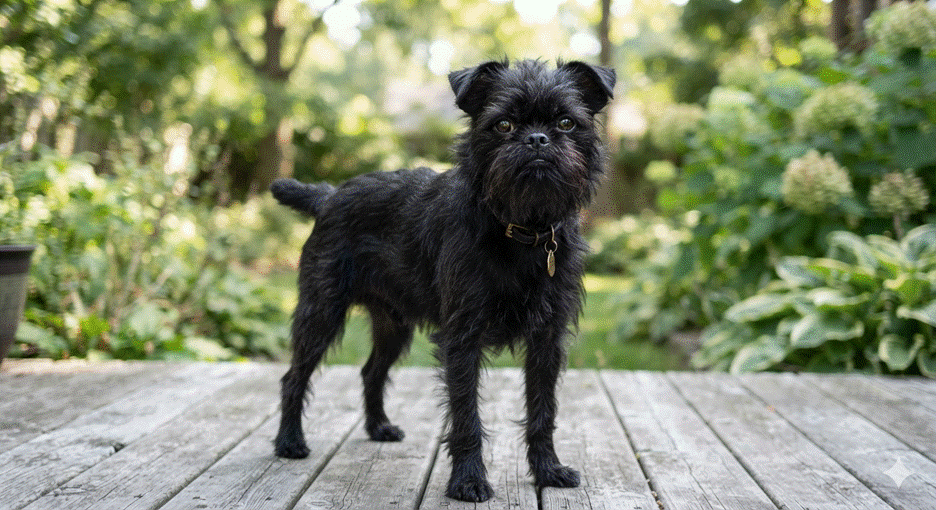
With its shaggy eyebrows, bristling mustache, and unmistakably curious expression, the Affenpinscher looks like it was built to make people laugh. The name itself gives it away: “Affenpinscher” translates roughly from German as “monkey terrier,” and in France the breed carries an even more colorful nickname, the Diablotin Moustachu — the “mustached little devil.” Beneath the comic appearance is a genuinely loyal, alert, and surprisingly fearless companion that has been winning over households for more than a century. This guide covers everything a prospective or current owner needs to know, from temperament and training to grooming, health, and cost.
Affenpinscher Quick Facts
| Attribute | Detail |
| AKC Group | Toy Group |
| FCI Group | Group 2, Section 1 (Pinschers and Schnauzers) |
| Country of Origin | Germany |
| Height | 9.5–11.5 in (24–29 cm) at the withers |
| Weight | 7–13 lb (4–6 kg) |
| Lifespan | 12–15 years |
| Coat | Wiry, dense, harsh double coat |
| Colors | Black, gray, silver, red, black and tan, belge |
| Temperament | Alert, fearless, loyal, mischievous |
What Is an Affenpinscher?
Origins in Germany
The Affenpinscher’s roots trace back to Germany, where dogs of this general type were already being kept by the 1600s. Those early dogs were somewhat larger than today’s Affenpinscher, standing 12 to 13 inches tall, and came in a wider range of colors including gray, fawn, and red. Their job was practical: clearing rats and other vermin out of kitchens, granaries, and stables.
The breed as we know it today began to take shape in the early 1900s, when the Berlin Lapdog Club started formalizing a breed standard in 1902. That standard wasn’t finalized until 1913, and it’s the version — translated into English — that the American Kennel Club (AKC) eventually adopted.
From Ratter to Companion
By the time the Affenpinscher entered the AKC Stud Book in 1936, its role had shifted from working ratter to household companion, a transition that suited its intelligent, people-oriented nature well. Today the breed sits in the Toy Group according to the AKC and in Group 2, Section 1 (Pinschers and Schnauzers) under the Fédération Cynologique Internationale (FCI) system. [Internal Link: Toy Group]
Appearance & Coat

Size and Build
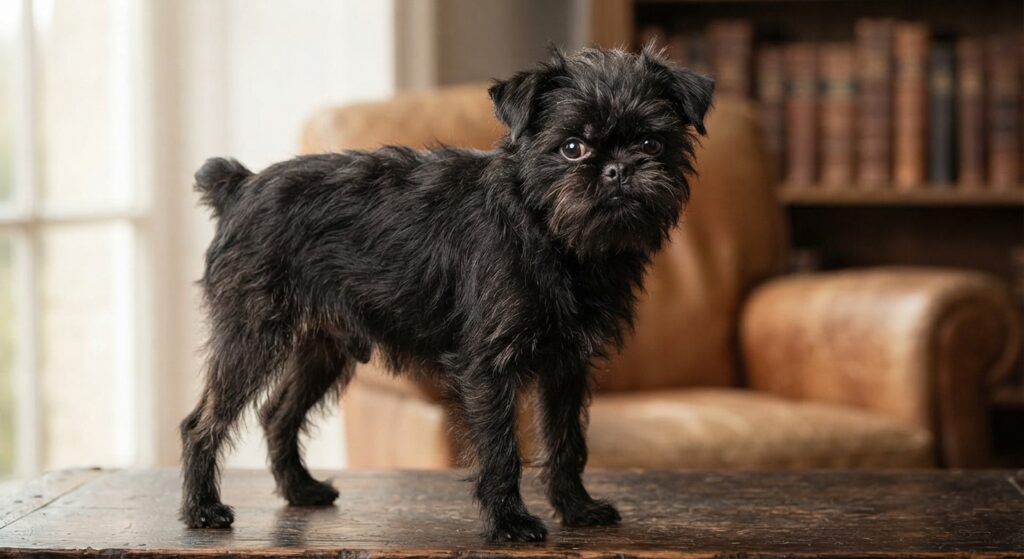
Affenpinschers are small but sturdy. The AKC breed standard calls for a compact, medium-boned dog standing 9.5 to 11.5 inches at the withers, with a build that’s noticeably more substantial than its size suggests — this is not a delicate teacup breed. Adults typically weigh between 7 and 13 pounds.
Coat Colors and Texture
The coat is one of the breed’s signature features: dense, wiry, and harsh to the touch, growing longer over the head, neck, and shoulders to form a mane-like frame around the face, while staying shorter along the back and hindquarters. Accepted colors include black, gray, silver, red, black and tan, and a mixed shade called belge, which blends black, brown, and white hairs with red.
Temperament and Personality
The Affenpinscher’s personality is often described as “big dog in a small body.” Bred originally to hunt vermin, it retains a terrier-like fearlessness that shows up as confidence, alertness, and a willingness to stand its ground against much larger dogs. At home, that same intensity softens into deep loyalty and affection toward family members.
Affenpinschers tend to be quiet by nature but will sound the alarm — sometimes loudly — if they sense a threat or an intruder, which makes them surprisingly effective watchdogs for their size. They’re also known for a mischievous, almost clownish streak that owners frequently cite as one of the breed’s most endearing traits.
Is an Affenpinscher Right for You?

Families and Children
Affenpinschers can do well in families, but their small size and sturdy-but-compact frame mean they’re generally a better match for households with older, gentler children who understand how to handle a small dog carefully, rather than toddlers or very young kids who might unintentionally injure them during rough play.
Other Pets
With early socialization, Affenpinschers typically get along fine with other dogs and cats in the household. Their terrier-like prey drive, however, means small caged pets like hamsters or birds may trigger a chase instinct.
Apartment Living
This is a breed built for apartment life. Affenpinschers are compact, only moderately active, and don’t require a yard to stay happy, making them a solid choice for city dwellers and first-time small-dog owners alike — provided the owner is ready for the grooming and training commitment described below.
Training an Affenpinscher
Training this breed is a study in contrasts. It’s intelligent and generally quick to pick up new commands, but that same sharpness comes paired with a stubborn streak inherited from its terrier ancestry. Consistent, gentle leadership works far better than harsh corrections, which tend to make the dog dig in its heels rather than comply — a battle of wills an Affenpinscher will happily lose slowly, on its own terms.
Early socialization matters too, helping puppies grow into confident, well-adjusted adults who greet new people, dogs, and environments with curiosity instead of suspicion. Positive reinforcement — treats, praise, and short, engaging sessions — tends to produce the best results, especially since long repetitive drills bore a dog this sharp fairly quickly. Owners who channel that intelligence into agility courses or structured obedience classes usually find training goes more smoothly, since the dog gets mental stimulation alongside physical exercise rather than viewing lessons as a chore.
Exercise Needs
Affenpinschers don’t need much: about 20 minutes of daily activity, split between walks and play, is generally enough to keep one physically and mentally satisfied. This modest requirement is part of why the breed suits apartment living so well.
Heat Safety Note: Affenpinschers have a shortened muzzle that puts them at risk for brachycephalic airway syndrome, a breathing condition common in flat-faced breeds. Because of this, exercise should be scaled back or avoided entirely during hot, humid weather, and owners should watch for excessive panting or labored breathing during activity.
Grooming (Including Hand-Stripping)
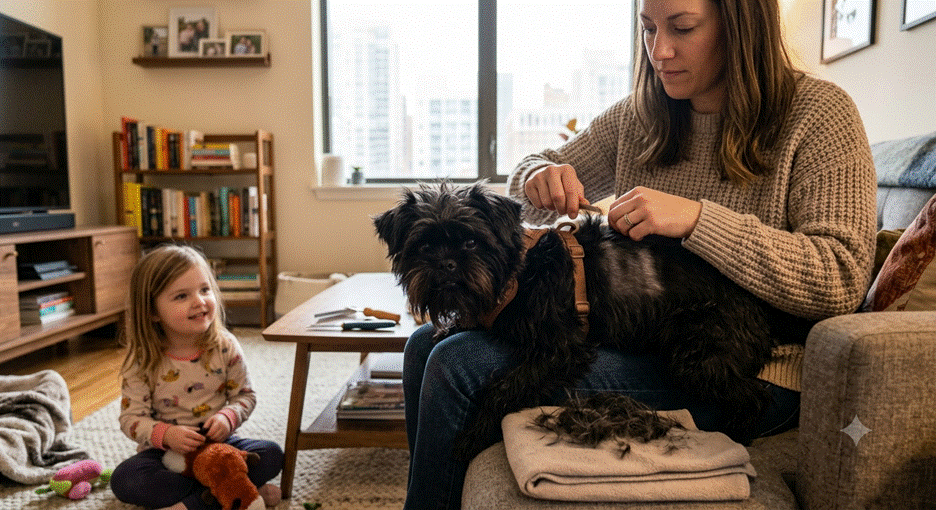
The Affenpinscher’s wiry coat needs brushing about twice a week to prevent the longer facial and neck hair from matting, along with a trim roughly every two to four months to keep hair out of the eyes.
Grooming Tip: Many breeders and show owners maintain the coat through hand-stripping [Internal Link: hand-stripping] rather than clipping. Hand-stripping means removing dead outer hairs by hand or with a specialized stripping tool, which preserves the coat’s harsh, wiry texture and encourages healthy new growth. It takes more time and skill than a simple haircut, but it keeps the coat looking and feeling the way the breed standard intends. Owners who’d rather skip the technique can opt for regular clipping instead, though the coat texture will soften over time.
Routine care should also include regular ear cleaning, nail trims, and — critically for this breed — consistent dental care, covered in more detail below.
Health and Lifespan
Affenpinschers are generally healthy dogs with no single dominant predisposed condition, and most live 12 to 15 years with attentive care. Still, a handful of conditions worth monitoring closely relate to their status as one of the brachycephalic breeds. [Internal Link: brachycephalic breeds]
| Condition | What It Is | What Owners Should Watch For |
| Brachycephalic airway syndrome | Breathing difficulty linked to the breed’s short muzzle | Heavy panting, noisy breathing, poor heat tolerance |
| Dental disease | Higher-than-average risk of tooth and gum problems | Bad breath, visible tartar, reluctance to chew |
| Hip dysplasia | Improperly formed hip joint, less common in toy breeds but possible | Limping, stiffness, reluctance to jump |
| Patellar luxation | Kneecap slips out of place | Intermittent skipping or hopping gait |
| Progressive retinal atrophy (PRA) | Genetic, gradual deterioration of the retina | Night vision loss progressing to full vision loss |
| Mitral valve disease (MVD) | Age-related heart valve deterioration | Coughing, fatigue, difficulty breathing in older dogs |
Dental disease deserves particular attention: left unmanaged, it can shorten an Affenpinscher’s lifespan by one to three years, making regular brushing and professional cleanings one of the highest-impact things an owner can do for long-term health. Senior dogs also benefit from periodic eye and heart screenings to catch PRA or MVD early.
Nutrition
A high-quality small-breed formula is generally the best fit for an Affenpinscher’s size and energy level, since these diets are calorie-dense enough to match a toy dog’s fast metabolism without requiring oversized portions. Because dental disease is a known risk for the breed, food formulated to support dental health — often through kibble shape and texture designed to scrape plaque during chewing — is worth considering.
Portion control matters just as much as food quality. Toy breeds gain weight quickly relative to their size, and even a small amount of extra weight puts real strain on joints already prone to patellar luxation. Splitting daily food into two smaller meals rather than one large one tends to work well for this breed, and treats are best kept small and infrequent given how little food an Affenpinscher actually needs to maintain a healthy weight.
Cost and Finding a Breeder
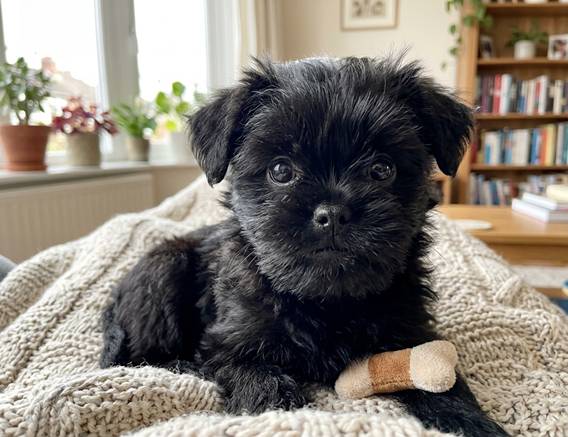
Affenpinscher puppies typically range from around $650 to $2,000, though actual prices vary widely by breeder, location, and lineage, so this figure should be treated as a general guide rather than a fixed number.
Because the breed is relatively rare, finding a responsible breeder takes some legwork. The reputable breeder [Internal Link: reputable breeder] vetting process should include a few key questions: Is the breeder in good standing with the AKC or the Affenpinscher Club of America (ACA)? Have the parents been health-tested, and are the results available to review? Will the breeder take the puppy back at any point in its life if the placement doesn’t work out? A breeder who welcomes these questions and answers them transparently is generally a good sign.
Related Breeds and Mixes


The Affenpinscher shares close historical ties with several other small breeds and has become a popular base for modern designer mixes. (See Brussels Griffon and Miniature Pinscher — internal links.)
| Breed | Size | Coat | Notable Trait |
| Brussels Griffon | 7–8 in tall (smaller) | Wiry or smooth | Believed to descend partly from the Affenpinscher |
| Miniature Pinscher | Similar toy size | Short, smooth | Shares regional German toy-breed ancestry |
| Affenpoo | Varies (Poodle-cross) | Wavy to curly | Affenpinscher × Poodle designer mix |
| Affengriffon | Small toy size | Wiry | Affenpinscher × Brussels Griffon mix |
Frequently Asked Questions
What is an Affenpinscher?
The Affenpinscher is a small German toy breed known for its wiry coat, monkey-like facial expression, and bold, terrier-like personality. It was originally bred to hunt rats and other vermin before becoming a companion dog.
Are Affenpinschers good family dogs?
They can be, especially in households with older, gentle children, other socialized pets, and owners ready for consistent training and regular grooming. They’re less suited to homes with very young children due to their small, sturdy-but-fragile size.
Do Affenpinschers shed?
Affenpinschers are low-shedding thanks to their wiry coat, but that coat needs regular brushing and periodic hand-stripping or trimming to stay healthy and mat-free.
Are Affenpinschers hard to train?
They’re intelligent and capable learners, but their stubborn streak means training goes best with patient, consistent, positive-reinforcement methods rather than harsh corrections.
How much does an Affenpinscher cost?
Puppies generally range from about $650 to $2,000, depending on the breeder, location, and lineage. Ongoing costs include grooming, veterinary care, and dental maintenance.
What health problems do Affenpinschers have?
Common concerns include brachycephalic airway syndrome, dental disease, hip dysplasia, patellar luxation, progressive retinal atrophy, and mitral valve disease in older dogs.
How long do Affenpinschers live?
Most Affenpinschers live between 12 and 15 years, particularly with good dental care, weight management, and regular veterinary checkups.
Conclusion
The Affenpinscher packs an outsized personality into a small, wiry-coated frame. It’s a breed that rewards owners willing to commit to regular grooming, patient and consistent training, and attentive health monitoring — particularly around dental care and heat sensitivity. In return, it offers a loyal, alert, and endlessly entertaining companion that adapts well to apartment life and stays devoted to its family for well over a decade. Anyone considering one should take the time to find a responsible breeder, ask the right health-testing questions, and go in with a clear picture of what daily life with this “mustached little devil” actually looks like.