Dunker Dog Breed: The Complete Norwegian Hound Guide
Most dog lovers have never heard of the Dunker, and there’s a good reason: fewer than 200 puppies are registered worldwide in a typical year, almost all of them in Norway and Sweden. Yet this blue-marbled hare hound carries one of the most remarkable stories in the purebred dog world — a breed that was nearly destroyed by its own pedigree and saved by a decision that was almost unthinkable at the time. If you’re researching the Dunker dog breed as a curious enthusiast or a serious prospective owner, this guide covers what the thin profiles elsewhere leave out: the real genetics behind that famous coat, what the official standard actually says, and what it would honestly take to bring one home in the United States.
What Is a Dunker? Breed Overview and Quick Facts
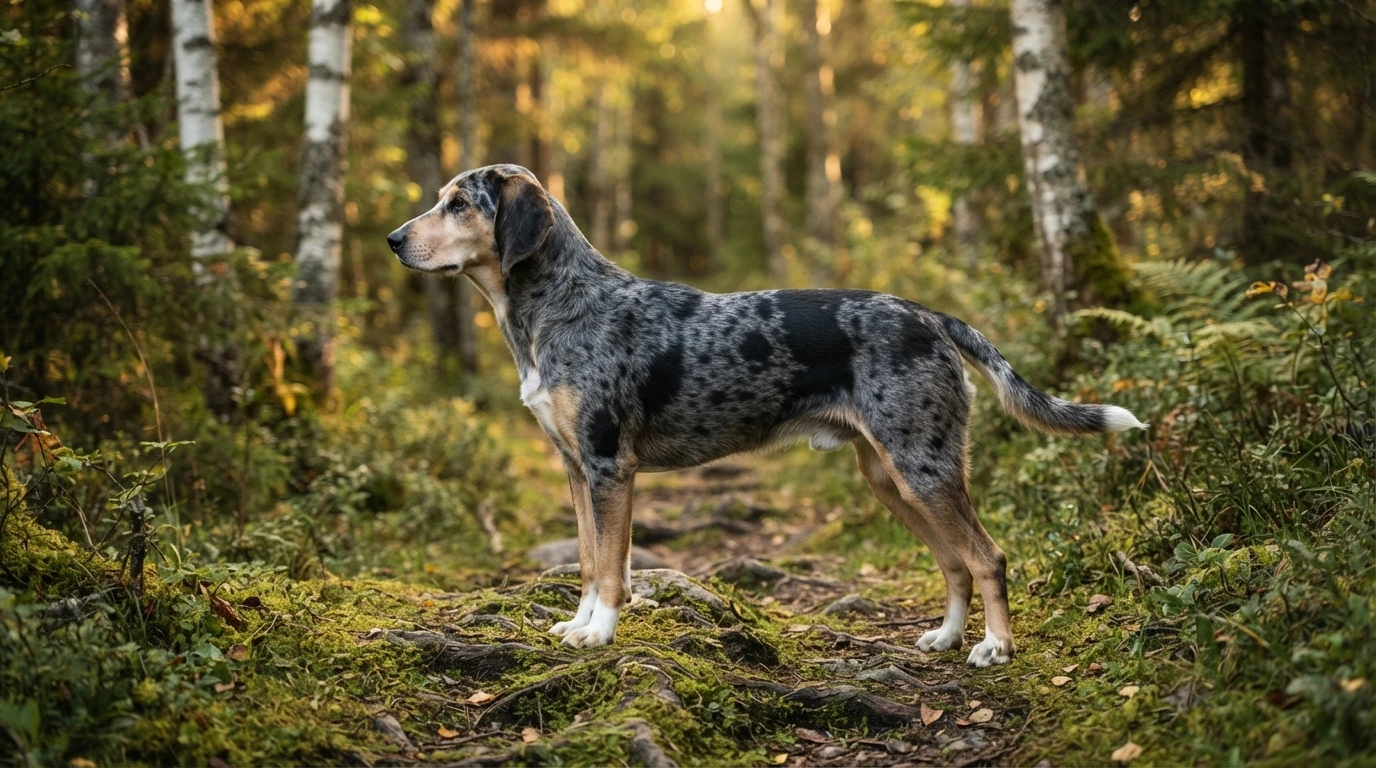
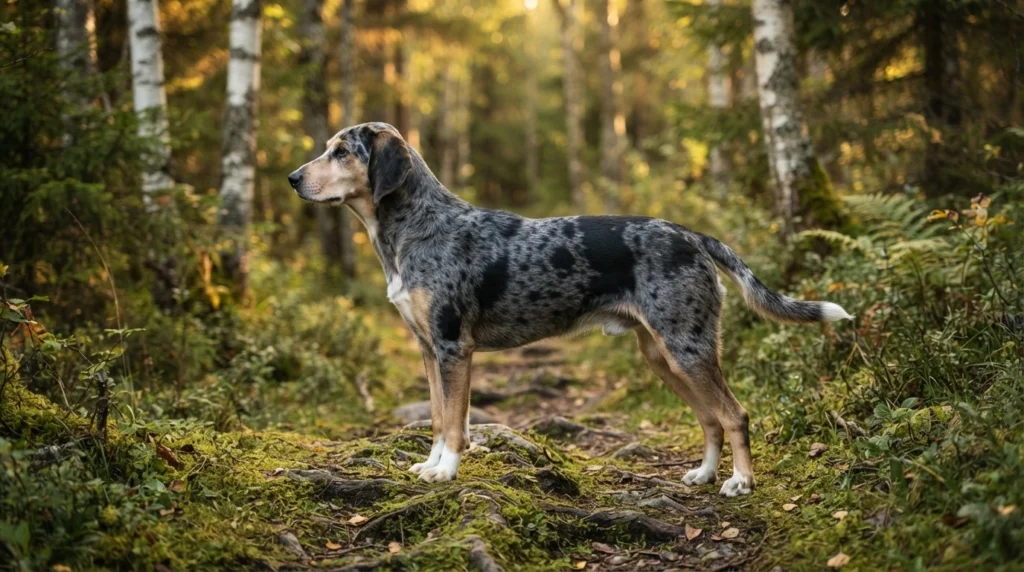
The Dunker is a medium-sized Norwegian scenthound developed in the 1820s to hunt hares by scent and voice. Known internationally as the Norwegian Hound, it is famous for its blue-marbled (merle) coat, its endurance in rough terrain, and its unusually sociable temperament for a working pack hound.
The breed is recognized by the FCI (Standard No. 203, Group 6, Section 1.2 — medium-sized hounds, with working trial) and has been recognized by the United Kennel Club in the US since January 1, 1996. The American Kennel Club does not currently recognize the breed, which tells you a lot about how rare it is on this side of the Atlantic.
| Quick Facts | |
| Origin | Norway, first half of the 19th century |
| Group | FCI Group 6 (Scenthounds), Section 1.2; UKC Scenthound |
| Height (males) | 50–58 cm (19.5–23 in), ideally 52–54 cm |
| Height (females) | 47–54 cm (18.5–21 in), ideally 49–51 cm |
| Weight | Roughly 16–22 kg (35–49 lb) |
| Coat | Straight, hard, dense; blue marbled (merle) or diluted black, with tan and white markings |
| Lifespan | Approximately 12–14 years |
| Temperament | Sociable, trusting, strong-nerved, scent-driven |
| Rarity | One of the world’s rarest recognized breeds (~130–180 registrations per year) |
Those height figures come straight from the current FCI standard, published in 2016 — worth noting, because many breed websites round them incorrectly. The standard describes a distinctly rectangular, powerfully built dog that “should convey the impression of endurance” without ever appearing heavy.
History: A Captain’s Hound and a Genetic Rescue
The breed carries the name of Captain Wilhelm Conrad Dunker, a Norwegian officer who set out in the 1820s to build the ideal hare-hunting hound for Norway’s punishing terrain and climate. His key ingredient was the Russian Harlequin Hound, crossed with reliable local Norwegian scent hounds. That Russian import contributed more than hunting ability — it brought the merle gene responsible for the breed’s marbled coat and its occasional pale “wall eyes,” both of which the FCI standard still explicitly permits today.
The Dunker did well for a century. It survived a wartime collapse in numbers, rebounded through the 1950s and 60s, then quietly slid into trouble. By the 1980s the population was so small and so homogenous that nearly every dog was closely related. Breeders faced a wall: excellent hunting dogs, dangerous pedigrees.
What happened next is the part of the story most breed profiles compress into a sentence, and it deserves better. In 1987, Norwegian breeders formally petitioned the Norwegian Kennel Club to allow crossbreeding with other scenthound breeds — essentially asking permission to break the closed studbook, the foundational rule of pedigree breeding. The application was initially denied. Roughly two years later, limited permission was granted, and a small number of carefully planned outcrosses were made.
The gamble worked. The current FCI standard itself acknowledges that the crossbreeding “resulted in much better genetic variation and health, still maintaining the typical and positive characteristics.” Norway later applied the same logic to the Norwegian Lundehund in a rescue program documented in peer-reviewed journals like PLOS One, but Dunker breeders were among the early movers. It remains one of the clearest real-world demonstrations that a studbook can be opened responsibly — and it’s a story every rare-breed fancier should know. If you find these preservation stories compelling, the breed still needs advocates: the population remains low despite the improved health.
[FUTURE LINK: Norwegian Elkhound]
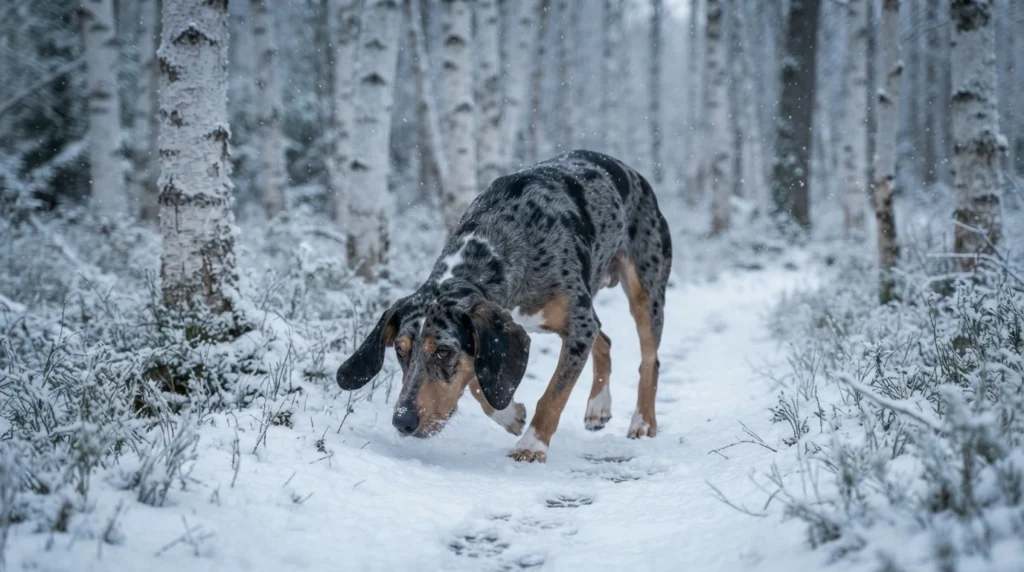
Appearance: The Merle Coat, Explained for Buyers
A Dunker looks like what it is: a working hound built for stamina rather than speed or bulk. The head is long and clean with parallel lines, the ears hang flat and reach halfway down the muzzle, and the chest is deep — about half the height at the withers, per the standard. Nothing about the dog is exaggerated.
The coat is where the breed becomes unmistakable. The FCI standard accepts two main colorways:
| Color | Description | Standard status |
| Blue marbled (merle) | Marbled gray-blue with pale tan and white markings | Accepted; the breed’s signature |
| Diluted black | Softer black with warm tan and white markings | Accepted |
| Jet black with tan | Deep black with warm tan | Less desirable |
| 50%+ white | Predominantly white | Undesirable |
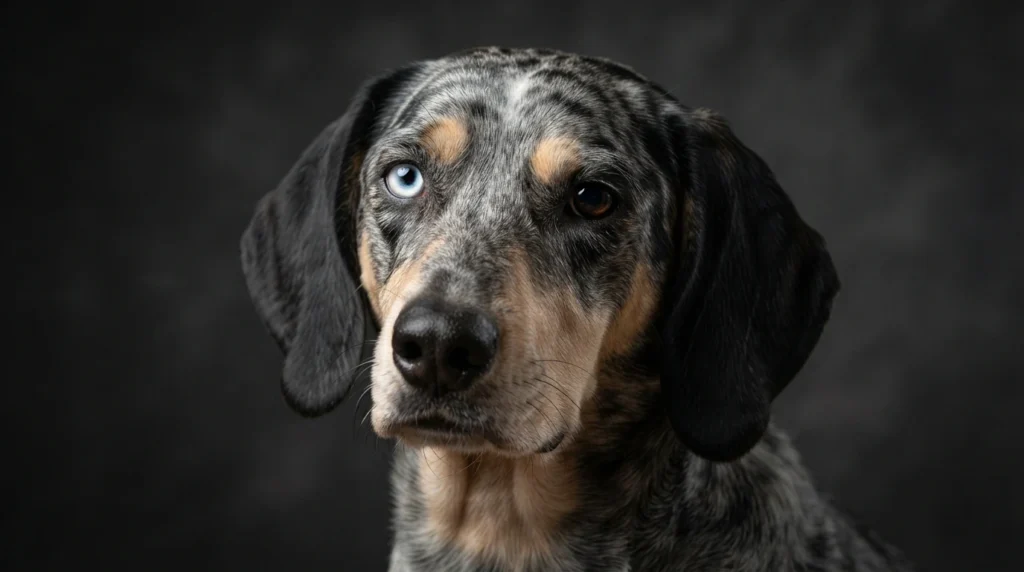
Here’s what buyers actually need to understand, because it has welfare consequences. The marbling comes from the merle gene (the M locus). A dog with one copy of merle gets the beautiful marbled coat and may have blue “wall eyes” — permitted in the standard for merle dogs. But when two merle carriers are bred together, puppies can inherit two copies, and “double merle” dogs carry a substantially elevated risk of congenital deafness and eye defects. This is the same genetic tradeoff seen in merle Collies and Australian Shepherds. Responsible Dunker breeders avoid merle-to-merle pairings and screen hearing with BAER (Brainstem Auditory Evoked Response) testing.
Practical takeaways if you’re evaluating a litter: ask what colors the parents are, ask directly whether the breeding was merle × non-merle, and ask for BAER results on blue-eyed puppies. A breeder who welcomes those questions is exactly the kind you want for a breed this rare.
[FUTURE LINK: merle gene in dogs]
Temperament and Family Life
The official standard is unusually warm about this breed’s character: strong nerves, “especially sociable and trusting,” and — notably — “easy to train” thanks to its open nature. That last phrase surprises people who know scenthounds, and it deserves context. Compared to other hare hounds, the Dunker genuinely is biddable and people-oriented. Compared to a Golden Retriever, it is still a hound: when a fresh scent hits that nose, your voice drops several places in the priority queue.
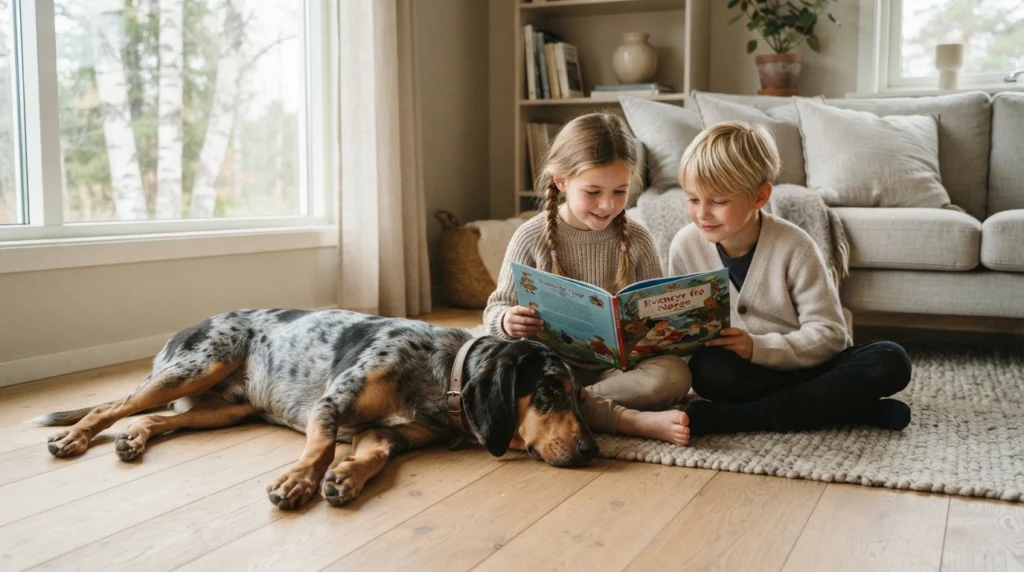
In the home, Dunkers are affectionate, gentle with children, and generally excellent with other dogs — they were bred to work near other hounds and around people. Their friendliness extends to strangers, which makes them cheerful hosts and hopeless guard dogs.
Two honest caveats for American households. First, this is a baying breed. Dunkers were selected to give voice on a trail, and a bored one will practice in your backyard; close-quarters suburbia or thin-walled apartments demand real commitment to exercise and enrichment. Second, small pets are a genuine risk area — a hound bred for 200 years to chase small mammals should be introduced to cats early and never left unsupervised with rabbits or rodents.
Dunker vs Beagle vs American Foxhound
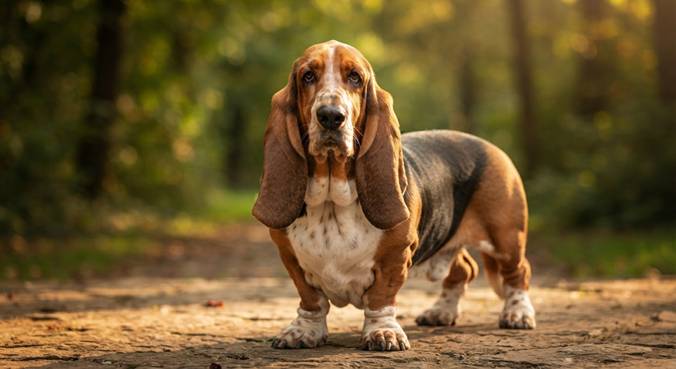
If you love the Dunker’s look but need a realistic path to ownership, two American-available scenthounds cover similar ground. The Beagle offers the same merry pack-hound temperament in a smaller, widely available package, while the American Foxhound matches the Dunker’s endurance and voice with deep American roots.
| Dunker | Beagle | American Foxhound | |
| Height | 47–58 cm (18.5–23 in) | 33–38 cm (13–15 in) | 53–64 cm (21–25 in) |
| Coat | Merle or diluted black w/ tan | Tricolor/bicolor | Tricolor, various |
| Energy | High (endurance) | Moderate–high | Very high |
| Voice | Loud bay | Loud bay | Very loud bay |
| Good with kids | Excellent | Excellent | Very good |
| US availability | Nearly zero | Everywhere | Uncommon but real |
| Signature trait | Merle coat, rarity | Compact size | Stamina, history |
The honest summary: the Beagle is the practical choice, the Foxhound is the endurance choice, and the Dunker is the passion project.
Exercise and Training a Scent-Driven Nose
Plan on at least 60 minutes of real exercise daily — and that means the nose gets to work, not just the legs. A leashed walk around the block doesn’t scratch a scenthound’s itch. The happiest Dunkers get some combination of long sniff-heavy hikes, formal scent work or tracking games, jogging or canicross, and free running in securely fenced areas. Specialized tracking breeds like the Bavarian Mountain Hound share this need: the nose is the engine, and it has to run.
Training is rewarding if you respect the breed’s design. Use positive reinforcement, keep sessions short and upbeat, and treat recall as a lifelong project rather than a solved problem.
Common mistakes new hound owners make:
- Trusting off-leash recall too early. Use a 10–15 m long line for months, not weeks, and consider it insurance forever in unfenced areas.
- Under-fencing. A determined scenthound treats a 4-foot fence as a suggestion. Six feet, checked for gaps, is the safer spec.
- Punishing the bay. Voice is genetics, not disobedience. Manage it with exercise, enrichment, and quiet-on-cue training instead.
- Exercising only the body. Fifteen minutes of scent games can tire a hound more than an hour of fetch.
- Skipping early cat/small-pet socialization. Prey drive that’s never addressed at 10 weeks becomes unmanageable at 10 months.
Health and Lifespan
The Dunker is a fundamentally sound breed — endurance hunting tolerates no fragility, and the outcross program measurably improved the gene pool. A healthy Dunker typically lives 12–14 years. Still, several conditions are documented and worth screening for:
| Condition | What it is | What buyers should ask |
| Hereditary deafness | Linked to double-merle breeding | BAER test results; parents’ colors |
| Progressive retinal atrophy (PRA) | Degenerative eye disease causing vision loss | DNA test (prcd-PRA variant) on parents |
| Hypothyroidism | Underactive thyroid; weight gain, coat/skin issues | Thyroid history in the line |
| Hip dysplasia | Malformed hip joint | Hip scores on both parents |
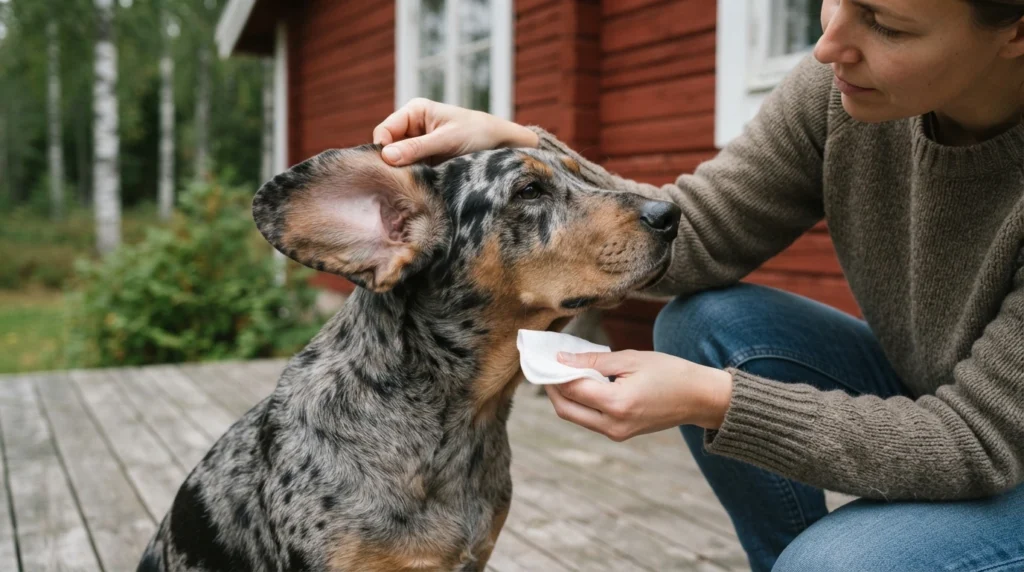
| Ear infections | Drop ears trap moisture | Your own weekly ear-care routine |
| Demodectic mange | Immune-linked skin mite overgrowth | Skin history in the line |
The hypothyroidism entry isn’t generic filler: a large Norwegian study of serum samples collected between 2001 and 2018 (over 23,000 dogs) found the Dunker among the breeds with the highest odds of developing the condition. It’s very manageable — a daily hormone tablet, typically — but owners should know the early signs: unexplained weight gain, lethargy, thinning coat, and cold intolerance.
Grooming and Everyday Care
This is the easy part. The hard, dense coat needs a weekly rubber-curry or bristle brushing, stepped up during spring and fall shedding. Bathe only when the dog earns it. No trimming, no stripping, no groomer’s bill.
The ears are the one non-negotiable: hanging ears plus forest humidity equals infection risk, so make a 30-second weekly ear check part of the routine and dry the ears after swimming or wet outings. Keep nails short, and keep the dog lean — an endurance hound gains nothing from extra weight except joint strain, and a Dunker with hypothyroid tendencies gains it easily. Feed a measured, high-quality diet matched to activity level, and adjust in hot weather using sensible summer feeding strategies — a breed built for Norwegian winters needs care in an American July.
Cost and How to Actually Get a Dunker
This is the part no US-focused profile writes honestly: you almost certainly cannot buy a Dunker in the United States. With ~130–180 puppies registered annually worldwide — nearly all in Norway and Sweden — there is no established American breeder base, and any US classified listing advertising “Dunker puppies” deserves extreme skepticism. Rare-breed scams follow search demand.
The realistic route runs through Norway: contact the Norwegian breed club (the Dunker is managed under Norway’s harehound club system), expect a conversation about your hunting or activity plans, and expect a waitlist. Breeders of a rare national treasure vet buyers carefully — a good sign, not an obstacle.
Estimated costs for a US buyer (2026, all figures estimates):
| Item | Estimated cost |
| Puppy price (Scandinavia) | $800–$1,500 |
| Flight, crate, transit (Norway → US) | $1,200–$3,500 |
| Import paperwork, vet certificates, microchip/rabies compliance | $300–$800 |
| First-year setup (gear, vaccines, neutering, insurance) | $1,500–$2,500 |
| Ongoing annual cost | $1,200–$2,000 |
All told, budget roughly $4,000–$8,000 to get started — comparable to importing any European working breed. CDC dog-import rules have tightened in recent years, so verify current requirements before committing. [FUTURE LINK: importing a dog to the United States]
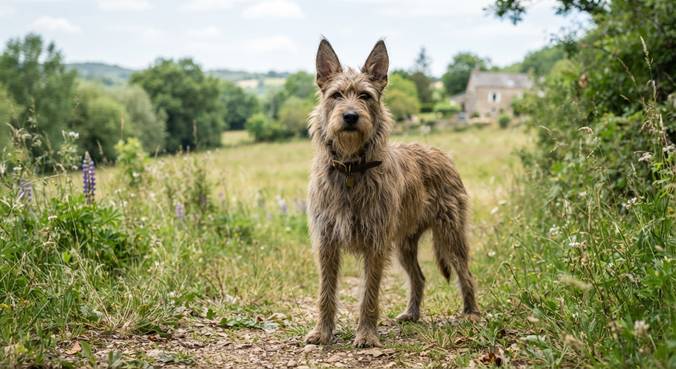
If that process sounds like too much, that’s useful information too. Enthusiasts drawn to rare European hounds without the import hurdle should look at the Ariegeois, another rare European scent hound with a small but growing international footprint.
Is a Dunker Right for You?
A Dunker is a strong match if you:
- Want an affectionate, kid-friendly companion that doubles as a serious outdoor partner
- Can provide 60+ minutes of daily exercise including real nose-work
- Have a securely fenced yard and tolerant neighbors (or rural space)
- Are patient enough to pursue an international waitlist and import process
- Care about breed preservation and want to be part of a conservation story
Look elsewhere if you:
- Need reliable off-leash freedom in unfenced areas
- Live in a noise-sensitive apartment
- Have free-roaming cats, rabbits, or other small pets
- Want a dog this year — the acquisition timeline is measured in months to years
Frequently Asked Questions
How rare is the Dunker?
Among the rarest recognized breeds on Earth. Annual registrations typically total 130–180 puppies worldwide, concentrated in Norway and Sweden. For comparison, US Labrador registrations run into the tens of thousands.
Why do some Dunkers have blue eyes?
The merle gene that creates the marbled coat can also lighten the eyes, producing “wall eyes” — permitted in the FCI standard for merle dogs. Blue eyes alone don’t mean a dog is deaf, but they justify asking for a BAER hearing test.
Are Dunkers good family dogs?
Yes — unusually so for a scenthound. The breed standard itself highlights a sociable, trusting nature, and Dunkers are typically gentle with children. Their exercise and noise needs, not their temperament, are the limiting factors.
Do Dunkers bark a lot?
They bay, loudly, especially when bored or on a scent. It’s a working trait, manageable with exercise and training but never fully removable.
Can I buy a Dunker in the United States?
Realistically, only by importing from Scandinavia through the Norwegian breed club system. Treat any US “Dunker puppies for sale” listing with heavy skepticism.
Are Dunkers hypoallergenic?
No. They have a dense, shedding double-layer coat. Allergy sufferers should consider low-shedding breeds instead.
Final Thoughts
The Dunker is proof that a dog breed can be both a working tool and a piece of cultural heritage worth saving. Its breeders made a hard, controversial call four decades ago and bought the breed a healthier future; its small population still depends on people willing to do things the slow way — waitlists, health testing, honest breeding choices. If you become one of the few Americans to own a Norwegian Hound, you’re not just getting a gentle, tireless, blue-marbled companion. You’re joining a conservation effort. And if the import route isn’t for you, the merry hounds already in American shelters and breed rescues — Beagles and Foxhounds among them — carry the same nose and much of the same heart.