Black Russian Terrier: The Complete Guide to the Soviet Union’s Engineered Guardian
Black Russian Terrier
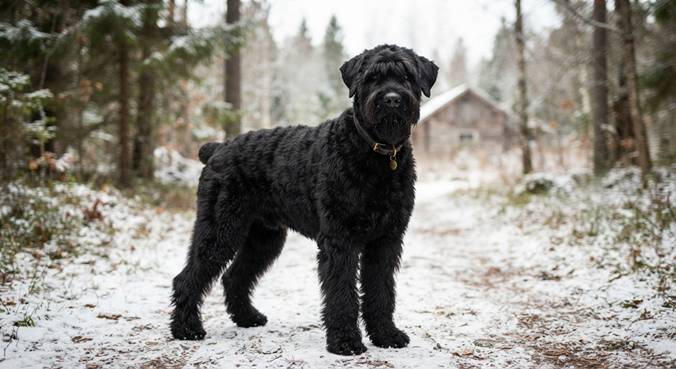
Most dog breeds emerged gradually, shaped by regional farmers or hunters over centuries of informal selection. The Black Russian Terrier had no such organic beginning. It was built, deliberately and methodically, by Soviet military breeders working from a direct government order to produce an all-weather guard dog capable of serving across the entire USSR. This guide gives that unusual engineering project its full due, names the specific breeds that went into the mix and why, and covers everything a prospective owner needs to know about living with this large, imposing, surprisingly devoted working dog today.
Black Russian Terrier Quick Facts
The Black Russian Terrier was deliberately created by Soviet military breeders starting in 1949 from roughly 17 different breeds, and it joined the AKC’s Working Group in 2004.
| Attribute | Detail |
| AKC Group | Working Group (recognized 2004) |
| FCI Group | Group 2, Section 2, Standard No. 327 |
| Country of Origin | Soviet Union (Russia) |
| Height | 26-30 in (males), 25.5-29 in (females) |
| Weight | 80-140 lb |
| Lifespan | 10-12 years |
| Coat | Dense, wiry, weather-resistant double coat |
| Colors | Black, sometimes with gray hairs |
| Temperament | Calm, confident, courageous, aloof with strangers |
What Is a Black Russian Terrier?
A 1949 Government Directive
In 1949, the Soviet government issued a directive to the Red Star Kennel, known in Russian as Krasnaya Zvezda, part of the Central State School of Military Service Dog Breeding and Training located near Moscow. The assignment was specific: create a domestically bred military and guard dog capable of working reliably in every climate zone the USSR spanned, from brutal winters to humid summers, without relying on breeds imported from elsewhere. This wasn’t a hobbyist’s passion project or a farmer’s informal selection process. It was a state-directed breeding program with a clear operational goal.
Seventeen Breeds, One Purpose
Over the following decade, Red Star Kennel breeders methodically crossed roughly 17 different breeds in pursuit of that goal, though four contributed the most to the breed’s final form. The Airedale Terrier lent trainability, terrier grit, and a wiry coat texture. The Rottweiler contributed size, strength, and natural guarding instinct. The Giant Schnauzer added intelligence and working drive along with more coat texture. The Newfoundland brought size, calm temperament, and cold-weather hardiness. Additional contributions came from the Caucasian Shepherd Dog, the South Russian Shepherd Dog, and several other regional and imported breeds, each selected for a specific trait the program needed. The result, gradually stabilized through selective breeding, was a large, dense-coated, all-black working dog suited to genuinely difficult conditions.
This kind of purpose-built, multi-breed engineering program has few real parallels in the dog world. Most working breeds trace back to a single regional type refined over generations by farmers, herders, or hunters responding to local needs. The Black Russian Terrier instead came out of a government facility with a written mandate, a target list of desired traits, and a systematic crossbreeding plan spanning multiple breeding generations before the type stabilized enough to show consistently. Soviet breeders weren’t trying to preserve an existing regional dog; they were trying to manufacture one from scratch. The fact that they largely succeeded, producing a dog stable enough to standardize within roughly a decade, says a great deal about how deliberately the program was run.
| Key Fact The Black Russian Terrier was first shown publicly in Moscow in 1955, and received full AKC Working Group recognition on July 1, 2004 – 55 years after the original 1949 directive. |
Standardization and AKC Recognition
The breed was first shown publicly in Moscow in 1955, evidence that Red Star Kennel’s breeding program had produced a recognizably consistent type. The Red Army published the first official breed standard in 1958 and revised it several times over the following decades, with a significant revision completed in 1981. American recognition came much later: the AKC admitted the Black Russian Terrier to its Miscellaneous Class in 2001, and granted the breed full recognition in the Working Group on July 1, 2004, more than half a century after the original government directive that started it all.
Black Russian Terrier vs. Giant Schnauzer vs. Rottweiler
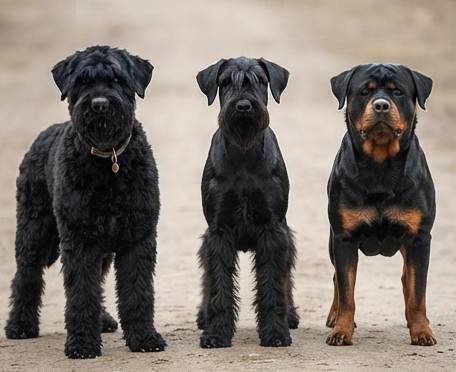
Given how directly the Giant Schnauzer and Rottweiler contributed to the Black Russian Terrier’s development, comparing all three helps clarify what the BRT actually inherited from each.
| Attribute | Black Russian Terrier | Giant Schnauzer | Rottweiler |
| Coat | Dense, wiry, black double coat | Wiry, salt-and-pepper or black | Short, dense, black and tan |
| Size | Large (80-140 lb) | Large (55-85 lb) | Large (80-135 lb) |
| Distinguishing Trait | Larger, denser-coated, calmer than either contributor alone | Bearded terrier-type face, more overtly energetic | Short coat, distinctive tan markings, no beard |
The Black Russian Terrier essentially combines the Giant Schnauzer’s coat texture and working intelligence with the Rottweiler’s size and guarding instinct, filtered through decades of Soviet military selection for calmness and reliability under a handler’s direction. The Airedale Terrier and Newfoundland are less visually obvious in the modern BRT but remain genetically present, contributing coat wiriness and calm temperament respectively.
Appearance
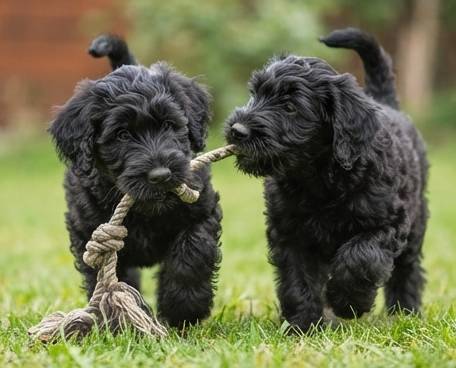
The Black Russian Terrier is a large, powerfully built working dog covered in a dense, wiry, weather-resistant black double coat, often accented with bushy eyebrows, a beard, and a mustache reminiscent of its Giant Schnauzer and Airedale Terrier ancestry. The overall impression is one of substantial strength combined with genuine athleticism rather than bulk alone.
Temperament
Black Russian Terriers are calm, confident, and self-assured, a temperament that reflects decades of deliberate selection for a dog that could work steadily under military and guard conditions without becoming reactive or unpredictable. They tend to be aloof or reserved with strangers but deeply devoted to their own families, forming strong bonds and generally preferring to stay close to their people rather than seeking out new relationships.
Is a Black Russian Terrier Right for You?

Families and Children
Black Russian Terriers can be good family dogs when properly socialized, generally getting along well with children and other household pets. That said, their considerable size and strength mean this breed suits households with older children or no young children better than homes with toddlers, simply because a dog this large and powerful requires careful management around very small kids regardless of temperament.
First-Time Owners
This is genuinely not a breed for inexperienced dog owners. The Black Russian Terrier’s size, strong will, and guarding instincts call for confident, consistent handling from day one, and owners without prior large-breed or working-breed experience often find the learning curve steeper than expected. Prospective first-time owners who are still drawn to this breed should seriously consider working with a professional trainer from the earliest weeks of ownership.
Living space matters as much as owner experience with a breed this size. A Black Russian Terrier isn’t well suited to a small apartment without a serious daily exercise plan, and prospective owners should honestly assess whether their home, yard, and daily schedule can accommodate an 80-to-140-pound dog that needs consistent structure, socialization, and a job to do. Owners who can offer that structure tend to find the breed remarkably steady and loyal in return.
Training
Black Russian Terriers are highly intelligent and generally trainable, a trait inherited directly from their Airedale Terrier and Giant Schnauzer ancestry, but their independent streak and size mean training needs to start early and stay consistent. Positive, confident, reward-based methods work well with this breed, while harsh or inconsistent handling tends to bring out stubbornness rather than cooperation.
Exercise Needs
Despite their calm demeanor indoors, Black Russian Terriers need regular daily exercise to stay physically fit and mentally satisfied, including long walks and interactive play or training sessions. A bored, under-exercised BRT can become destructive or difficult to manage simply because it has too much unspent energy and intelligence with nowhere productive to go.
Grooming
The Black Russian Terrier’s dense double coat requires substantial regular maintenance, with thorough brushing and combing recommended two to three times a week at minimum, and daily brushing genuinely preferred to prevent matting in a coat this thick. The good news is that despite all that fur, the breed doesn’t shed excessively, which many owners find a fair tradeoff for the grooming time required. Professional grooming every six to twelve weeks, typically running $65 to $130 per session, rounds out a realistic care routine for most owners of this large, heavily coated breed.
Regular attention to the beard and facial furnishings is worth calling out separately, since food and water tend to collect there and can cause skin irritation if left unaddressed between grooming appointments. Nail trims, ear checks, and routine dental care round out the broader maintenance picture, and owners who stay consistent with all of it from puppyhood generally find the adult routine far more manageable than owners who try to establish it later.
Health and Lifespan

Black Russian Terriers typically live 10 to 12 years and are considered a relatively healthy breed overall, though several conditions common to large working dogs are worth understanding.
| Condition | What It Is | What Owners Should Watch For |
| Hip dysplasia | Abnormal hip joint development leading to joint laxity and arthritis over time | Difficulty rising, reluctance to jump, altered gait |
| Elbow dysplasia | Abnormal elbow joint development, a structural concern in large breeds | Front-leg lameness, stiffness after exercise |
| Bloat (gastric torsion) | A rare but life-threatening stomach distension and twisting, more common in deep-chested large breeds | Restlessness, unproductive retching, distended abdomen |
| Progressive retinal atrophy | A degenerative eye condition leading to gradual vision loss | Night blindness, reluctance to move in dim light |
Hip dysplasia screening through OFA or PennHIP evaluations, along with bloat awareness given the breed’s deep chest, are genuinely important standard questions to ask any breeder before bringing home a puppy of this size.
Reputable breeders should also be able to share eye clearance results relevant to progressive retinal atrophy, since the condition is hereditary and screening breeding stock is the most effective way to reduce its prevalence in future litters. Annual veterinary checkups that include joint and eye assessment, particularly as a Black Russian Terrier moves into its senior years, give owners the best chance of catching developing issues early, when they’re generally easier and less costly to manage.
Nutrition
A high-quality diet formulated for large or giant working breeds suits the Black Russian Terrier well, with careful portion control and, given the breed’s bloat risk, many owners choosing slow-feed bowls and avoiding vigorous exercise immediately around mealtimes as a simple precaution.
Cost and Adoption
Black Russian Terrier puppies from reputable breeders typically range from fifteen hundred to three thousand dollars, with total annual ownership costs, including food, grooming, and routine veterinary care, often running two thousand to four thousand dollars given the breed’s size. The Black Russian Terrier Club of America maintains breeder referral resources, and given the breed’s continued rarity in the United States, prospective owners should expect a genuine wait for a puppy from a health-tested, reputable line.
Frequently Asked Questions
What is a Black Russian Terrier?
The Black Russian Terrier is a large working breed deliberately created by Soviet military breeders starting in 1949, combining traits from roughly 17 breeds into a single all-climate guard dog.
Why was the Black Russian Terrier created?
The Soviet government directed the Red Star Kennel to develop a domestically bred military and guard dog capable of working reliably across the USSR’s diverse climate zones.
What breeds make up a Black Russian Terrier?
The Airedale Terrier, Rottweiler, Giant Schnauzer, and Newfoundland were the principal contributors, alongside the Caucasian Shepherd Dog and several other regional breeds.
Are Black Russian Terriers good with kids?
Generally yes with proper socialization, though the breed’s large size makes it a better fit for households with older children than very young kids.
How much grooming does a Black Russian Terrier need?
Substantial – thorough brushing two to three times a week at minimum, with daily brushing preferred, plus professional grooming every six to twelve weeks.
What health problems do Black Russian Terriers have?
Hip and elbow dysplasia, bloat, and progressive retinal atrophy are the most commonly documented concerns.
How much does a Black Russian Terrier cost?
Puppies from reputable breeders typically range from fifteen hundred to three thousand dollars, with annual ownership costs often reaching two to four thousand dollars.
Conclusion
The Black Russian Terrier’s origin as a deliberately engineered Soviet military breed sets it apart from virtually every other dog in the AKC’s Working Group, and that purposeful design shows up clearly in its calm, confident, capable temperament today. Understanding the real size, training, and grooming commitment this breed requires, and matching it with an experienced, prepared owner, gives this genuinely unique working dog its best chance at a good home.