Pomeranian Guide: Temperament, Size & Health Facts
Quick Facts
| Attribute | Detail |
| Group | AKC Toy Group |
| Height | 6–7 in |
| Weight | 3–7 lb |
| Lifespan | 12–16 years |
| Coat | Dense double coat, heavy “fluff” |
| Colors | Orange, red, cream, black, and many others |
| Temperament | Lively, bold, extroverted, alert |
| Best suited for | Owners ready for real grooming commitment and a bold, confident little personality |
The Pomeranian is a toy-sized spitz breed with a personality that far outpaces its 3-to-7-pound frame, descended from working sled dogs many times its current size. That dramatic size reduction wasn’t accidental; it was the result of deliberate Victorian-era breeding decisions, and understanding that history helps explain both the breed’s charm and the structural fragility that comes with being bred so small. This guide treats the fluffy, photogenic side of the Pomeranian with the same seriousness as its real health considerations, because a well-informed owner gets far more out of this breed than someone chasing a cute photo alone.
History: From Sled Dog to Queen Victoria’s Lapdog
The Pomeranian takes its name from Pomerania, a historical region along the Baltic coast spanning parts of modern Germany and Poland, where the breed’s larger spitz-type ancestors worked as sled and herding dogs. Those early Pomeranians were considerably bigger than the toy breed known today, commonly estimated at 20 to 30 pounds, closer in size to a modern Keeshond or small Samoyed than to the lapdog carried in handbags today. The transformation from working sled dog to toy companion happened deliberately, and remarkably quickly, over the course of the 19th century.
Much of that transformation is credited to Queen Victoria, who encountered a small Pomeranian in Italy and imported one, reportedly named Marco, to England in 1888. Taken with the compact size, Victoria began actively breeding Pomeranians, favoring progressively smaller dogs across successive generations, and her position and visibility meant British breeders followed suit almost immediately. Within a few decades, the breed’s average size had dropped by roughly half, cementing the toy-sized Pomeranian as the standard rather than the exception. The American Kennel Club recognized the breed in 1900, not long after this size transformation had taken hold, and the modern Pomeranian, energetic, fluffy, and pocket-sized, is very much a product of that specific 19th-century royal influence rather than a natural evolutionary outcome.
The breed’s popularity continued to grow through the early 20th century as American and British toy-dog fanciers embraced the newly downsized Pomeranian, and by the time of AKC recognition in 1900, the smaller type had already become the accepted standard rather than a novelty. That rapid, deliberate downsizing over just a few generations is unusual even by dog-breeding standards, and it’s worth keeping in mind when evaluating the breed’s modern structural health considerations, several of which trace directly back to how quickly and dramatically the breed’s size was compressed.
Pomeranian vs. American Eskimo Dog: Spitz Family Cousins
The Pomeranian belongs to the broader spitz family of dogs, a group defined by pointed ears, dense double coats, and tails that curl up over the back, and it shares that ancestry with breeds like the American Eskimo Dog. The two aren’t the same breed and didn’t develop along the same path, the American Eskimo Dog descends from German and other European spitz breeds brought to the US and standardized separately, but side by side, the family resemblance in coat type, ear shape, and general alertness is easy to see. If you’re drawn to the Pomeranian’s spitz-type look but want a larger, sturdier dog, the American Eskimo Dog is worth a look; our full American Eskimo Dog guide covers that breed’s distinct history and care needs. Other spitz relatives worth knowing about include the Samoyed, a much larger working sled dog that shares the family’s dense double coat and curled tail.
[FUTURE LINK: Samoyed breed guide]
Pomeranian vs. Poodle vs. Bichon Frise
Buyers comparing small, expressive companion breeds often narrow their search to these three. All three are popular choices for their personality and manageable size, but their coat type, grooming demands, and origin differ meaningfully.
| Attribute | Pomeranian | Poodle (Toy) | Bichon Frise |
| Origin | Pomerania (Germany/Poland) | Germany/France | France |
| Weight | 3–7 lb | 4–6 lb | 12–18 lb |
| Coat | Dense double coat | Dense, curly | Soft, curly, dense |
| Temperament | Bold, extroverted | Alert, highly trainable | Cheerful, sociable |
| Shedding | Moderate–heavy seasonal | Minimal | Minimal |
See our full guides to the Poodle and the Bichon Frise for a broader small-companion-breed comparison.
Appearance
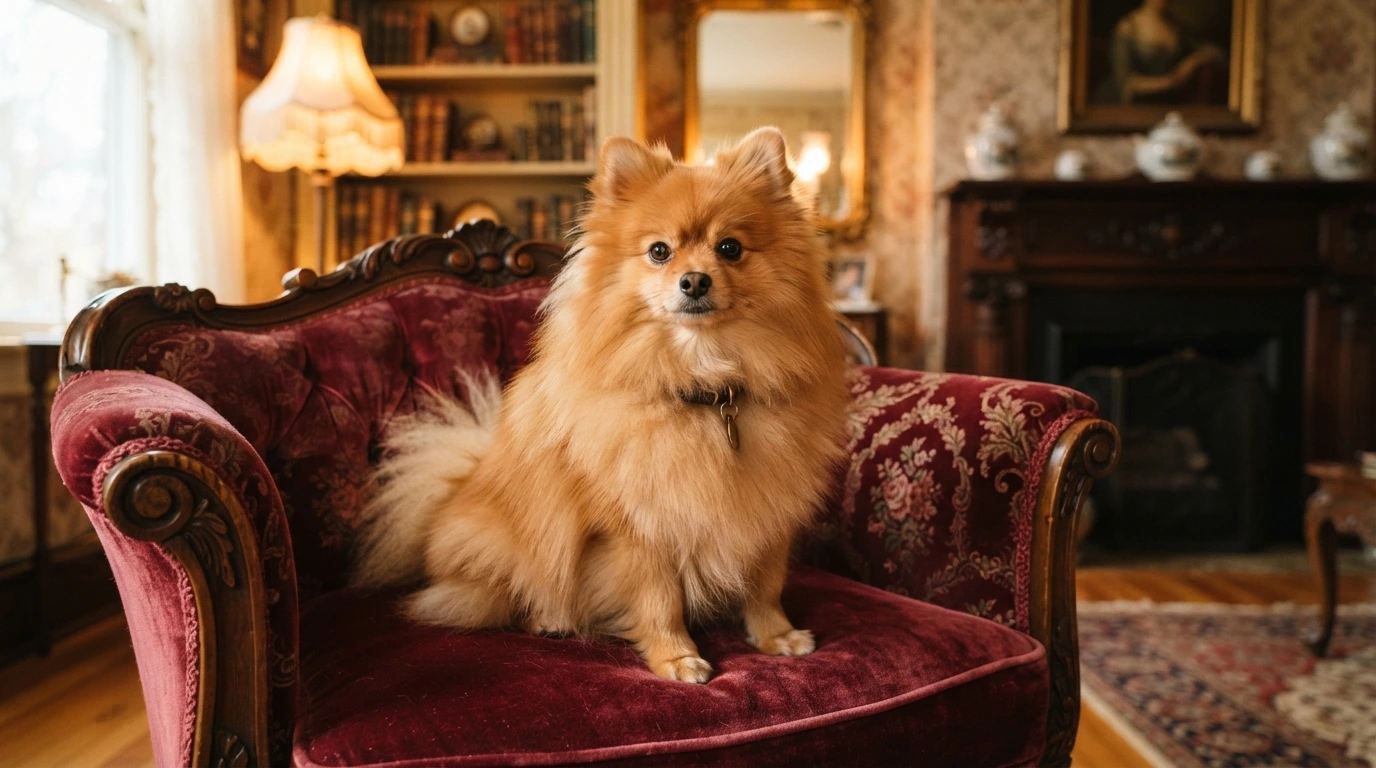
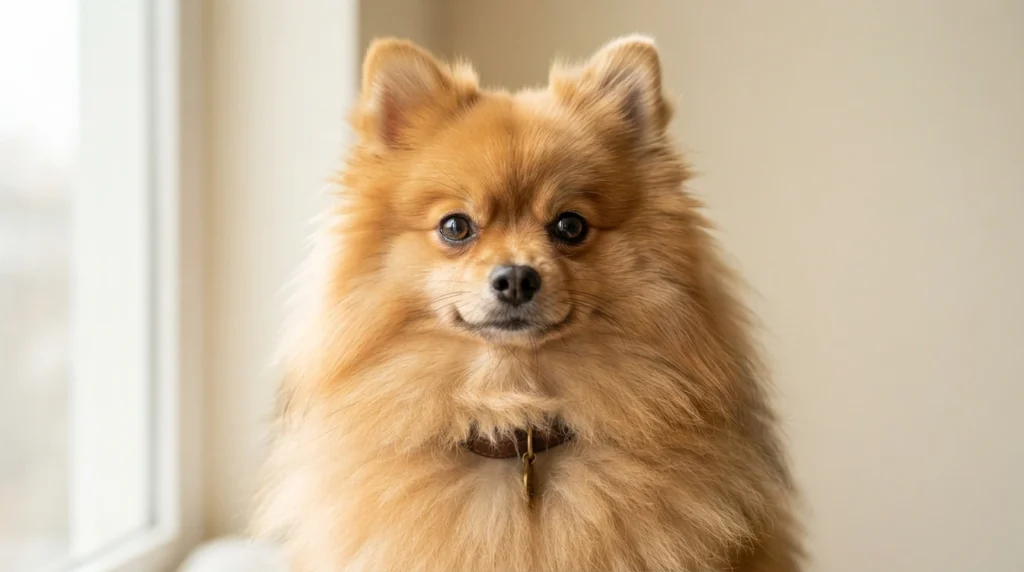
The Pomeranian’s most recognizable trait is its dense double coat, an outer layer of long, harsh guard hairs over a soft, thick undercoat, which stands away from the body to create the breed’s signature “fluff.” The face is fox-like, with small erect ears and an alert, expressive look, and the plumed tail curls up and over the back in classic spitz fashion. The breed comes in an unusually wide color range, including orange, red, cream, black, and numerous other patterns and combinations, more color variety than most toy breeds offer.
Temperament
Pomeranians are bold, confident, and often seem entirely unaware that they weigh less than most house cats. That “small dog, big personality” trait means Pomeranians will readily bark at, challenge, or investigate things far larger than themselves, a trait that makes them excellent, highly alert watchdogs but one that also needs early management to prevent excessive barking from becoming a persistent habit. With family, most Pomeranians are affectionate and enjoy being included in daily activities, and their intelligence and alertness mean they generally do best with owners who provide consistent mental engagement rather than treating them as purely decorative companions.
Is a Pomeranian Right for You?
The Pomeranian adapts well to apartment living and doesn’t need much space, making it a popular urban companion. That said, its small size makes it genuinely fragile, similar to other toy breeds covered elsewhere in this guide series, and falls, rough handling, or an accidental step can cause serious injury. Most breeders and veterinarians recommend against Pomeranians in households with very young children who can’t yet be trusted to handle a small, delicate dog gently. Despite the tiny frame, this isn’t a low-engagement breed: Pomeranians are intelligent and alert, and they do best with owners who provide regular mental stimulation, training, and companionship rather than leaving them to their own devices for long stretches.
Training
Pomeranians are intelligent and generally food-motivated, which makes basic training approachable, though the breed’s confident, sometimes willful streak means consistency matters more than force. Positive reinforcement, kept short and upbeat, tends to work best. Housebreaking often takes longer in toy breeds generally, Pomeranians included, partly due to their small bladder capacity, so patience and a consistent schedule matter more than corrections. Early socialization and consistent redirection of barking triggers help manage the breed’s natural watchdog alertness before it becomes an overused response to every passerby.
Exercise Needs
Physical exercise needs are modest: short daily walks and indoor or yard play are typically sufficient to keep a Pomeranian physically satisfied. Mental stimulation matters just as much as physical activity, puzzle toys, short training sessions, and varied walking routes all help prevent the boredom-driven barking and mischief this breed can develop when under-stimulated.
Grooming: Managing the Double-Coat “Fluff”
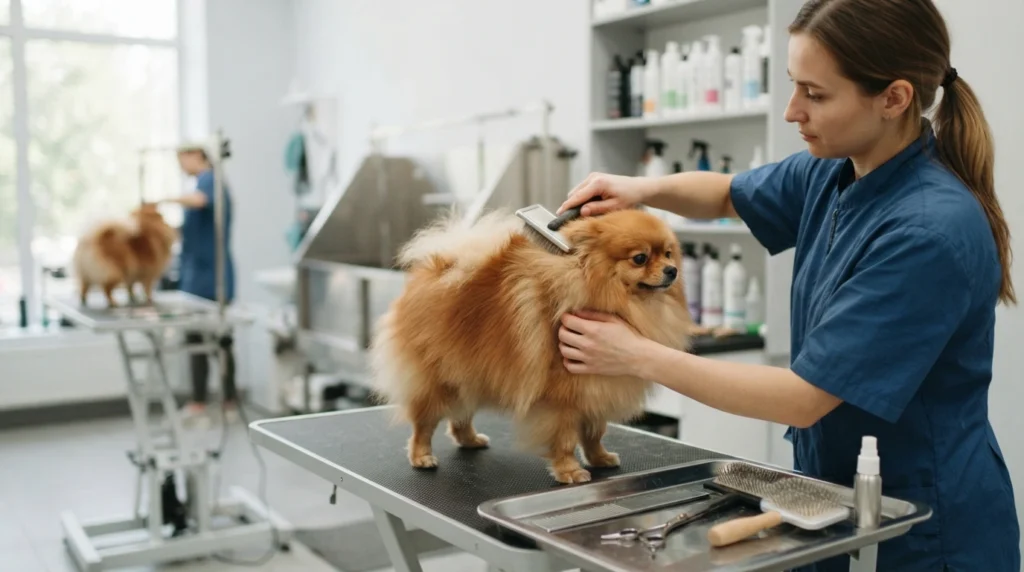
The glamorous, fully “fluffed” Pomeranian coat seen in show photos and social media takes real, ongoing work to maintain, and buyers drawn purely by those photos are often surprised by the actual time commitment. The dense double coat needs brushing two to three times a week to prevent matting and tangling, particularly around the neck ruff and britches, and during seasonal “coat blow” periods, typically once or twice a year, daily brushing becomes close to necessary as the undercoat sheds heavily. Regular bathing helps maintain the coat’s texture and volume, and many owners opt for professional grooming every 6 to 8 weeks to manage the coat properly, especially if aiming for the fuller, rounded “teddy bear” look rather than a shorter practical trim. This is a much higher-maintenance coat than its small size might suggest.
Health and Lifespan: Small Size, Real Risks
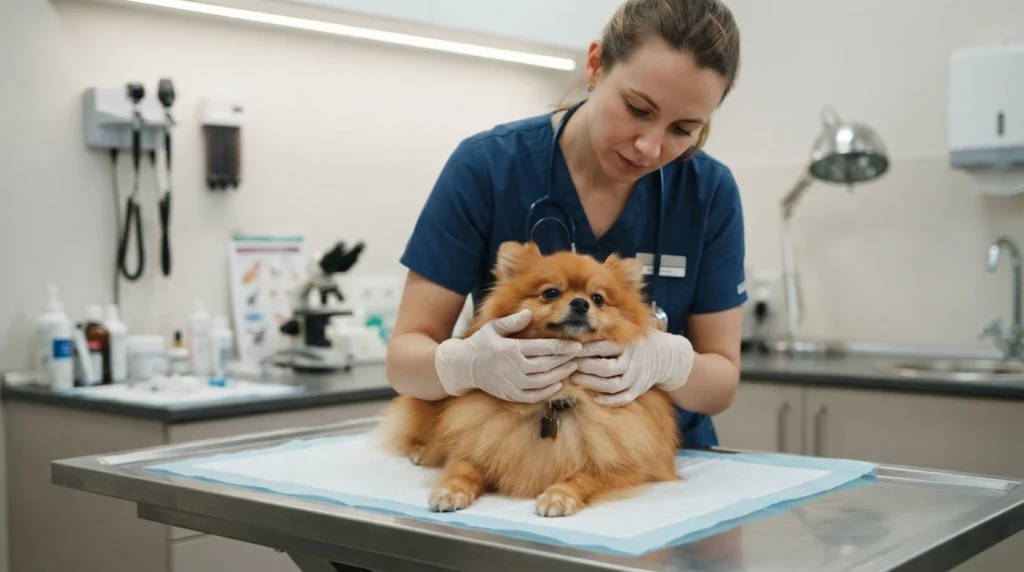
Tracheal collapse is one of the more consequential and, unfortunately, common conditions in toy breeds, and Pomeranians are no exception. It occurs when the cartilage rings supporting the windpipe weaken and flatten, producing a distinctive dry, honking cough, often triggered by excitement, exercise, or pulling against a collar. The single most effective preventive step an owner can take is switching from a collar to a harness for walks, since pressure on the throat directly aggravates the condition, and this is a change worth making proactively rather than waiting for symptoms to appear. Mild cases are often managed with weight control and environmental adjustments, while more severe cases may require medication or, in rare cases, surgery, so any persistent honking cough warrants a veterinary evaluation rather than being dismissed as a quirk.
[FUTURE LINK: canine tracheal collapse guide]
Periodontal disease is dramatically more common in toy breeds generally, Pomeranians included, since a full set of adult teeth crowds into a proportionally small jaw, making plaque buildup and early tooth loss common without consistent dental care. Luxating patella, a kneecap that slips out of its normal groove, is another common small-breed orthopedic issue, ranging from a minor intermittent problem to one requiring surgical correction. Pomeranians are also associated with a condition called alopecia X, sometimes called “black skin disease,” a poorly understood hormonal and coat disorder that causes progressive hair loss and skin darkening, typically starting on the trunk and hind legs; it’s not painful or life-threatening, but it does require veterinary diagnosis to rule out other causes of hair loss, since conditions like thyroid disease and Cushing’s disease can produce similar symptoms and need to be ruled out first.
One issue deserves the same direct treatment given elsewhere in this guide series: “teacup” Pomeranians. Teacup is not a recognized size classification by the AKC or any legitimate breed standard, it’s a marketing term applied to dogs bred smaller than the standard, often from the runts of litters rather than selected for health. Breeding deliberately for extreme smallness meaningfully raises the risk of juvenile hypoglycemia, organ and skeletal defects, and a shortened lifespan, and a “teacup” label should prompt more scrutiny of a breeder’s health-testing practices, not less. Buyers weighing this breed against similarly tiny toy breeds like the Chihuahua should know the same “teacup” caution applies across the toy-breed category broadly, not just to Pomeranians specifically.
[FUTURE LINK: Chihuahua breed guide] With attentive dental care, weight management, and awareness of tracheal health, a well-bred Pomeranian commonly lives a full 12 to 16 years, among the longer lifespans in the toy-breed world.
Nutrition
Very young Pomeranian puppies, particularly smaller individuals, are prone to hypoglycemia and benefit from small, frequent meals rather than one or two large ones until they’re better able to regulate blood sugar between feedings. A toy-breed-formulated food with appropriately sized kibble supports both nutrition and dental health, and portion control matters more than it might seem given how small proportional weight gain can be on a 3-to-7-pound frame.
Cost and Adoption
A Pomeranian puppy from a reputable, health-tested breeder typically costs $1,500 to $3,000; “teacup” marketed puppies are sometimes priced higher despite carrying more health risk, not less, which is worth remembering when evaluating a listing. Annual costs, including food, routine veterinary care, and grooming, generally run $1,200 to $2,000, with professional grooming and dental cleanings representing two of the more consistent recurring expenses that first-time toy-breed owners sometimes underestimate when budgeting.
Common Buyer Mistakes
- Paying a premium for a “teacup” label. Extreme smallness is a health liability, not a bonus feature; verify a breeder’s health-testing practices rather than paying more for a riskier dog.
- Underestimating grooming time and cost. The full double coat needs regular brushing and periodic professional grooming; skipping this leads to painful matting.
- Using a collar instead of a harness. Given the breed’s tracheal collapse risk, this small switch is one of the most protective things an owner can do.
- Ignoring an early honking cough. Persistent coughing warrants veterinary evaluation rather than being written off as normal small-dog behavior.
- Skipping dental care. Toy-breed dental disease progresses quickly without routine cleanings and at-home brushing.
- Getting a Pomeranian for a home with very young children. The size mismatch creates real injury risk for the dog, a pairing generally discouraged by breeders and veterinarians alike.
FAQ
Why did Pomeranians get smaller?
Queen Victoria imported a small Pomeranian in 1888 and actively bred for smaller size, and British breeders quickly followed her lead. Within a few decades, the breed’s average size had dropped by roughly half from its original 20-to-30-pound sled-dog-type ancestors.
Is a teacup Pomeranian safe to buy?
“Teacup” isn’t a recognized size class; it describes dogs bred deliberately smaller than the standard, which raises the risk of hypoglycemia, organ defects, and a shortened lifespan. Treat the label as a red flag prompting more scrutiny, not a premium feature.
What does tracheal collapse sound like?
A dry, honking cough, often triggered by excitement, exercise, or pressure on the throat from a collar. Switching to a harness is one of the most effective preventive steps an owner can take.
How is a Pomeranian different from an American Eskimo Dog?
Both are spitz-family breeds sharing pointed ears, dense double coats, and curled tails, but they developed separately and differ significantly in size, the American Eskimo Dog is considerably larger than the toy-sized Pomeranian.
How long do Pomeranians live?
Typically 12 to 16 years, among the longer lifespans for a toy breed, especially with attentive dental care and tracheal-health awareness.
Do Pomeranians shed a lot?
Yes, moderately year-round with heavier seasonal “coat blow” periods once or twice a year, when daily brushing becomes close to necessary to manage the loose undercoat.
How much does a Pomeranian cost to own?
Expect $1,500 to $3,000 for a health-tested puppy and roughly $1,200 to $2,000 annually thereafter, with grooming and dental care as consistent recurring costs.
Conclusion
The Pomeranian’s journey from a 20-to-30-pound Baltic sled dog to a pocket-sized royal favorite is a genuinely remarkable piece of deliberate breeding history, and the bold, alert personality that made it such a compelling companion never got smaller along with the body. Prospective owners who understand that combination, real grooming demands, real toy-breed health risks like tracheal collapse, and a personality entirely unaware of its own size, tend to be well matched with the breed. Go in informed, skip the “teacup” premium, and the Pomeranian delivers an outsized amount of personality and companionship in one of the smallest, fluffiest, most historically unlikely packages in the dog world.