Miniature Schnauzer: Complete Breed & Health Guide
Quick Facts
| Attribute | Detail |
| Group | AKC Terrier Group |
| Height | 12–14 in |
| Weight | 11–20 lb |
| Lifespan | 12–15 years |
| Coat | Wiry double coat, low-shedding |
| Colors | Salt and pepper, black, black and silver |
| Temperament | Spirited, intelligent, alert, affectionate |
| Best suited for | Owners ready for real grooming commitment and a genuine terrier personality |
The Miniature Schnauzer is a compact, bearded terrier built for farm work and scaled down for household life without losing its working instincts. Its wiry coat and unmistakable eyebrows and beard get most of the attention, but the more useful story for a prospective owner is what that coat actually requires to maintain, and a health picture defined less by dramatic disease and more by a very specific, very manageable dietary sensitivity that deserves real attention.
History: Bavaria’s All-Purpose Farm Ratter
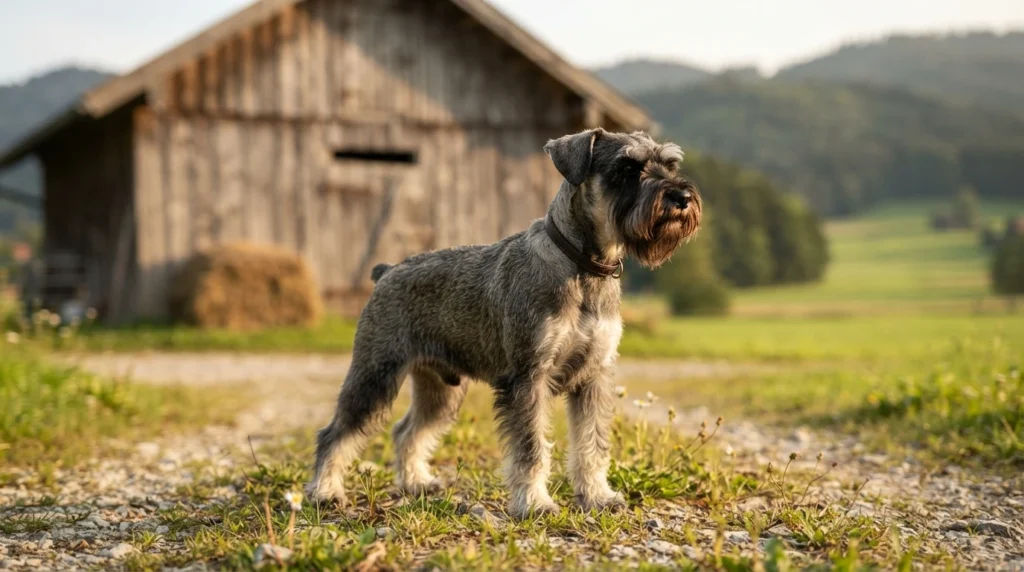
The Miniature Schnauzer developed in 19th-century Bavaria and other parts of Germany as farmers looked for a smaller, more economical version of the Standard Schnauzer, a breed already valued for ratting, guarding, and general farm utility. Breeders crossed Standard Schnauzers with smaller breeds, most likely including the Affenpinscher and Poodle, to produce a compact dog that retained the ratting instinct and alert temperament of its larger relative while requiring less food and space, a meaningful consideration for smallholding farmers. The breed’s name comes directly from the German word “schnauze,” meaning muzzle or snout, a fitting reference to the pronounced bearded, whiskered face that remains the breed’s most recognizable trait.
Miniature Schnauzers were first exhibited separately from Standard Schnauzers in Germany in the early 1900s, and the breed crossed into the United States not long after, gaining American Kennel Club recognition in 1926. Its combination of small size, low-shedding coat, and spirited but manageable temperament helped it become one of the most consistently popular terrier breeds in the US throughout the 20th century and into today, a farm dog whose practical, unfussy origins belie its current status as a favorite urban and suburban companion.
Early breed standards placed heavy emphasis on the dog’s ratting ability alongside its appearance, and 19th-century German breeders reportedly tested candidate dogs against live rats before including them in breeding programs, a practical selection method that shaped both the breed’s confident temperament and its keen, fast reflexes. That working-trial approach faded as the breed transitioned into a companion role through the 20th century, but the instincts it left behind, quick reactions, strong prey drive toward small animals, and an alert, watchful nature, remain clearly visible in the modern Miniature Schnauzer, even in dogs who have never seen a rat in their lives.
Miniature vs. Standard vs. Giant Schnauzer: Three Separate Breeds
A common misconception is that Miniature, Standard, and Giant Schnauzers are simply three sizes of the same dog. They aren’t. All three are separately recognized breeds by the AKC, each developed for a different original purpose: the Miniature for ratting and small-farm work, the Standard as the original all-purpose farm and guard dog from which the other two were developed, and the Giant for cattle-droving and serious guard duty in Bavaria and Württemberg. They share the same distinctive bearded look and general temperament traits, but a buyer choosing between them should think of it as choosing between three different breeds with different exercise needs, guarding instincts, and household suitability, not simply picking a size.
[FUTURE LINK: Standard Schnauzer breed guide]
[FUTURE LINK: Giant Schnauzer breed guide]
Miniature Schnauzer vs. Poodle vs. Bichon Frise
Buyers drawn to the Miniature Schnauzer’s low-shedding coat often compare it against other popular low-shedding small companion breeds. All three make strong choices for allergy-sensitive households, but their coat texture, grooming style, and terrier-versus-non-terrier temperaments differ meaningfully.
| Attribute | Miniature Schnauzer | Poodle (Toy/Miniature) | Bichon Frise |
| Origin | Germany | Germany/France | France |
| Weight | 11–20 lb | 4–15 lb | 12–18 lb |
| Coat | Wiry double coat | Dense, curly | Soft, curly, dense |
| Temperament | Spirited terrier | Alert, highly trainable | Cheerful, sociable |
| Shedding | Minimal | Minimal | Minimal |
See our full guides to the Poodle, the Bichon Frise, and its larger terrier cousin the Airedale Terrier for a broader comparison.
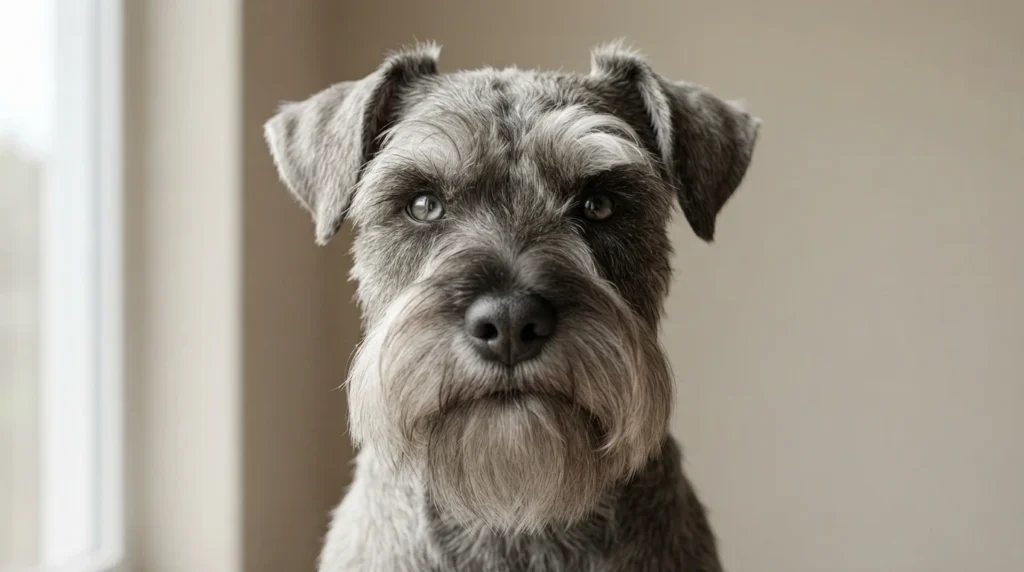
Appearance
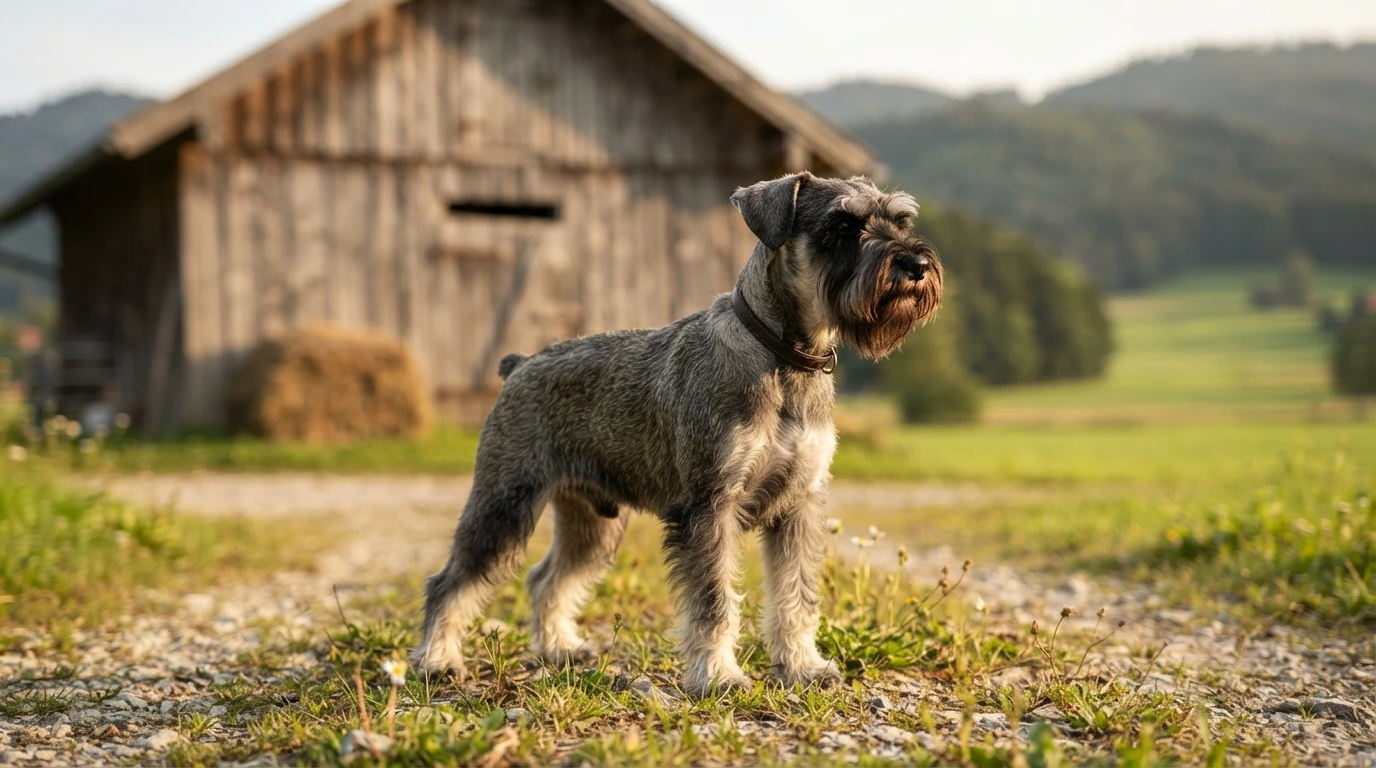
The Miniature Schnauzer’s signature look comes from its wiry, double-layered coat, particularly the pronounced eyebrows and beard that give the breed its distinctive, almost human-like expressiveness. Correct coloring is salt and pepper, solid black, or black and silver, with a compact, square-proportioned body built more for sturdy agility than speed. Ears were traditionally cropped to stand erect and the tail docked short, though both are cosmetic traditions rather than health necessities, and cropping in particular has become considerably less common as breeders and owners increasingly favor natural, folded ears.
Temperament
Miniature Schnauzers carry genuine terrier spirit: alert, spunky, and quick to notice anything unusual, which makes them excellent natural watchdogs but also means barking can become a habit without early management. With family, most Miniature Schnauzers are deeply affectionate and eager to be involved in whatever’s happening, often following owners from room to room. Their intelligence and alertness mean they need mental engagement to stay well-adjusted; a bored Miniature Schnauzer, like many terriers, tends to find its own entertainment through digging, barking, or general mischief rather than settling quietly. The breed’s ratting heritage also means a real prey drive toward small, fast-moving animals, so households with pet rodents, rabbits, or birds should introduce a Miniature Schnauzer carefully and supervise interactions closely, even in an otherwise well-socialized dog.
Is a Miniature Schnauzer Right for You?
The Miniature Schnauzer adapts well to apartment and family life alike, and its low-shedding coat makes it a popular choice for allergy-sensitive households. That said, prospective owners should understand the grooming commitment is real and ongoing rather than occasional, covered in detail below, and budget both time and money accordingly. The breed generally does well with children and other pets when properly socialized, and its moderate size and manageable exercise needs make it a flexible fit for a range of households, from active families to quieter single-owner homes, provided its mental stimulation needs are met. Renters and apartment dwellers should also weigh the breed’s watchdog barking tendency honestly against their living situation, since shared walls and thin ceilings can turn an otherwise manageable trait into a genuine source of neighbor friction without early training.
Training
Miniature Schnauzers are intelligent and generally food-motivated, which makes basic training approachable, though the breed’s terrier stubbornness can surface, particularly around recall and impulse control with small animals given its ratting heritage. Positive reinforcement methods, kept short and consistent, tend to work best. Early socialization and consistent redirection of barking triggers help manage the breed’s natural watchdog alertness before it becomes a persistent nuisance behavior.
Exercise Needs
Exercise needs are moderate: daily walks combined with active play sessions are generally sufficient to keep a Miniature Schnauzer physically satisfied. That said, this is still a genuine terrier with real energy and a working heritage, and a dog left without any outlet for that energy, physical or mental, is prone to developing the digging and barking habits terriers are known for.
Grooming: Hand-Stripping vs. Clipping, and What It Actually Costs
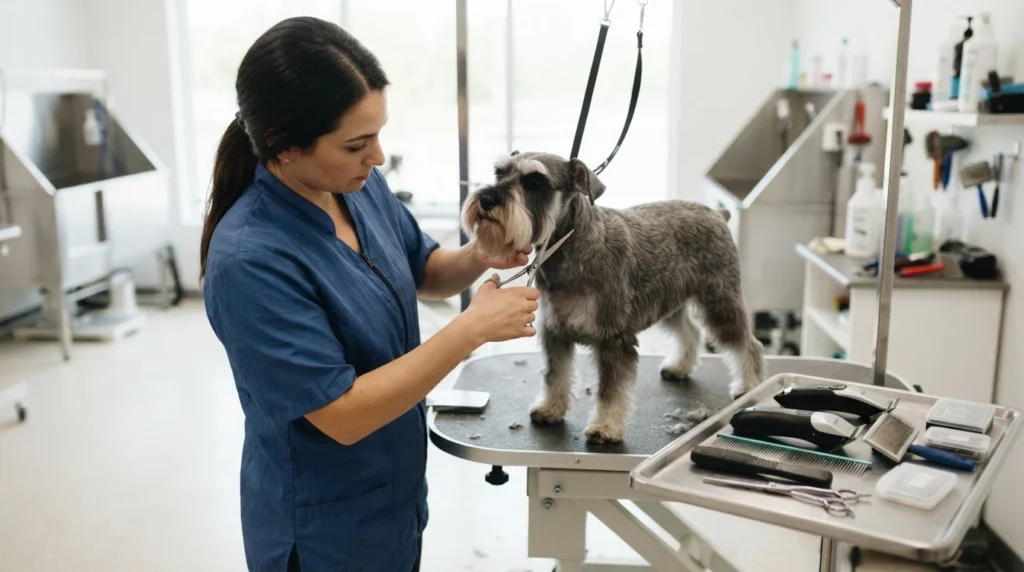
The Miniature Schnauzer’s wiry coat can be maintained two fundamentally different ways, and the choice has real cost and appearance consequences most buyers don’t fully understand going in. Hand-stripping, plucking dead outer hairs by hand or with a stripping tool rather than cutting them, preserves the coat’s harsh, wiry texture and vivid coloring, and is the method used for show dogs, but it takes considerably longer, requires a specialist groomer, and typically costs more per session. Clipping is faster, cheaper, and far more common for pet Miniature Schnauzers, but repeated clipping gradually softens the coat’s texture and fades its color over successive grooming cycles, a tradeoff worth knowing about before committing to one method or the other. Whichever method you choose, professional grooming every 4 to 6 weeks is typical, and the breed’s beard needs near-daily attention, wiping after meals and regular combing, to prevent food debris and bacteria buildup that can otherwise lead to skin irritation around the mouth.
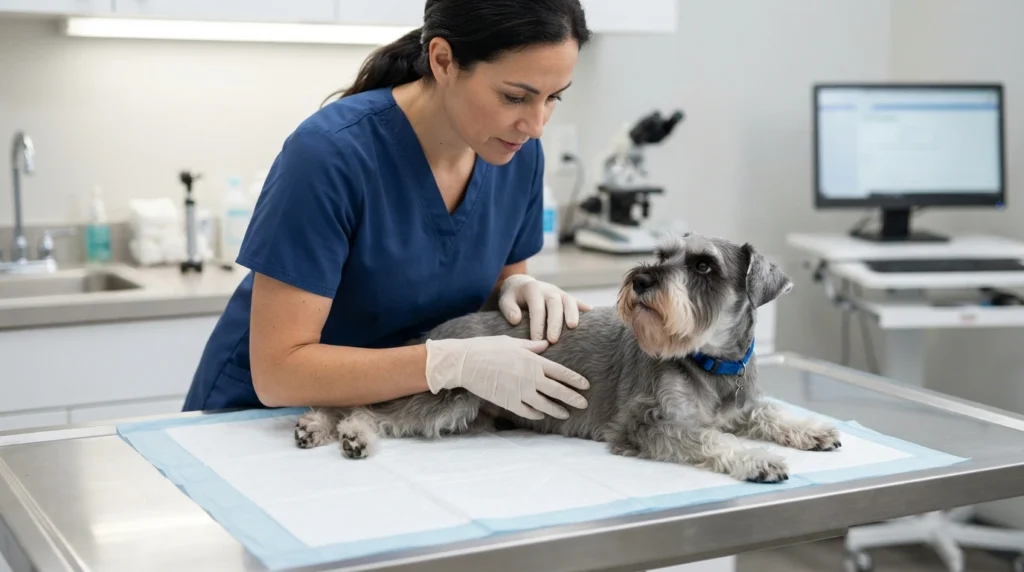
Health and Lifespan: The Fat-Sensitivity Connection
Miniature Schnauzers carry a distinctive skin condition called comedone syndrome, sometimes described as “Schnauzer bumps,” in which follicles along the back become blocked and form blackhead-like bumps, occasionally progressing to small cysts or infections. It’s generally more of a cosmetic and maintenance issue than a serious health threat, managed with medicated shampoos and regular skin checks, but it’s common enough in the breed that owners should expect it as a routine part of ownership rather than a surprising abnormality.
The more consequential health fact for this breed is its well-documented sensitivity to dietary fat. Miniature Schnauzers have a notably higher rate of hyperlipidemia, elevated fat levels in the blood, than most breeds, and that predisposition directly raises the risk of pancreatitis, a painful and potentially serious inflammation of the pancreas that can be triggered by a single fatty meal or ongoing high-fat feeding. This isn’t a minor footnote; it’s one of the most actionable health facts a Miniature Schnauzer owner can act on. Consistently avoiding fatty table scraps, choosing a lower-fat commercial diet formulated with the breed’s needs in mind, and being especially cautious around holiday meals and high-fat treats meaningfully reduces pancreatitis risk in a way that’s entirely within an owner’s control. The breed also shows an elevated predisposition to calcium oxalate bladder stones, which is worth discussing with a veterinarian regarding diet and hydration, particularly for dogs who’ve had a prior stone episode. With attentive diet management and routine veterinary care, Miniature Schnauzers commonly live a full 12 to 15 years, among the longer lifespans in the small-breed world.
Recognizing early pancreatitis symptoms is worth knowing, since prompt treatment meaningfully affects outcomes. Warning signs include vomiting, a hunched or “praying” posture with the front end lowered and rear raised, abdominal pain, lethargy, and reduced appetite, particularly following a fatty meal or dietary indiscretion. Any combination of these symptoms warrants same-day veterinary attention rather than a wait-and-see approach, since pancreatitis can escalate quickly and, in severe cases, become life-threatening. Owners who know their dog has had a prior episode should treat future dietary lapses with real caution, since a history of pancreatitis raises the risk of recurrence.
Nutrition
Given the breed’s documented fat sensitivity, diet deserves more deliberate attention here than in an average breed. A consistent, lower-fat commercial diet, portioned reliably rather than free-fed, and a firm household rule against fatty table scraps are genuinely protective health measures in this breed, not just general good practice. Owners should discuss specific fat-content targets with their veterinarian, especially for dogs with a personal or family history of pancreatitis. It’s also worth extending this discipline to the whole household: well-meaning guests or children sharing food from the table are a common, easily overlooked source of the fatty-food exposure that triggers pancreatitis episodes, so setting clear expectations with visitors is a small but genuinely protective habit.
Cost and Adoption
A Miniature Schnauzer puppy from a reputable, health-tested breeder typically costs $1,000 to $2,500. Annual costs, including food, routine veterinary care, and grooming, generally run $1,200 to $2,000, with professional grooming representing one of the more consistent recurring expenses, particularly if hand-stripping is chosen over clipping. Buyers should factor grooming cost realistically into their long-term budget rather than treating it as an occasional expense, since this breed’s coat genuinely requires regular professional maintenance to stay healthy and comfortable.
Common Buyer Mistakes
- Underestimating grooming cost and frequency. Professional grooming every 4 to 6 weeks is typical, and skipping it leads to matting and beard hygiene problems.
- Feeding fatty table scraps. Given this breed’s documented pancreatitis risk, this is one of the more consequential everyday mistakes an owner can make.
- Confusing Miniature, Standard, and Giant Schnauzers. These are three separate breeds with different needs, not size variants of one dog.
- Neglecting beard hygiene. Food and bacteria buildup in the beard, if not cleaned regularly, can lead to skin irritation around the mouth.
- Assuming a small dog means low exercise needs. This is a genuine terrier with real energy; under-exercising it leads to digging and barking behaviors.
- Not asking a breeder about the coat method they raise puppies for. Hand-stripped and clipping-raised lines can differ in coat texture expectations, worth clarifying before purchase.
FAQ
Are Miniature Schnauzers hypoallergenic?
No dog is truly hypoallergenic, but Miniature Schnauzers have a wiry double coat that sheds minimally, making them a popular choice for allergy-sensitive households. Individual reactions still vary, so spending time with the breed beforehand is worthwhile.
What’s the difference between a Miniature, Standard, and Giant Schnauzer?
They’re three separate AKC-recognized breeds, not size variants of one. Each was developed for a different original purpose: ratting for the Miniature, general farm work for the Standard, and cattle-droving/guarding for the Giant.
Why do Schnauzers get bumps on their back?
This is comedone syndrome, a follicular condition common in the breed that causes blackhead-like bumps along the back. It’s generally cosmetic and manageable with medicated shampoos and regular skin checks.
Is hand-stripping or clipping better for a Miniature Schnauzer?
Hand-stripping preserves the coat’s wiry texture and color but costs more and takes longer; clipping is faster and cheaper but gradually softens texture and fades color over time. Neither is objectively “better” — it depends on your priorities, your budget, and whether you plan to show the dog.
How long do Miniature Schnauzers live?
Typically 12 to 15 years, among the longer lifespans for a small breed, especially with attentive diet management and regular veterinary checkups given the breed’s fat sensitivity.
Do Miniature Schnauzers bark a lot?
They can. Strong terrier alertness makes them excellent natural watchdogs, but that same instinct means barking triggers, doorbells, passersby, other animals, need consistent early training to manage.
How much does a Miniature Schnauzer cost to own?
Expect $1,000 to $2,500 for a health-tested puppy and roughly $1,200 to $2,000 annually thereafter, with professional grooming as a genuine recurring cost that scales up if you choose hand-stripping over clipping.
Conclusion
The Miniature Schnauzer’s bearded, expressive face has made it one of the most recognizable small breeds in the world, but the working terrier underneath that distinctive look still needs real mental and physical engagement. Prospective owners who understand the genuine grooming commitment, the actionable dietary-fat connection to pancreatitis risk, and the breed’s real terrier alertness tend to be well matched with this dog. Go in prepared for the beard maintenance and the low-fat feeding discipline, and the Miniature Schnauzer delivers a spirited, deeply loyal companion built to last well into its mid-teens, beard, bumps, barking, and all.