Cavalier King Charles Spaniel: Breed & Health Guide
A wealthy American who never owned one of these dogs is arguably the reason the modern Cavalier King Charles Spaniel exists at all. In 1926, Roswell Eldridge offered British breeders a small fortune in silver to recreate a type of spaniel that had all but vanished — a dog he knew only from 300-year-old royal portraits. He died before his gamble paid off. This guide covers that genuinely improbable rescue story, the breed’s famously affectionate temperament, and the honest, unflinching health guidance every prospective owner needs — because few popular breeds carry a hereditary health burden as severe, or as directly tied to their own history, as this one.

Cavalier King Charles Spaniel Quick Facts
The Cavalier King Charles Spaniel is a small, silky-coated toy breed developed as a companion dog, prized for its gentle, adaptable temperament and its striking royal ancestry.
| Attribute | Detail |
| AKC Group | Toy Group |
| Country of Origin | England |
| Height | 12–13 in |
| Weight | 13–18 lb |
| Lifespan | 9–14 years typical range; often shortened by heart disease |
| Coat | Silky, medium-length, slightly wavy |
| Colors | Blenheim (chestnut and white), tricolor, black and tan, ruby |
| Temperament | Affectionate, gentle, eager to please, adaptable |
History: A Royal Companion, Nearly Bred Out of Existence
The breed takes its name from King Charles II, who came to the throne in 1661 and was rarely seen without small spaniels underfoot — a devotion captured repeatedly in court portraits by Anthony van Dyck, which show longer-nosed, flatter-domed spaniels quite different from the dog we know today. Those portraits matter enormously to this breed’s story, because they later became the literal blueprint for its recreation.
Through the late 1600s and into the 1800s, breeders crossed the original royal spaniel type with flatter-faced breeds like the Pug, gradually producing a shorter-muzzled, more domed-skull dog. By the 19th century, this transformed spaniel — what we now call the King Charles Spaniel, or English Toy Spaniel — had entirely replaced the longer-faced original in fashionable circles. The dog in Van Dyck’s paintings had, in effect, gone extinct.
In 1926, an American named Roswell Eldridge decided to do something about it. He placed an advertisement in a British dog show catalog offering 25 pounds of sterling silver — a genuinely substantial prize at the time — for the best male and female “Blenheim Spaniels of the old type, as shown in pictures of Charles II’s time: long face, no stop, flat skull, not inclined to be domed.” British breeders were reportedly appalled at the idea of reviving what they considered an outdated look, but several entered dogs anyway. Eldridge died before seeing the project succeed, but the seed was planted: in 1928 the first Cavalier club formed, built around a foundation dog named Ann’s Son, and in 1945 the UK Kennel Club finally recognized the Cavalier King Charles Spaniel as a distinct breed from its flat-faced cousin.
Cavalier vs. King Charles Spaniel: Not the Same Breed
These two names cause genuine confusion, and it’s worth clearing up directly. The King Charles Spaniel (called the English Toy Spaniel in the US) is the flat-faced, domed-skull descendant that never went away — the breed produced by that 17th-to-19th-century crossbreeding trend. The Cavalier King Charles Spaniel is the separate, later breed deliberately recreated to match the older, longer-nosed look from the royal portraits. Today the AKC recognizes both as distinct breeds with different standards, different faces, and different health profiles. If you’ve seen both side by side without knowing the history, the family resemblance — and the reason for it — should now make a lot more sense.
[FUTURE LINK: King Charles Spaniel (English Toy Spaniel) breed guide]
Cavalier vs. Cocker Spaniel vs. American Cocker Spaniel
The Cavalier shares spaniel ancestry and a similarly gentle, people-oriented temperament with the Cocker Spaniel and the American Cocker Spaniel, though the Cavalier is smaller and was bred purely for companionship rather than fieldwork.
| Attribute | Cavalier King Charles Spaniel | Cocker Spaniel | American Cocker Spaniel |
| Origin | England | England | United States |
| Size | Toy (13–18 lb) | Small-medium (26–34 lb) | Small (20–30 lb) |
| Original purpose | Royal companion | Flushing game birds | Flushing game birds |
| Coat | Silky, medium-length | Silky, medium-length | Silky, long, dense |
| Signature trait | Royal portrait history | Merry, active temperament | Domed head, gentle nature |
Appearance
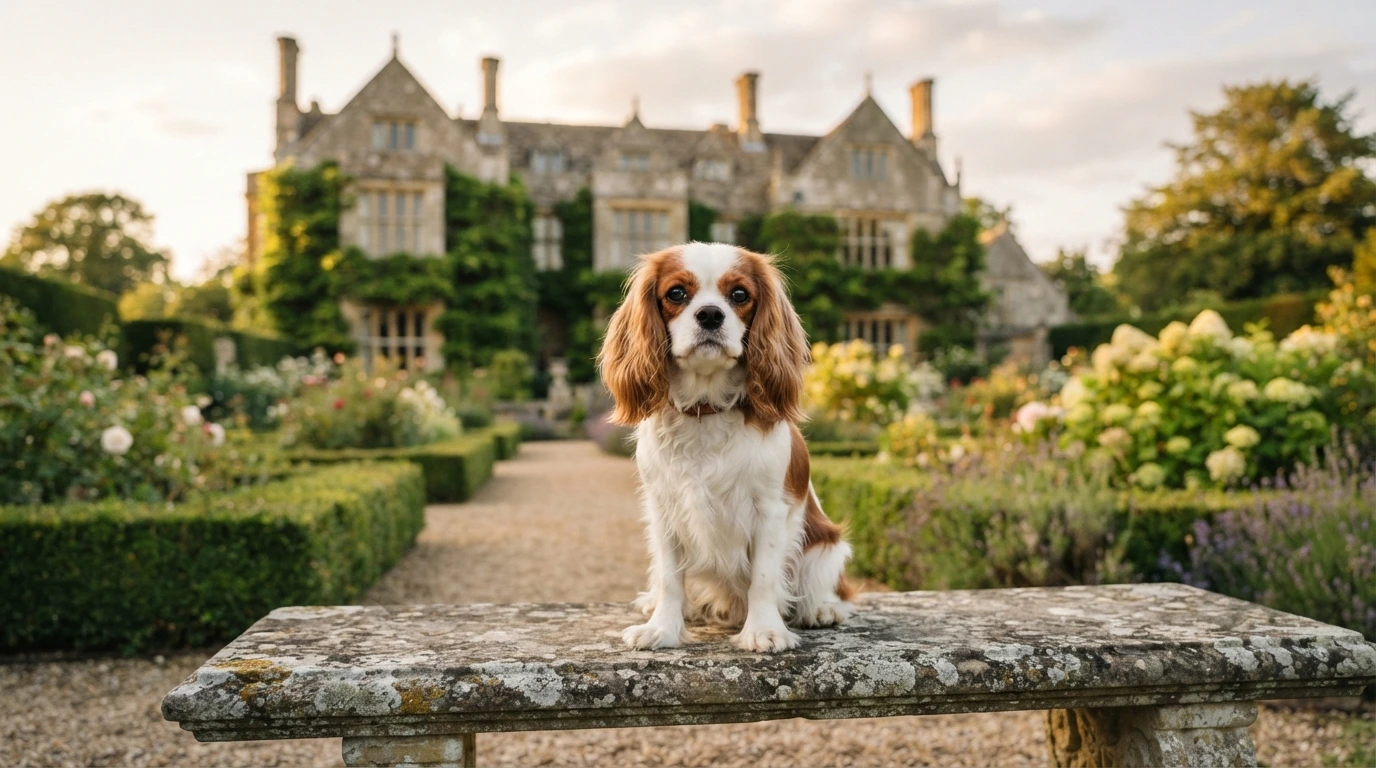
The Cavalier is a small, well-balanced toy dog with a silky, slightly wavy medium-length coat, long feathered ears, and large, dark, round eyes that give the breed its famously soft, appealing expression. The AKC recognizes four color patterns: Blenheim (rich chestnut markings on a pearly white background), tricolor (black and white with tan markings), black and tan, and ruby (solid rich red).

Temperament
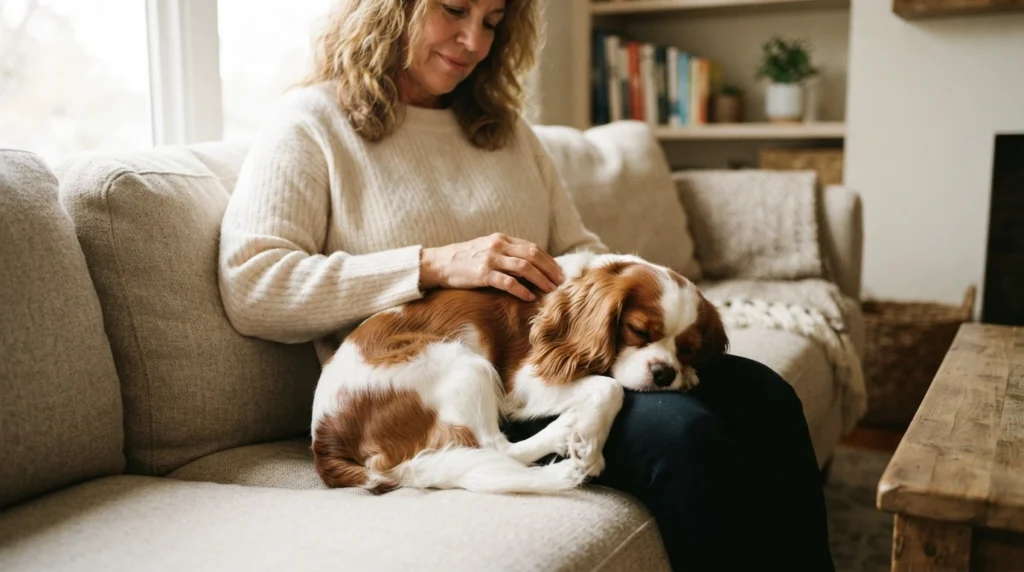
The Cavalier King Charles Spaniel is affectionate, gentle, and eager to please almost to a fault — this is a breed with minimal guarding instinct and an enthusiastic, indiscriminate friendliness toward strangers, children, other dogs, and often cats. Adaptable to nearly any household, from quiet apartments to bustling families, the Cavalier’s defining trait is a near-total orientation toward human companionship.
Is a Cavalier King Charles Spaniel Right for You?
Cavaliers are typically wonderful family dogs, gentle with children and always eager to be wherever their people are. Their small size and moderate exercise needs make them well suited to apartment living, and their friendly nature makes them poor watchdogs but excellent companions.
Two honest considerations matter before committing. First, this is a breed prone to real separation anxiety — a Cavalier left alone for long stretches regularly can develop genuine distress, not just mild fussing. Second, and more seriously, this is a breed whose most likely health outcomes are already well documented and severe, covered fully below. Committing to a Cavalier means committing to proactive veterinary screening as a normal, ongoing part of ownership, not an occasional afterthought.
Training
Cavaliers are intelligent and eager to please, which makes them responsive to positive, reward-based training, though their soft temperament means harsh correction backfires easily. Early socialization is straightforward given the breed’s naturally friendly disposition; the bigger training challenge is usually building independence and confidence to reduce separation-anxiety risk.
Exercise Needs
Cavaliers need moderate daily exercise — a couple of walks and some play are generally sufficient, reflecting the breed’s companion-dog purpose rather than a working heritage. This is considerably less demanding than higher-energy spaniel relatives like the English Springer Spaniel, making the Cavalier a better fit for less active households.
Grooming
The Cavalier’s silky coat needs regular brushing, two to three times weekly, to prevent matting, especially around the ears and feathering. Those long, heavy ears also trap moisture and debris, so routine ear checks and cleaning matter more for this breed than for many others — infections here are common if care lapses.
Health and Lifespan: The Skull, the Heart, and Syringomyelia
Cavaliers typically live 9 to 14 years, though in practice the breed’s two defining health conditions frequently shorten that range. Both are directly connected to the very traits — a domed, compact skull and a devoted, popular bloodline built from a relatively narrow founding population — that make this breed what it is.
| Condition | What it is | What owners should watch for |
| Mitral valve disease (MVD) | Progressive degeneration of the heart’s mitral valve; the leading cause of death in the breed | Heart murmur (often first detected by a vet), coughing, exercise intolerance, labored breathing |
| Syringomyelia (SM) | Fluid-filled cavities forming in the spinal cord, linked to skull conformation | Scratching at the neck/shoulder without contact (“phantom scratching”), yelping, sensitivity to touch, reluctance to be picked up |
| Chiari-like malformation (CM) | Skull too small for the brain, causing partial cerebellar herniation; a precursor condition to SM | Often asymptomatic alone; screened via MRI |
| Patellar luxation | Kneecap dislocation common in small breeds | Skipping gait, intermittent limping |
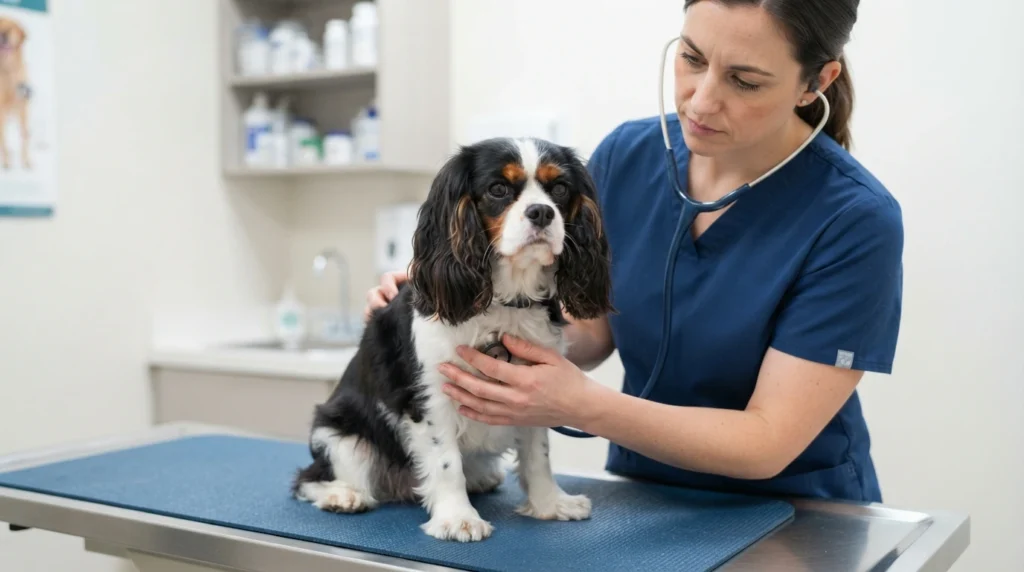
Mitral valve disease is, by a wide margin, this breed’s defining health reality. Roughly 50% of Cavaliers show signs of MVD by age 5, climbing to about 70% by age 7, and nearly 100% of Cavaliers 10 years and older are affected — a prevalence rate approximately 20 times higher than the average dog breed, and the leading cause of death in Cavaliers worldwide. Researchers have identified genetic markers, including variants near the nebulette gene, associated with MVD severity, and responsible breeders now have parent dogs evaluated by a veterinary cardiologist before breeding. For owners, the practical takeaway is a proactive screening habit: annual cardiac auscultation starting well before symptoms would ever appear, since early detection meaningfully changes management options. [FUTURE LINK: canine mitral valve disease guide]
A breeding protocol developed specifically for this crisis, sometimes called the “5-5 rule,” recommends that breeding dogs be at least five years old and clear of a heart murmur, evaluated by a cardiologist, before being bred — an attempt to slow the disease’s spread through the population one generation at a time. It hasn’t eliminated the problem, but breeders who follow it are taking the disease seriously in a way that’s worth rewarding with your purchase.
Syringomyelia is the breed’s other defining risk, and it traces directly back to the skull shape prized since the Eldridge-era recreation. Chiari-like malformation — where the back of the skull is too small to properly house the brain, forcing part of the cerebellum to herniate through the base of the skull — is estimated to affect up to 95% of Cavaliers, though not all of those dogs develop symptoms. Syringomyelia, the fluid-filled spinal cavities that can result from that malformation, affects up to half the breed, with one study finding 70% prevalence by age 6. Dogs with more exaggerated, rounder, shorter skulls appear to carry higher risk, while a less domed, more elongated skull shape is associated with lower risk — a genuinely direct, measurable link between the look the breed was recreated to achieve and the neurological risk it now carries. MRI is the only way to definitively diagnose SM, and signs like unexplained scratching near the head or neck without actually touching the skin, or apparent pain when picked up, warrant a veterinary neurology referral. [FUTURE LINK: syringomyelia in dogs guide]
Breed clubs on both sides of the Atlantic now recommend MRI screening for breeding dogs and publish scoring schemes that grade both the malformation and any resulting cavities by severity, giving breeders a structured way to select against the worst-affected lines over time. As with MVD, progress has been gradual rather than dramatic — but a breeder actively participating in MRI screening programs is doing meaningfully more than one who isn’t, and it’s a fair, direct question to ask before you commit to a puppy.
Nutrition
A high-quality diet formulated for small, less active breeds suits the Cavalier well, with portion sizes controlled carefully, since excess weight adds unnecessary strain to a heart already at elevated risk from MVD. Weight management in this breed is a cardiac-health issue, not just a cosmetic one.
Cost and Adoption
Cavalier King Charles Spaniel puppies from reputable breeders typically range from $2,500 to $4,000, reflecting both the breed’s popularity and the genuine cost of proper cardiac and neurological health screening in breeding stock. Annual ownership costs, including food, routine veterinary care, and the cardiac monitoring this breed benefits from, generally run $1,500 to $2,500 — though owners should budget beyond that baseline for echocardiograms or an MRI if symptoms emerge. Before committing to a puppy, ask directly whether both parents have current cardiologist clearances and, ideally, MRI results or a favorable family history for syringomyelia; a breeder who can’t answer either question is a serious red flag given how well-documented these risks are.
Common Buyer Mistakes
- Skipping cardiologist clearance questions. Given ~50% MVD prevalence by age 5, this is not optional due diligence — it’s essential.
- Not asking about syringomyelia screening or family history. MRI screening isn’t universal among breeders; ask directly.
- Underestimating separation anxiety. A Cavalier left alone for long hours regularly is a common source of preventable distress.
- Letting weight creep up. Extra weight directly strains a heart already at elevated structural risk.
- Confusing this breed with the King Charles Spaniel (English Toy Spaniel). They are different breeds with different faces and different health profiles — confirm which one you’re actually looking at.
- Assuming a calm, friendly puppy means a healthy one. Both MVD and early-stage syringomyelia are frequently invisible in a young, energetic puppy — temperament tells you nothing about cardiac or neurological status.
- Leaving a Cavalier alone for a full workday without preparation. This breed’s attachment needs are real; crate training and gradual alone-time conditioning from puppyhood matter more here than in more independent breeds.
Frequently Asked Questions
Is a Cavalier King Charles Spaniel the same as a King Charles Spaniel?
No. The King Charles Spaniel (English Toy Spaniel in the US) is the older, flatter-faced breed that resulted from 17th-to-19th-century crossbreeding. The Cavalier is a separate breed, deliberately recreated in the 1920s-40s to match the longer-nosed spaniels seen in 17th-century royal portraits.
Why do Cavaliers get heart disease so often?
Mitral valve disease affects roughly 50% of Cavaliers by age 5 and nearly 100% by age 10 — about 20 times the average breed rate. The exact genetic causes are still being researched, including variants near the nebulette gene, but the prevalence is well documented and is the leading cause of death in the breed.
What is syringomyelia in Cavaliers?
A condition where fluid-filled cavities form in the spinal cord, linked to Chiari-like malformation — a skull too small to properly house the brain. It’s estimated to affect up to half of Cavaliers, with the underlying skull malformation present in up to 95% of the breed.
How long do Cavalier King Charles Spaniels live?
Typically 9 to 14 years, though heart disease frequently shortens actual outcomes; regular cardiac screening meaningfully affects quality and length of life.
Are Cavaliers good family dogs?
Yes, exceptionally so. They’re gentle, affectionate, and adaptable to most households, though their attachment to people means they don’t do well with long stretches alone.
How much exercise does a Cavalier need?
Moderate daily exercise — a couple of walks and some play — considerably less demanding than higher-energy spaniel relatives.
How much does a Cavalier King Charles Spaniel puppy cost?
Typically $2,500 to $4,000 from a reputable breeder with proper health screening, with annual ownership costs generally running $1,500 to $2,500.
Conclusion
The Cavalier King Charles Spaniel’s story is genuinely unusual among dog breeds: a royal companion nearly erased by changing fashion, deliberately resurrected from centuries-old portraits by a man who never lived to see it happen, and now defined as much by its severe, well-documented health risks as by its famously gentle nature. Owners who commit to real cardiac and neurological screening, understand the direct link between this breed’s cherished look and its health burden, and provide the close companionship this breed craves tend to find the Cavalier an extraordinarily devoted, if medically demanding, companion.