Bernese Mountain Dog: The Complete Guide to Switzerland’s Gentle Giant
Few breeds inspire the kind of devoted love the Bernese Mountain Dog does, and few breeds ask their owners to reckon with a harder truth: this beloved, gentle giant also carries one of the most serious cancer predispositions in the entire dog world. This guide doesn’t shy away from that reality. Alongside the Bernese Mountain Dog’s genuine Swiss farm-dog history, its place in the four-breed Sennenhund family, and its famously calm, affectionate temperament, this article gives the breed’s health profile the specific, honest, actionable treatment that too many breed guides gloss over. If you’re considering this dog, you deserve the full picture.
Bernese Mountain Dog Quick Facts
The Bernese Mountain Dog is the only long-coated member of the four-breed Swiss Sennenhund family, recognized by the AKC in 1937 and placed in the Working Group.
| Attribute | Detail |
| AKC Group | Working Group (recognized 1937) |
| FCI Group | Group 2, Section 3, Standard No. 45 |
| Country of Origin | Switzerland (Canton of Bern) |
| Height | 25-27.5 in (males), 23-26 in (females) |
| Weight | 80-115 lb |
| Lifespan | 8-10 years (breed-specific research; see Health section) |
| Coat | Long, thick, double coat |
| Colors | Tricolor: black, rust, and white |
| Temperament | Calm, affectionate, gentle, good-natured |
What Is a Bernese Mountain Dog?
Roman Mastiffs and Swiss Farm Dogs
The Bernese Mountain Dog’s ancestry traces back roughly two thousand years, to Roman soldiers crossing the Alps with large mastiff-type dogs alongside black-and-tan dogs marked with white. Those dogs were bred with local Swiss farm dogs over the centuries that followed, eventually producing the sturdy, versatile working breed we know today. Farmers and dairymen in the canton of Bern relied on these dogs for genuinely hard physical work: pulling carts loaded with milk, cheese, and textiles, droving small groups of cattle, and guarding isolated farms. The breed’s name reflects that regional origin directly – “Berner” for Bern, and “Sennenhund,” from the German words for alpine pasture and dog.
The Only Long-Coated Sennenhund
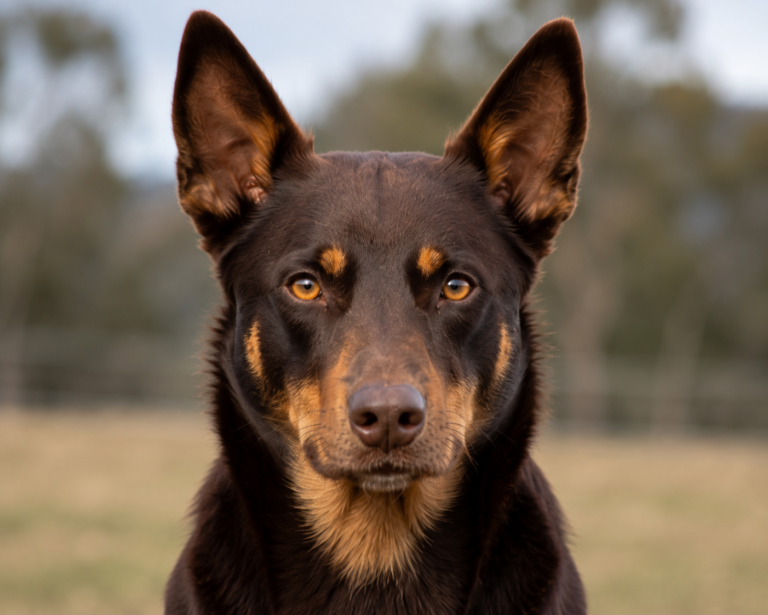
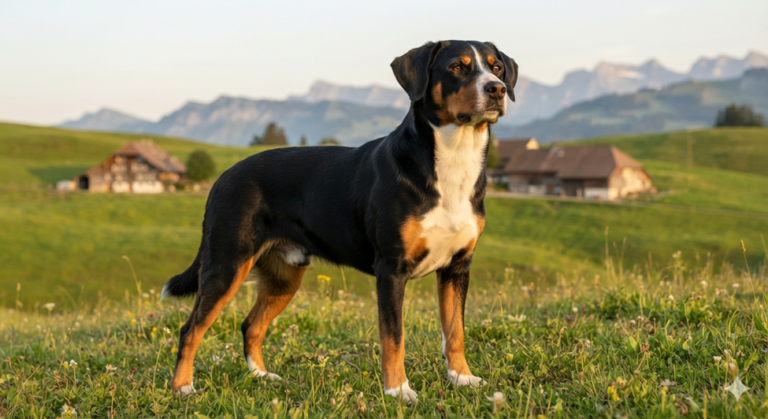
The Bernese Mountain Dog is one of four Sennenhund breeds native to Switzerland, alongside the [Greater Swiss Mountain Dog], the [Appenzeller Sennenhund], and the [Entlebucher Mountain Dog]. All four share the same tricolor pattern and general Alpine working heritage, but the Bernese Mountain Dog is the only one with a long coat – the other three are all short-coated. That distinctive coat, combined with the breed’s larger size, has made it by far the most internationally recognized member of the Sennenhund family, even though all four breeds share essentially the same regional roots.
AKC Recognition and Breed Standard History
Swiss breed fanciers formed a specialty club in 1907 specifically to re-establish and standardize the Bernese Mountain Dog, and the breed gained formal Swiss recognition in 1912. Kansas farmer Isaac Schliess is credited as the first to import the breed to the United States, in 1926, in pursuit of AKC recognition, which the AKC granted in 1937. The current AKC breed standard, revised in 1990, reflects decades of refinement in coordination with the FCI standard.
Bernese Mountain Dog vs. the Other Sennenhund Breeds
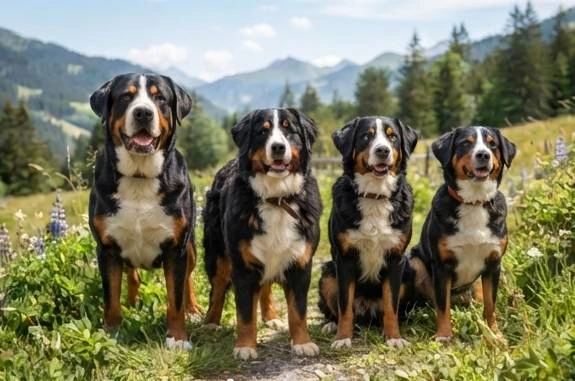
All four Sennenhund breeds share tricolor coats and Alpine working origins, but they differ enough in size and coat that a direct comparison against the [Greater Swiss Mountain Dog], [Appenzeller Sennenhund], and [Entlebucher Mountain Dog] is genuinely useful.
| Attribute | Bernese Mtn Dog | Greater Swiss Mtn Dog | Appenzeller Sennenhund | Entlebucher Mtn Dog |
| Size | Large (80-115 lb) | Largest (85-140 lb) | Medium (48-70 lb) | Smallest (45-65 lb) |
| Coat | Long, thick, double coat | Short, dense double coat | Short, dense double coat | Short, dense, tighter coat |
| Distinguishing Trait | Only long-coated Sennenhund; calm temperament | Largest, heaviest-boned | Agile, strong herding drive | Smallest, most agile |
The two larger breeds, the Bernese Mountain Dog and the Greater Swiss Mountain Dog, tend to share a heavier build and calmer working style, while the two smaller breeds, the Appenzeller and the Entlebucher, are noticeably more agile and higher-energy. Coat length is the fastest way to identify a Bernese Mountain Dog specifically among the group, since it’s the only one of the four with long hair.
Appearance
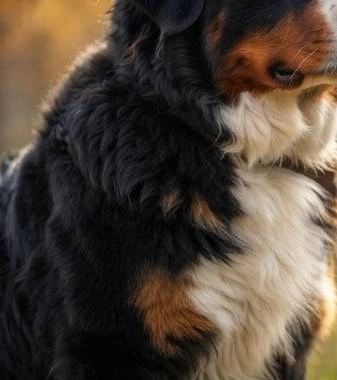
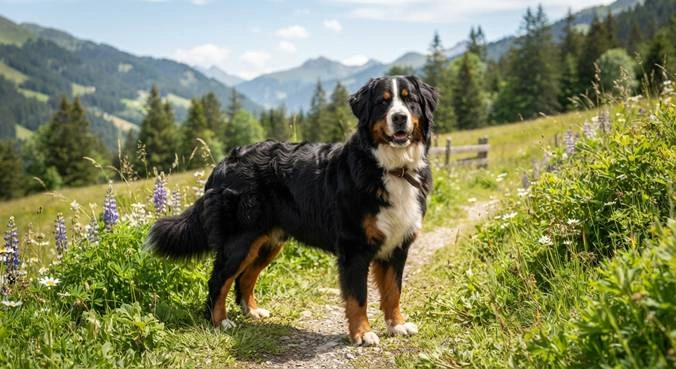
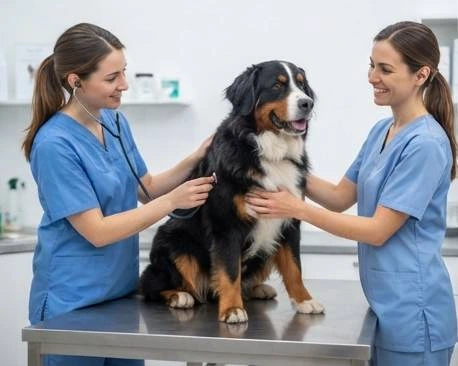
The Bernese Mountain Dog is a large, sturdily built dog with a thick, long, double tricolor coat: jet black as the base color, with rust markings above the eyes, on the cheeks, legs, and chest, and crisp white markings on the chest, feet, and tail tip. The breed’s expression is typically described as gentle and intelligent, matching its famously good-natured temperament.
Temperament
Bernese Mountain Dogs are calm, affectionate, and good-natured, forming deep bonds with their families without becoming anxious or overly clingy. They tend to be patient with children in a way that surprisingly few large breeds manage consistently, and they generally get along well with other dogs. That said, their working heritage means they’re happiest with a real sense of purpose, whether that’s a job, regular training, or simply consistent daily engagement with their people.
Is a Bernese Mountain Dog Right for You?
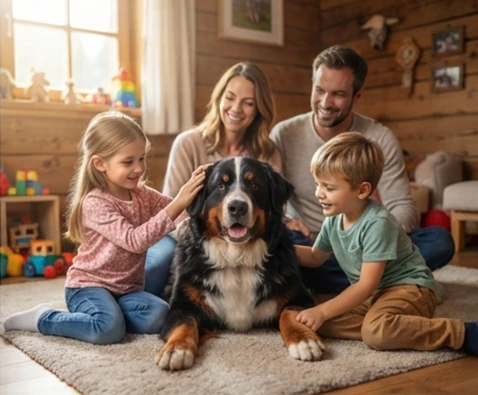
Families and Children
Bernese Mountain Dogs are widely considered excellent family dogs, combining size and strength with a naturally gentle, patient disposition around children. Early socialization and basic training still matter given the breed’s substantial size, but temperament-wise, this is one of the more forgiving large breeds for active households with kids.
First-Time Owners
The Bernese Mountain Dog’s calm temperament makes it more approachable for first-time large-breed owners than many other working breeds, though the size, grooming commitment, and genuine exercise needs still call for real preparation. The most important thing a first-time owner can do with this breed is understand its health profile clearly before committing, since informed breeder vetting matters more here than with most breeds.
Training
Bernese Mountain Dogs are intelligent and generally eager to please, making them reasonably straightforward to train compared to more independent working breeds, especially with positive, reward-based methods. Early socialization helps this naturally friendly breed reach its full potential, and basic obedience work gives this large, strong dog the manners its size genuinely requires.
Exercise Needs
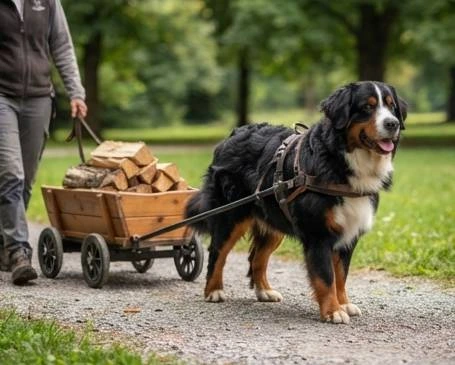
Bred originally for farm work, Bernese Mountain Dogs need a solid daily dose of physical activity – most sources recommend at least 30 to 60 minutes of exercise daily, whether that’s walking, hiking, or structured activities like weight-pulling and carting, a sport with genuine roots in the breed’s draft-dog history. Bernese Mountain Dogs also tolerate cold weather exceptionally well thanks to their thick double coat, but they’re more prone to overheating in hot climates and need careful monitoring during summer activity.
Grooming
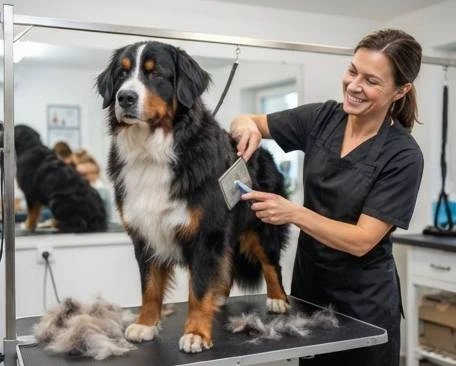
The Bernese Mountain Dog’s long double coat needs brushing several times a week to prevent matting and manage shedding, with daily brushing often necessary during the heavier spring and fall shedding seasons. Many owners schedule professional grooming every four to eight weeks in addition to at-home brushing, and the breed’s substantial coat means grooming is a genuine, ongoing time and cost commitment rather than an occasional chore.
Health and Lifespan: An Honest Look
| Key Fact Roughly 50% of Bernese Mountain Dogs develop cancer during their lifetime, and histiocytic sarcoma alone affects an estimated 25% of the breed – a genetic risk-screening test from Antagene is now available to help breeders assess this risk. |
This is the section every prospective Bernese Mountain Dog owner should read carefully. The breed carries one of the more serious cancer predispositions of any AKC-recognized breed, and being honest about the numbers matters more than softening them.
| Condition | What It Is | What Owners Should Watch For |
| Histiocytic sarcoma | An aggressive cancer affecting an estimated 25% of the breed; uniquely predisposed | Lameness, lethargy, respiratory difficulty, weight loss |
| Other cancers | Roughly 50% of the breed develops some form of cancer in its lifetime | Lumps, swelling, unexplained illness |
| Hip and elbow dysplasia | Abnormal joint development leading to laxity and arthritis over time | Difficulty rising, reluctance to jump, altered gait |
Peer-reviewed Swiss research places the breed’s median lifespan around 8.4 years, meaningfully shorter than most breeds of similar size, though more recent UK data suggests a somewhat higher average closer to 10 years. A genetic risk-screening test developed by Antagene, using nine identified genetic markers, is now available to help breeders assess [histiocytic sarcoma] risk in potential breeding pairs – asking a breeder whether their dogs have been screened with this test is a genuinely meaningful question for a prospective puppy buyer to ask. [Hip dysplasia] and [elbow dysplasia] screening through OFA or PennHIP evaluations round out the standard health-testing conversation.
Nutrition
A high-quality diet formulated for a large or giant working breed suits the Bernese Mountain Dog well, with careful attention to weight management, since excess weight places additional strain on a breed already prone to joint issues.
Cost and Adoption
Bernese Mountain Dog puppies from reputable, health-tested breeders typically range from around fifteen hundred to thirty-five hundred dollars, and given the breed’s health profile, verifying a breeder’s health-testing practices, including histiocytic sarcoma risk screening where available, matters more here than with most breeds. Rescue organizations specific to the breed exist through the Bernese Mountain Dog Club of America’s network, and adoption costs are typically far lower than the price of a puppy from a breeder.
Frequently Asked Questions
What is a Bernese Mountain Dog?
The Bernese Mountain Dog is a large, tricolor Swiss working breed from the canton of Bern, and the only long-coated member of the four-breed Sennenhund family.
Why do Bernese Mountain Dogs have a shorter lifespan?
The breed has a significantly elevated cancer rate, with roughly 50% developing cancer during their lifetime and histiocytic sarcoma alone affecting an estimated 25% of the breed, which brings down the average lifespan compared to similarly sized breeds.
Is a Bernese Mountain Dog the same as a Greater Swiss Mountain Dog?
No – they’re closely related Sennenhund breeds, but the Bernese Mountain Dog has a long coat while the Greater Swiss Mountain Dog has a short coat and is typically larger.
Are Bernese Mountain Dogs good with kids?
Yes, generally excellent – the breed’s calm, patient temperament makes it one of the more forgiving large breeds for families with children.
How much exercise does a Bernese Mountain Dog need?
At least 30 to 60 minutes of daily activity, with cold-weather tolerance being a genuine strength and hot-weather activity requiring careful monitoring.
What health problems do Bernese Mountain Dogs have?
The breed’s most serious concern is a high cancer rate, particularly histiocytic sarcoma, alongside hip and elbow dysplasia; a genetic risk-screening test is available to help assess histiocytic sarcoma risk in breeding pairs.
How much does a Bernese Mountain Dog cost?
Puppies from reputable, health-tested breeders typically range from around fifteen hundred to thirty-five hundred dollars.
Conclusion
The Bernese Mountain Dog earns its devoted following honestly: a calm, affectionate, genuinely gentle giant with deep Swiss farm-dog roots and a temperament that makes it one of the more forgiving large breeds for families. But loving this breed responsibly means understanding its health reality clearly, asking breeders the right screening questions, and going in with eyes open about a lifespan that, while improving, still runs shorter than most dogs this size deserve.