
American Staffordshire Terrier: The Complete Breed Guide
American Staffordshire Terrier
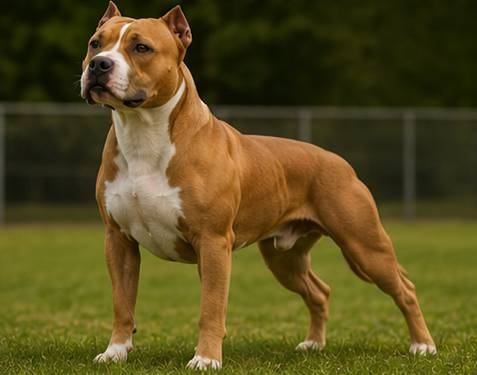
The American Staffordshire Terrier, often called the AmStaff, is a muscular, confident, AKC-recognized breed whose history is closely tied to — and often confused with — the American Pit Bull Terrier. That confusion has a specific, datable origin: the AKC recognized a subset of the same base population in 1936, then renamed the breed in 1969 specifically to separate it from both the Pit Bull and the British Staffordshire Bull Terrier. This guide explains that history clearly, cites the AKC’s own breed standard on temperament, and compares the AmStaff directly to its closest relatives.
American Staffordshire Terrier Quick Facts
The AmStaff sits in the AKC Terrier Group [Internal Link], among dogs bred for tenacity, confidence, and working drive.
| Attribute | Detail |
| AKC Group | Terrier Group (recognized 1936) |
| FCI Status | Not FCI breed-recognized; FCI Standard No. 286 applies for judging at FCI shows only |
| Country of Origin | United States |
| Height | 18–19 in (males), 17–18 in (females) |
| Weight | Approximately 40–70 lb |
| Lifespan | 12–14 years, potentially longer with good care |
| Coat | Short, stiff, glossy |
| Colors | Any color, including brindle; white markings common |
| Temperament | Confident, good-natured, loyal, protective |
What Is an American Staffordshire Terrier?
Bull-and-Terrier Origins
Like the American Pit Bull Terrier, the AmStaff descends from 19th-century English bull-and-terrier stock, dogs that arrived in the United States by around 1850. These dogs were themselves the product of earlier crosses between bulldogs and terriers, originally developed in England for blood sports that have long since been outlawed and are now widely condemned. The United Kennel Club recognized this base population under the name American Pit Bull Terrier in 1898, giving the shared ancestry its first formal registry home, decades before any AKC involvement.
How the AKC Separated the AmStaff from the Pit Bull
This is the single most important fact for understanding the breed’s identity. In 1936, the American Kennel Club recognized a subset of this population under the name “Staffordshire Terrier,” after breeders assured the AKC that the dogs would not be used for fighting. Effective January 1, 1969, the AKC renamed the breed “American Staffordshire Terrier,” a change made specifically to distinguish the AKC line from the British Staffordshire Bull Terrier [Internal Link], a separate, smaller breed with its own AKC recognition. Genetically and historically, the AmStaff and the American Pit Bull Terrier [Internal Link] share deep common ancestry, but they have been bred and registered as distinct populations for roughly nine decades, and modern breed clubs on both sides maintain separate standards and goals. The Staffordshire Terrier Club of America, the AKC’s official parent club for the breed, has overseen that separate development since recognition, focusing breeding programs on temperament and conformation suited to companionship and the show ring rather than the working or fighting purposes tied to the breed’s distant ancestry.
American Staffordshire Terrier vs. Related Breeds

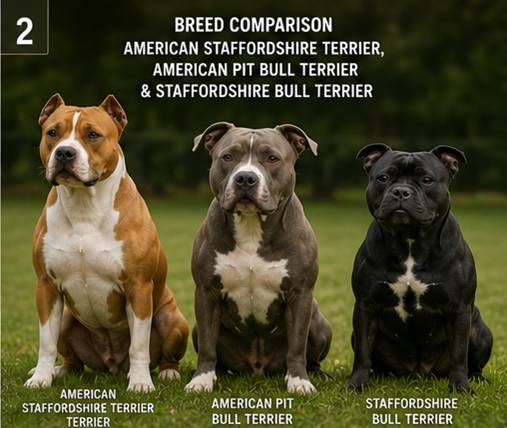
Three breeds get routinely confused with one another, largely because of this shared history, and a fourth relative, the American Bully [Internal Link], sometimes gets thrown into the mix as well despite being a more recently developed breed with its own separate UKC recognition. Here’s how the three most closely related breeds compare.
| Attribute | American Staffordshire Terrier | American Pit Bull Terrier | Staffordshire Bull Terrier |
| Registry Status | AKC-recognized (1936/1969) | UKC, ADBA (not AKC/FCI) | AKC-recognized; separate British breed |
| Typical Size | 40–70 lb, 17–19 in | 30–65 lb, 17–21 in | Smaller, typically 24–38 lb |
| Origin/Purpose | AKC line formally separated from APBT bloodlines in 1936/1969 | UKC-registered since 1898; farm work, vermin hunting | Developed in England as a distinct, smaller companion/working breed |
Appearance

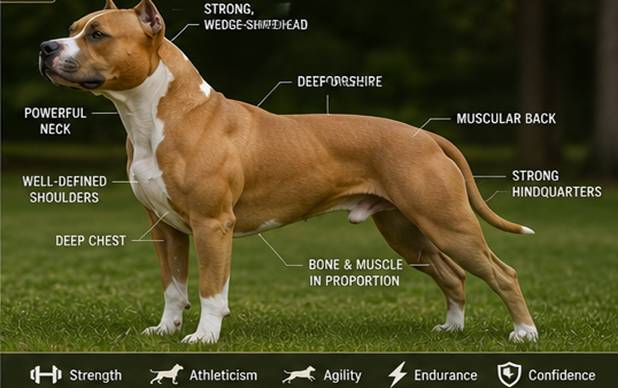
The American Staffordshire Terrier is medium-sized, stocky, and muscular, giving what the AKC standard describes as “the impression of great strength for his size” while remaining agile and graceful in movement. The coat is short, stiff, and glossy, and the AKC standard accepts any color, including brindle, with white markings commonly seen.
Temperament
The AKC breed standard emphasizes strength, agility, and gracefulness of movement, and breed-club sources consistently describe the AmStaff as confident, good-natured, and loyal to its family, often notably affectionate with people it knows well. With consistent socialization, AmStaffs typically grow up calm around strangers, other animals, and new situations, though without that groundwork they can be reserved or wary of unfamiliar people and may not get along well with unfamiliar dogs or small pets. That wariness is a socialization-dependent trait rather than an inherent aggression problem, and it’s worth planning training around from puppyhood. AmStaffs also tend to form especially strong bonds with their immediate family, which can translate into a naturally protective streak — a trait that’s generally manageable with training but worth being aware of when introducing new people or pets into the household.
Is an American Staffordshire Terrier Right for You?

Families and Children
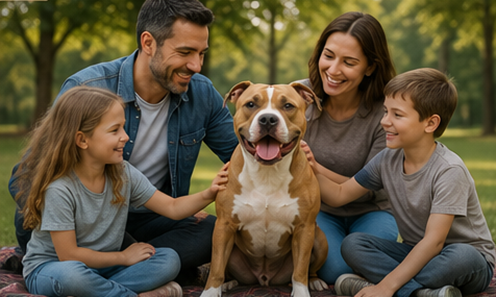
AmStaffs are frequently described by breed clubs and veterinary sources as loving and affectionate with their families, including children, particularly when raised with consistent socialization from puppyhood. As with any strong, energetic breed, supervision during play with young children is a standard, sensible precaution rather than something unique to this breed, and many families report that the breed’s loyalty and playfulness make it a genuinely engaged household companion once expectations on both sides are well established.
Other Dogs and Pets
Because AmStaffs can be selective with unfamiliar dogs and small animals, gradual, careful introductions and ongoing management matter, especially in multi-pet households. Early socialization meaningfully improves outcomes here.
Breed-Specific Legislation Note
Practical Note: Even though the American Staffordshire Terrier is AKC-recognized, breed-specific legislation in some cities and counties defines restricted “pit bull type” dogs by physical appearance rather than registered breed name, which means an AmStaff can potentially fall under local restrictions despite its AKC papers. Before bringing one home, check your specific local ordinance language directly rather than assuming AKC recognition provides automatic exemption.
Training

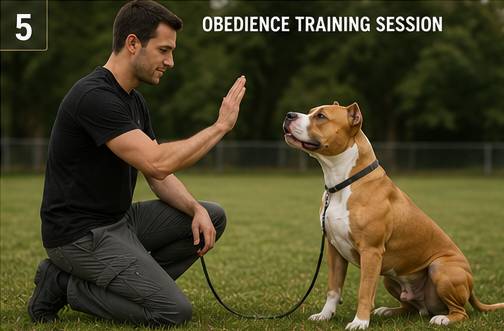
American Staffordshire Terriers are intelligent and generally responsive to consistent, positive-reinforcement training. Early socialization is especially valuable, helping puppies grow into the calm, confident adults the breed standard describes rather than developing unnecessary wariness of new people, dogs, or environments.
Structured obedience classes tend to work particularly well for the breed, giving puppies controlled exposure to new dogs and people in a supervised setting while building foundational skills like sit, stay, and reliable recall. Because AmStaffs are strong and physically capable dogs, consistent leash manners are worth prioritizing early — a well-trained AmStaff is simply easier and safer to manage on walks, at the vet, and around visitors than one that hasn’t had that foundation.
Exercise Needs
AmStaffs are a moderate-to-high energy breed, generally needing 45 to 60 minutes or more of daily exercise. Structured activities like fetch, obedience work, agility, or brisk walks and runs suit the breed’s muscular build and drive well, and many AmStaffs also do well in canine sports like weight pulling or dock diving, which give the breed’s athleticism a productive, well-supervised outlet. A consistently under-exercised AmStaff is more likely to develop destructive habits or excess energy at home, so treating daily exercise as a non-negotiable part of the routine, rather than something to fit in when convenient, tends to make for a calmer household overall.
Grooming
The short, stiff coat is low-maintenance: weekly brushing is generally enough to manage shedding and keep the coat glossy. Standard care — nail trims, ear checks, and dental hygiene — completes the routine, and occasional bathing as needed is typically sufficient given how little the coat traps dirt or odor compared to longer-coated breeds.
Health and Lifespan

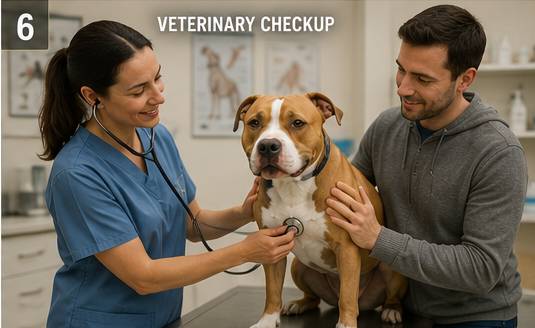
Most American Staffordshire Terriers live between 12 and 14 years, with some reaching close to 16 with good veterinary care. The breed is generally healthy, but a few conditions are worth watching for.
| Condition | What It Is | What Owners Should Watch For |
| Hip dysplasia | Abnormally formed hip joint, more common in muscular breeds | Limping, stiffness, reluctance to jump |
| Progressive retinal atrophy (PRA) | Hereditary condition causing gradual vision loss | Night-vision difficulty progressing to broader vision loss |
| Hypothyroidism | Underactive thyroid slowing metabolism | Weight gain, lethargy, coat changes; usually manageable with medication |
Responsible breeders typically screen breeding stock for hip dysplasia [Internal Link] and hereditary eye conditions before pairing dogs, and asking to see health clearances is a reasonable, standard request when buying a puppy. Routine veterinary checkups remain the best tool for catching any of these conditions early, particularly since hip dysplasia and PRA can both progress gradually before becoming obviously noticeable at home.
Nutrition
A high-quality, active-breed formula suited to a muscular, athletic dog is a solid foundation for an American Staffordshire Terrier. Because the breed is prone to hip dysplasia, maintaining a healthy weight through careful portion control helps reduce joint strain over the dog’s lifetime.
Cost and Adoption


Breeder pricing for American Staffordshire Terrier puppies varies by breeder, region, and lineage, so prospective buyers should confirm current pricing directly and work with breeders who health-test for hip dysplasia and eye conditions rather than choosing on price alone. Because AmStaffs are frequently mistaken for or grouped with more commonly surrendered “pit bull type” dogs, they’re also regularly available through rescues and shelters, often at a lower cost than buying a puppy, and rescue staff can help match a dog’s individual temperament to your household — a genuinely practical route worth considering alongside working with a breeder.
Frequently Asked Questions
What is an American Staffordshire Terrier?
The American Staffordshire Terrier is a medium-sized, muscular, AKC-recognized terrier breed, formally separated from American Pit Bull Terrier bloodlines by AKC action in 1936 and renamed in 1969.
Is an American Staffordshire Terrier the same as a Pit Bull?
Not officially. They share deep common ancestry, but the American Staffordshire Terrier has been AKC-recognized and separately registered since 1936, while the American Pit Bull Terrier remains registered by the UKC and ADBA rather than the AKC.
What’s the difference between an AmStaff and a Staffordshire Bull Terrier?
The Staffordshire Bull Terrier is a separate, generally smaller British breed with its own distinct AKC recognition. The AKC specifically renamed the American Staffordshire Terrier in 1969 to avoid confusion between the two.
Are American Staffordshire Terriers good family dogs?
Yes, generally — breed sources describe them as affectionate and loyal with their families, including children, particularly with consistent early socialization. Standard supervision during play applies, as with any strong, energetic breed.
Are AmStaffs affected by breed-specific legislation?
Potentially, yes. Some local ordinances define restricted “pit bull type” dogs by appearance rather than registered breed name, so AKC recognition doesn’t automatically exempt an AmStaff. Check your specific local laws directly.
What health problems do AmStaffs have?
Common concerns include hip dysplasia, progressive retinal atrophy, and hypothyroidism, though the breed is generally considered healthy overall.
How much does an American Staffordshire Terrier cost?
Breeder pricing varies by lineage and region; confirm current pricing directly with breeders. Adoption through rescues and shelters is common and often more affordable.
Conclusion
The American Staffordshire Terrier’s identity is inseparable from a specific piece of registry history: the AKC’s 1936 recognition and 1969 renaming that formally separated it from the American Pit Bull Terrier and distinguished it from the British Staffordshire Bull Terrier. What that history leaves owners with today is a confident, muscular, generally affectionate breed that does best with consistent early socialization and an owner aware that AKC papers don’t automatically exempt the dog from local breed-specific legislation. For those who do their homework on health, training, and local law, the American Staffordshire Terrier is, per its own breed standard, a strong, good-natured companion.