Bedlington Terrier: The Complete Guide to England’s Lamb-Like Terrier
Bedlington Terrier
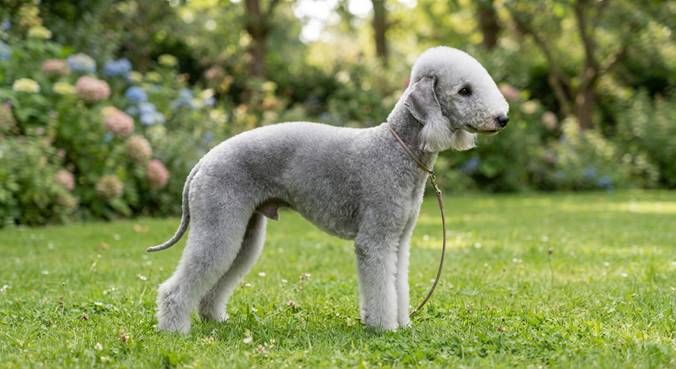
Few dog breeds provoke the same first reaction as the Bedlington Terrier: “Is that a lamb?” With its arched back, tucked flank, rounded head, and fluffy white topknot, a properly groomed Bedlington Terrier really can look like a small decorative sheep at a glance. That soft appearance hides a genuinely tough working history – this breed was bred by 19th-century English coal miners and poachers for speed, stealth, and serious prey drive. It also carries a hereditary health condition, copper toxicosis, so strongly linked to the breed that Bedlington Terriers have contributed to human medical research. This guide covers the real story behind the lamb-like look, the breed’s working-class origins, and an honest, detailed look at what living with this distinctive terrier actually involves.
Bedlington Terrier Quick Facts
The Bedlington Terrier has been AKC-recognized since 1886 and is classified under the Terrier Group in the US and FCI Group 3, Section 1 (Large and Medium Terriers), Standard No. 9, internationally.
| Attribute | Detail |
| AKC Group | Terrier Group (recognized 1886) |
| FCI Group | Group 3, Section 1, Standard No. 9 |
| Country of Origin | England |
| Height | 15.5-17.5 in at the shoulder |
| Weight | 17-23 lb |
| Lifespan | 11-16 years |
| Coat | Thick, curly, “linty” texture; non-shedding |
| Colors | Blue, liver, sandy, and combinations with tan |
| Temperament | Mild-mannered, spirited, intelligent, game, generally good-natured |
What Is a Bedlington Terrier?
Northumberland Origins and the “Rothbury’s Lambs” Nickname
The Bedlington Terrier originated in Northumberland, in the north of England, and was known earlier as the Rothbury Terrier, named for the town of Rothbury, before eventually taking the name of the nearby coal-mining town of Bedlington. A dedicated breed association was established in 1877, formalizing a type that had already been working in the region for decades. The breed’s early nickname, “Rothbury’s Lambs,” captures exactly the same lamb-like impression the breed still makes today, and the name has stuck in breed history ever since.
A Coal Miner’s and Poacher’s Dog
Long before it became a show-ring curiosity, the Bedlington Terrier earned its keep in genuinely hard working conditions. Coal miners in Northumberland relied on the breed as a skilled ratter in mines and factories, valuing its ability to work in tight, grimy spaces. The same speed, stealth, and intense prey drive that made it useful underground also made it a favorite among poachers, who used Bedlington Terriers to hunt rabbits and foxes discreetly on land where they had no legal right to hunt. The breed was also used to go to ground after badgers and other den-dwelling animals, work that demanded real courage from a dog that, on the surface, looks anything but fierce.
AKC and FCI Status
The American Kennel Club recognized the Bedlington Terrier in 1886, placing it in the Terrier Group. The FCI classifies the breed under Standard No. 9, Group 3, Section 1, among large and medium terriers.
Bedlington Terrier vs. Dandie Dinmont Terrier vs. Whippet
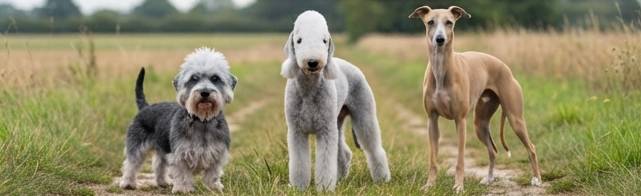
These three English breeds are sometimes confused, whether for coat texture or body shape. Here’s how the Bedlington Terrier compares to the Dandie Dinmont Terrier [Internal Link] and the Whippet [Internal Link].
| Attribute | Bedlington Terrier | Dandie Dinmont Terrier | Whippet |
| Origin | England (Northumberland) | Scotland/England border | England |
| Size | 15.5-17.5 in, 17-23 lb | Smaller, 8-11 in, longer body | Taller, leaner, built for speed |
| Distinguishing Trait | Lamb-like silhouette, curly linty coat | Long body, large topknotted head | Sighthound build, minimal coat |
The Dandie Dinmont Terrier shares distant regional roots but has a completely different long, low body shape and large head, while the Whippet – sometimes mentioned because of the Bedlington’s surprisingly athletic, arched-back build – is a true sighthound bred purely for speed rather than terrier work. The Otterhound [Internal Link], another rare English breed with a distinctive rough coat, shares the Bedlington’s working-class hunting background despite looking nothing alike.
Appearance
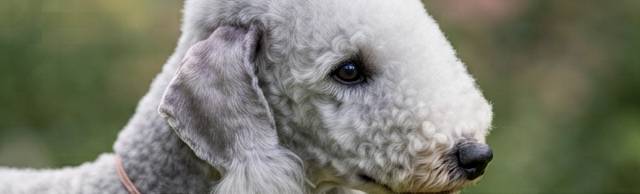
The Bedlington Terrier’s signature look comes from its arched back, tucked-up flank, and narrow, rounded head topped with a profuse topknot that’s lighter in color than the body. The thick, curly coat has a distinctive “linty” texture unlike any other terrier’s, and it comes in blue, liver, sandy, or combinations with tan. Properly trimmed, the silhouette really does resemble a lamb standing in profile.
Temperament
Despite the gentle, lamb-like appearance, the Bedlington Terrier is a genuine terrier underneath – spirited, game, and possessing real prey drive inherited from generations of ratting and hunting work. At the same time, the breed is famously mild-mannered and affectionate with its own family, striking a temperament balance that surprises people expecting either a lapdog or a scrappy terrier and getting a bit of both instead.
Is a Bedlington Terrier Right for You?
Families and Children
Bedlington Terriers generally do well with children and tend to be a good-natured, adaptable presence in an active household, though their terrier prey drive means small pets like rabbits or hamsters require careful introduction and supervision.
First-Time Owners
Bedlington Terriers can work reasonably well for first-time owners who are prepared for consistent grooming costs and a genuine terrier independent streak; this is a more manageable terrier for a first dog than many of its more headstrong relatives, but it’s still not a fully hands-off breed.
Training
Bedlington Terriers are intelligent and generally responsive, though their terrier heritage means training sessions benefit from consistency and patience rather than repetition alone. Positive reinforcement and early socialization help channel the breed’s prey drive and independence productively.
Exercise Needs
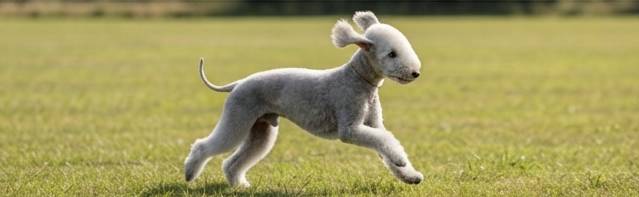
Despite its dainty appearance, the Bedlington Terrier is a genuinely athletic dog capable of real speed, and it needs a moderate to high amount of daily exercise, including secure off-leash play. Given the breed’s strong prey drive, a securely fenced yard and reliable recall are especially important before letting a Bedlington off-leash near wildlife. Activities like lure coursing or agility tend to satisfy the breed’s athletic side particularly well, channeling that surprising speed into structured, safe outlets.
Grooming (Achieving the Lamb-Like Look)
The Bedlington Terrier’s famous lamb-like silhouette isn’t a natural resting shape – it’s the direct result of a specific, skilled hand-scissoring or clipping technique performed roughly every six to eight weeks, typically by a professional groomer experienced with the breed. The coat itself is low-shedding, which makes it a genuinely appealing option for allergy-sensitive households, though “low-shedding” is not the same guarantee as truly hypoallergenic, and individual sensitivity still varies. Between professional sessions, regular brushing helps prevent matting in the curly, linty texture.
Health and Lifespan

Bedlington Terriers typically live 11 to 16 years, a genuinely long lifespan for a breed of this size, though one hereditary condition in particular defines the breed’s health profile more than any other.
Copper Toxicosis: The Breed’s Defining Health Concern
Key Fact: Copper toxicosis is a hereditary condition causing the liver to accumulate excess copper, typically becoming apparent between two and four years of age. Bedlington Terriers with this condition have served as a valuable genetic research model for Wilson’s disease, the corresponding copper-metabolism disorder in humans.
Left unmanaged, copper toxicosis can progress to liver inflammation, cirrhosis, and potentially fatal liver failure, but with a genetic carrier test, regular liver-value screening, and a managed low-copper diet, many affected dogs maintain a good quality of life.
| Condition | What It Is | What Owners Should Watch For |
| Copper toxicosis | Hereditary excess copper accumulation in the liver | Lethargy, appetite loss, jaundice, vomiting (genetic testing is the real safeguard) |
| Progressive retinal atrophy | A degenerative eye condition leading to gradual vision loss | Night blindness, reluctance to move in dim light |
| Distichiasis | Abnormal eyelash growth causing irritation | Excessive tearing, squinting, eye rubbing |
| Entropion | Inward rolling of the eyelid | Visible eye irritation, redness, tearing |
Asking a breeder directly about copper toxicosis [Internal Link] genetic testing for both parents is one of the single most important health questions for this breed specifically, and progressive retinal atrophy [Internal Link] and entropion [Internal Link] screening are worth asking about as well.
Nutrition
Standard high-quality nutrition suits most Bedlington Terriers, but owners of dogs identified as copper toxicosis carriers or affected individuals should work directly with a veterinarian on a low-copper diet plan, since ordinary commercial diets can contain copper levels that are genuinely inappropriate for these dogs.
Cost and Adoption
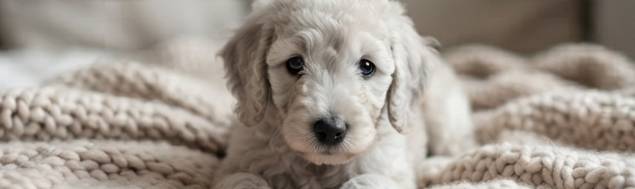
Bedlington Terrier puppies from health-tested breeders typically range from around a thousand to two thousand dollars, and prospective owners should treat copper toxicosis genetic testing of both parents as a non-negotiable question rather than an optional nicety. Because the breed is relatively rare, Bedlington Terrier-specific rescue organizations exist but may require some patience and geographic flexibility to find an available dog. Meeting a breeder’s adult dogs in person, and asking to see documented copper and eye test results rather than just verbal assurances, is a genuinely worthwhile step before committing.
Frequently Asked Questions
What is a Bedlington Terrier?
The Bedlington Terrier is an English terrier breed known for its distinctive lamb-like silhouette, curly coat, and working history as a coal miner’s and poacher’s dog.
Why does a Bedlington Terrier look like a lamb?
The breed’s arched back, tucked flank, rounded head, and fluffy topknot combine to create a silhouette that closely resembles a lamb, especially when professionally groomed.
What is copper toxicosis?
Copper toxicosis is a hereditary liver condition, strongly associated with this breed, in which the body fails to properly eliminate copper, leading to potential liver damage if unmanaged.
Is a Bedlington Terrier hypoallergenic?
The breed’s curly coat sheds minimally, which many allergy-sensitive owners find more manageable, but no dog breed is truly 100% hypoallergenic.
Are Bedlington Terriers good with kids?
Generally yes – the breed is good-natured and adaptable with children, though supervision around small pets is wise given its terrier prey drive.
How much grooming does a Bedlington Terrier need?
Professional grooming roughly every six to eight weeks is needed to maintain the signature lamb-like silhouette, along with regular brushing between sessions.
How much does a Bedlington Terrier cost?
Puppies from health-tested breeders typically range from around a thousand to two thousand dollars; breed-specific rescues exist but may require patience.
Conclusion
The Bedlington Terrier proves that appearances can be genuinely deceiving – a dog that looks like a woolly lamb was built by coal miners and poachers for speed, courage, and hard work, and today carries a hereditary condition significant enough to matter beyond veterinary medicine. Understanding the real grooming commitment, the copper toxicosis screening question, and the terrier spirit underneath that soft coat is the clearest path to a good match with this genuinely unique breed.