German Shepherd Dog: History, Lines & Health Facts
Unlike many breeds that emerged gradually over centuries, the German Shepherd Dog can be traced to one specific afternoon. In April 1899, a former cavalry officer walked into a dog show, spotted a wolf-like dog with striking intelligence, and bought him on the spot. Within a month, that purchase had become the foundation of an entirely new breed club. This guide covers that precise founding story, a decades-long identity crisis that stripped “German” from the breed’s name entirely, an ongoing controversy about the breed’s modern silhouette that connects directly to its biggest health risk, and the honest, statistically grounded guidance every prospective owner needs.
German Shepherd Dog Quick Facts
The German Shepherd Dog is a large, athletic herding breed developed in Germany specifically for versatility, intelligence, and utility.
| Attribute | Detail |
| AKC Group | Herding Group |
| Country of Origin | Germany |
| Height | 22–26 in |
| Weight | 50–90 lb |
| Lifespan | 7–10 years commonly cited (2024 UK study mean: 11.3 years) |
| Coat | Medium-length double coat |
| Colors | Black and tan, sable, black, and others |
| Temperament | Confident, intelligent, loyal, versatile |
History: Max von Stephanitz and the Dog Show That Started It All
The German Shepherd Dog exists because of one man’s deliberate vision. Max von Stephanitz, a former cavalry officer and student at Berlin Veterinary College, spent years searching for the ideal all-purpose shepherd dog — one combining intelligence, physical capability, and genuine working utility. In April 1899, he attended a dog show with a friend and spotted a four-year-old dog named Hektor Linksrhein, whose wolf-like appearance first caught his eye, but whose intelligence and character sealed the decision. Von Stephanitz paid 200 German gold marks on the spot and renamed the dog Horand von Grafrath.
Within a month of that purchase, von Stephanitz and his friend founded the Verein für Deutsche Schäferhunde (SV), the world’s first German Shepherd Dog club, with von Stephanitz as its first president and “Utility and Intelligence” as its guiding motto. Horand became the breed’s foundation sire, and through three particular grandsons — Heinz von Starkenburg, Beowolf, and Pilot — his bloodline flows through virtually every German Shepherd Dog alive today.
The Alsatian Years: A Name Erased by War
Few breed histories include a chapter where the dog’s own name became a wartime casualty, but the German Shepherd Dog’s did. The breed’s founder had named it, in German, the Deutscher Schäferhund — literally “German Shepherd Dog.” That name became a liability almost overnight when World War I broke out and anti-German sentiment swept the US and UK.
In the United States, the American Kennel Club directed the German Shepherd Dog Club of America to strip “German” from both the club’s name and the breed’s name; the organization briefly became the Shepherd Club of America. Britain went further: the UK Kennel Club renamed the breed the “Alsatian Wolf Dog” in 1919, borrowing the name of Alsace, the French region bordering Germany, specifically to distance the dog from its German identity. The US and the Alsace-based European clubs restored the original name by around 1925. The UK, however, held onto “Alsatian” far longer — “German Shepherd” was only added back in brackets for decades, and the UK Kennel Club didn’t fully restore “German Shepherd Dog” as the official name until 1977, more than half a century after the war that prompted the change had ended.
German Shepherd Dog vs. Belgian Malinois vs. Rottweiler
The German Shepherd Dog shares Herding Group ancestry and a similarly versatile working temperament with the Belgian Malinois, and comparing it to the Rottweiler clarifies how European working breeds developed distinct specialties.
| Attribute | German Shepherd Dog | Belgian Malinois | Rottweiler |
| Origin | Germany | Belgium | Germany |
| Size | Large (50–90 lb) | Medium-large (40–80 lb) | Large (80–135 lb) |
| Coat | Medium-length double coat | Short, dense coat | Short, dense double coat |
| Historical purpose | Herding, versatile working dog | Herding, protection work | Cattle driving, guarding |
Appearance
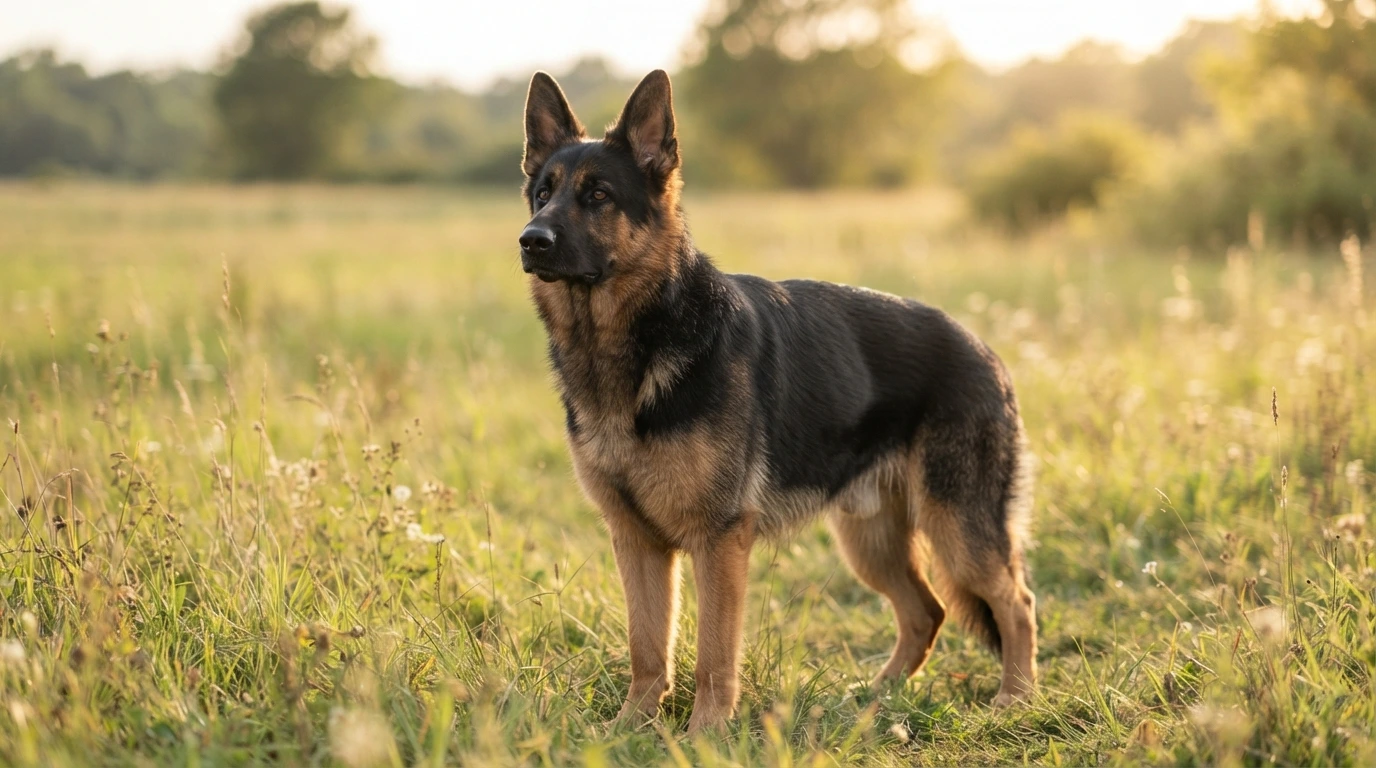
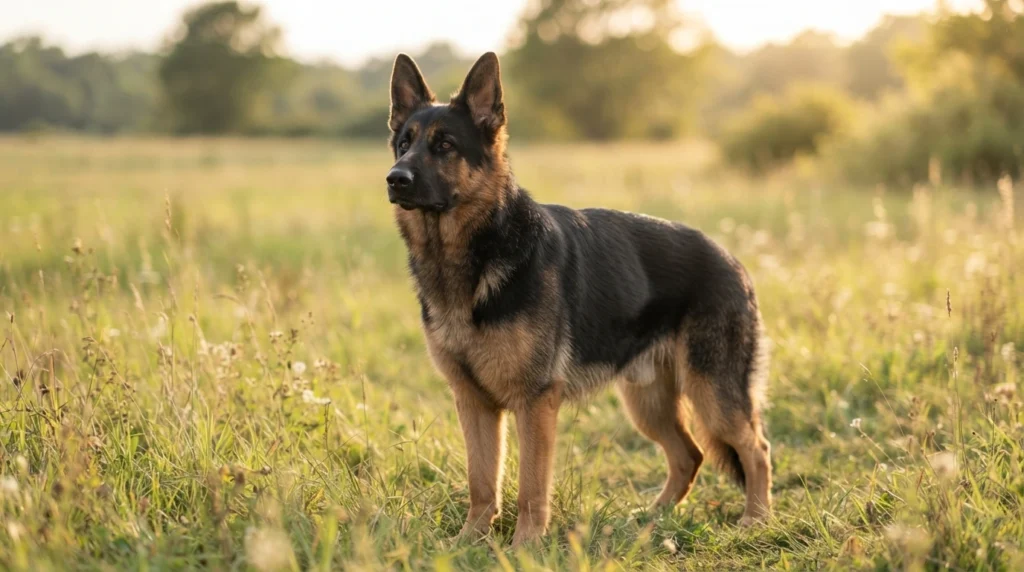
The German Shepherd Dog is a large, muscular, well-proportioned dog with a noble, wolf-like head, erect ears, and a medium-length double coat most commonly seen in black and tan or sable. Its distinctive topline and confident, ground-covering gait reflect the breed’s working heritage — though as the next section explains, exactly how sloped that topline should be is one of the most contested questions in the breed today.
Coat color has its own emerging story worth knowing about. Most German Shepherds appear in black and tan, sable, solid black, or occasionally solid white, but a rare, naturally occurring white-spotting pattern known as the “panda” German Shepherd was first documented in 2019 in a single litter. Unlike the dapple or merle patterns discussed in other breeds, the panda pattern arose from a spontaneous genetic mutation within the purebred Shepherd population rather than crossbreeding, and it doesn’t carry the same documented health risks as double-merle breeding in other breeds — though it remains outside the AKC standard and is not eligible for conformation showing. [FUTURE LINK: panda German Shepherd color guide]
Working Line vs. Show Line: The Sloped-Back Controversy
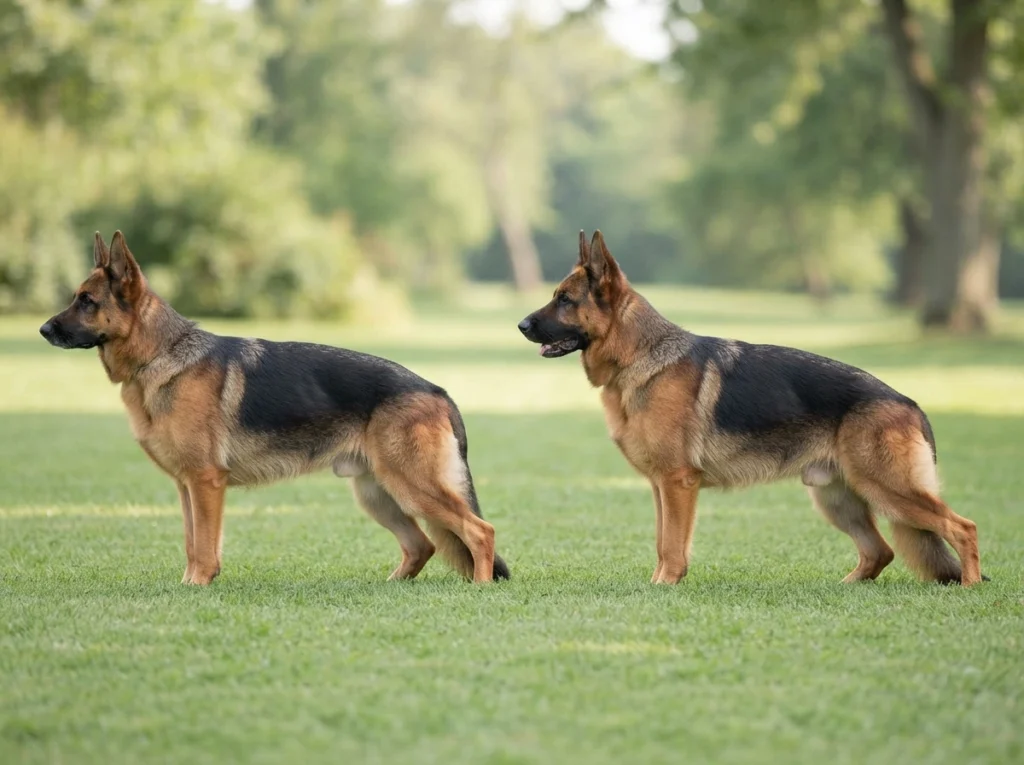
If you’ve noticed that some German Shepherds stand nearly level while others show a pronounced, almost crouching slope from shoulders to hindquarters, you’ve spotted the single most debated divide in the breed. Max von Stephanitz’s original standard described a dog with a level, strong topline — there’s no evidence he intended the dramatic slope seen in many modern show-ring dogs.
That slope developed gradually as conformation showing rewarded increasingly exaggerated angulation in the hindquarters, producing the distinctive “flying trot” gait judges favored. The debate reached a wider public audience in 2016, when video of that year’s Crufts Best in Show winner, a German Shepherd, showed the dog appearing to struggle with its movement, visibly hesitant and uneasy on its hind legs. The footage prompted public criticism from veterinarians and breed enthusiasts alike, reigniting a debate that had simmered within the breed community for years.
The health concern isn’t cosmetic. Extreme hindquarter angulation places genuine mechanical strain on joints that don’t form correctly at that angle, and dogs with pronounced sloped backs are considered more prone to hip dysplasia and earlier-onset osteoarthritis — a connection worth keeping in mind given the hip dysplasia statistics later in this guide. Working-line German Shepherds, bred primarily for police, military, and sport work rather than the show ring, have generally retained a straighter, more level topline closer to von Stephanitz’s original vision. Neither line is more “purebred” than the other, but if orthopedic health is a priority, ask a breeder directly which line their dogs come from and look at the parents’ movement, not just their show photos.
Temperament
The German Shepherd Dog is confident and intelligent, widely regarded as one of the most versatile and trainable breeds for its combination of loyalty, courage, and eagerness to work. Devoted to its family, the breed’s temperament reflects von Stephanitz’s original vision of a dog built for real utility rather than appearance alone.
Is a German Shepherd Dog Right for You?
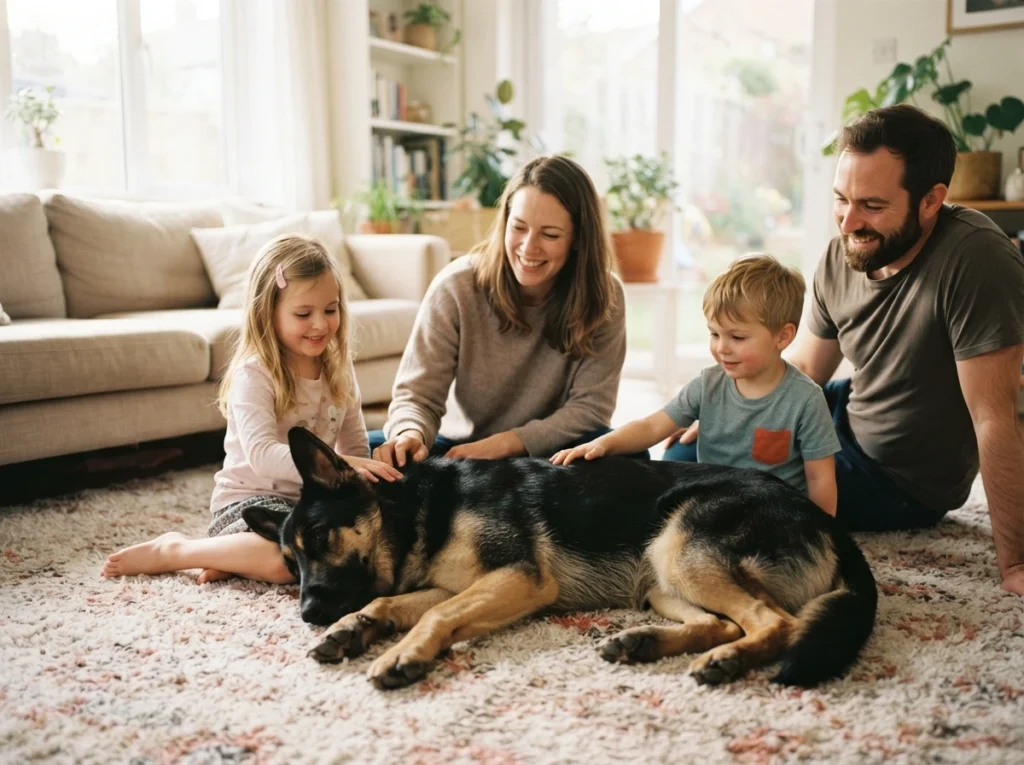
German Shepherd Dogs are typically loyal and protective with their own families, and with proper socialization, they tend to be gentle and patient with children. Their intelligence and trainability have made them one of the most consistently recommended breeds for active households willing to invest in real training.
This is also a breed where prospective owners need to plan for real daily engagement. German Shepherds were bred for versatile, demanding work, and without sufficient physical exercise and mental stimulation, that same intelligence and drive can turn into destructive or anxious behavior.
Training
German Shepherd Dogs are highly intelligent and eager to work, making them one of the most trainable breeds in existence, particularly with consistent, positive, reward-based methods. Early socialization and structured training help channel the breed’s natural drive and protective instincts into reliable, well-mannered behavior.
That trainability is exactly why the breed dominates police, military, and search-and-rescue work worldwide, alongside significant roles in guide and service dog programs. Von Stephanitz’s original “Utility and Intelligence” motto wasn’t marketing — it described a dog capable of learning complex, high-stakes tasks reliably, and that same capacity is what makes pet ownership demanding in a different way: a German Shepherd without structured mental work tends to invent its own jobs, which are rarely jobs an owner wants done. [FUTURE LINK: service and police dog breeds guide]
Exercise Needs
German Shepherd Dogs need substantial daily exercise, including vigorous walks, structured training sessions, and real mental stimulation, reflecting their heritage as an all-purpose working breed. Without adequate outlets, this breed’s intelligence and energy can become difficult to manage.
Grooming
The German Shepherd Dog’s medium-length double coat sheds significantly, particularly during seasonal blowouts, and benefits from regular brushing to manage loose fur. Routine ear checks, nail trims, and dental care round out a straightforward grooming routine for this breed.
Health and Lifespan: Hip Dysplasia and Degenerative Myelopathy
German Shepherd Dogs are commonly cited with a 7 to 10-year lifespan, though a 2024 UK study found a longer mean lifespan of 11.3 years, and the breed carries a serious, well-documented list of orthopedic and neurological health risks that responsible ownership requires taking seriously.
| Condition | What it is | What owners should watch for |
| Hip dysplasia | Skeletal disorder affecting hip joint development; present in an estimated 20% of German Shepherds | Reluctance to jump, altered gait, stiffness |
| Degenerative myelopathy | Incurable, progressive spinal cord disease typically appearing after age 7; affects an estimated 14.2% of tested dogs | Hind-limb weakness, dragging paws, eventual paralysis |
| Bloat/GDV | Life-threatening stomach distension and twisting requiring emergency treatment within 30–60 minutes | Distended abdomen, unproductive retching, restlessness |
| Elbow dysplasia | Skeletal disorder affecting elbow joint development | Front-leg lameness, stiffness after rest |
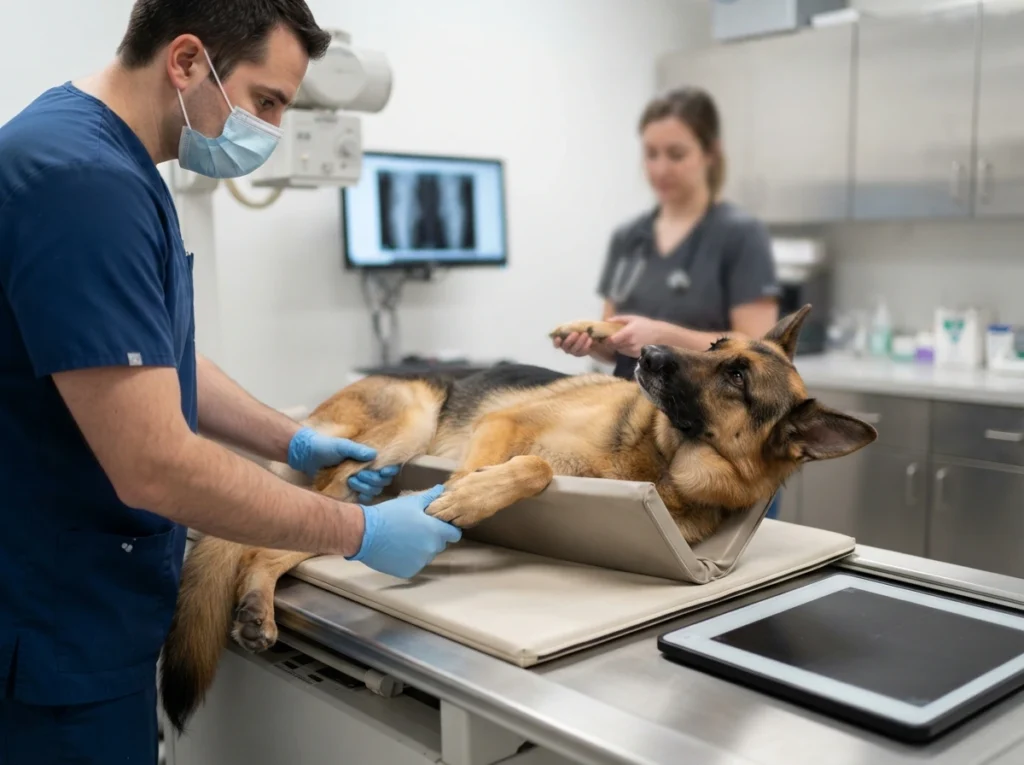
Hip dysplasia affects an estimated 20% of German Shepherds, driven by the breed’s large size and the genuine strain placed on developing joints — a risk that, as the section above explains, is meaningfully elevated in dogs bred for extreme hindquarter angulation. Responsible breeders screen parent dogs through OFA evaluation before breeding, and asking about both hip scores and topline/line type gives a fuller picture of a puppy’s orthopedic risk than either question alone.
Degenerative myelopathy is a separate, genuinely serious concern: an incurable, progressive spinal cord disease affecting roughly 14.2% of tested dogs, typically appearing after age 7 and leading to eventual hind-limb paralysis, though a genetic test for the SOD1 gene exists that allows breeders to identify carriers and reduce the disease’s prevalence over time. Overall, roughly half of all German Shepherds are likely to face at least one major orthopedic or neurological condition during their lifetime, underscoring why proactive screening matters so much for this breed. [FUTURE LINK: canine hip dysplasia screening guide]
Bloat, or gastric dilatation-volvulus (GDV), deserves separate emphasis because unlike hip dysplasia and DM, it isn’t a slow-developing condition — it’s a sudden, life-threatening emergency that can kill a healthy-seeming dog within hours if untreated. The breed’s deep, narrow chest is a known risk factor, and prevention centers on practical daily habits: feeding two or three smaller meals rather than one large one, avoiding vigorous exercise for an hour before and after eating, and using a slow-feed bowl if a dog tends to gulp its food. Any German Shepherd showing a visibly distended abdomen, unproductive retching, or sudden restlessness needs emergency veterinary care immediately, not a wait-and-see approach.
Nutrition
A high-quality diet formulated for large, active breeds suits the German Shepherd Dog well, with portion sizes monitored carefully and feeding schedules structured to reduce bloat risk, since this breed’s deep chest carries genuine GDV vulnerability.
Cost and Adoption
German Shepherd Dog puppies from reputable breeders typically range from $1,000 to $2,500, with annual ownership costs, including food, routine veterinary care, and the training and exercise this working breed genuinely requires, generally running $1,500 to $2,500. The German Shepherd Dog Club of America maintains breeder referral resources, and prospective owners should ask directly about hip screening and degenerative myelopathy genetic testing for any litter’s parent dogs before committing to a puppy.
Common Buyer Mistakes
- Choosing a puppy for appearance alone. An extreme sloped topline may look striking in photos but carries real orthopedic tradeoffs.
- Skipping hip and DM screening questions. Ask for OFA hip scores and SOD1 genetic test results on both parents.
- Underestimating the working-breed mindset. A GSD without a job — structured training, sport, or real daily purpose — often becomes an anxious or destructive one.
- Free-feeding or single large meals. Both increase bloat/GDV risk in a deep-chested breed; smaller, scheduled meals are safer.
- Assuming all lines are interchangeable. Working-line and show-line German Shepherds can differ meaningfully in energy, drive, and structure — match the line to your lifestyle, not just the breed name.
Frequently Asked Questions
Who created the German Shepherd Dog breed?
Max von Stephanitz, a former cavalry officer, who purchased the foundation dog Horand von Grafrath in April 1899 and founded the world’s first German Shepherd Dog club within a month.
Why was the German Shepherd called an Alsatian?
Anti-German sentiment during and after World War I led the UK Kennel Club to rename the breed the “Alsatian Wolf Dog” in 1919. The US restored “German Shepherd Dog” by around 1925, but the UK didn’t fully restore the name until 1977.
Are sloped-back German Shepherds unhealthy?
Dogs bred for extreme hindquarter angulation carry meaningfully elevated risk of hip dysplasia and earlier-onset osteoarthritis compared to straighter-backed working-line dogs. The original breed standard did not call for a pronounced slope.
Are German Shepherds prone to hip dysplasia?
Yes; an estimated 20% of German Shepherds develop hip dysplasia, which is why OFA screening of parent dogs is genuinely important.
How long do German Shepherds live?
Commonly cited at 7 to 10 years, though a 2024 UK study found a mean lifespan of 11.3 years.
Are German Shepherds good family dogs?
Generally yes, with proper socialization and training; they are typically loyal and protective, though their size and energy mean active engagement matters.
How much exercise does a German Shepherd need?
Substantial daily exercise, including vigorous walks, structured training, and real mental stimulation, reflecting the breed’s working heritage.
How much does a German Shepherd puppy cost?
Typically $1,000 to $2,500 from a reputable breeder, with annual ownership costs generally running $1,500 to $2,500.
Conclusion
The German Shepherd Dog’s documented history — a breed traceable to one specific 1899 dog show purchase, a name erased by two world wars’ worth of politics, and a modern silhouette debate with genuine health stakes — gives this breed a far richer story than its familiar reputation suggests. Owners who commit to real training and exercise, screen for hip dysplasia and degenerative myelopathy, and understand the tradeoffs behind working-line versus show-line structure tend to find the German Shepherd Dog an exceptionally capable and devoted companion.