Australian Cattle Dog: The Complete Guide to the Blue Heeler / Red Heeler Breed
Australian Cattle Dog
If you’ve ever seen a compact, speckled dog trotting a few feet behind its owner’s heels, watching everything and missing nothing, there’s a good chance you were looking at an Australian Cattle Dog. This breed goes by several names — Blue Heeler, Red Heeler, Queensland Heeler — and that alone trips up a lot of first-time researchers.
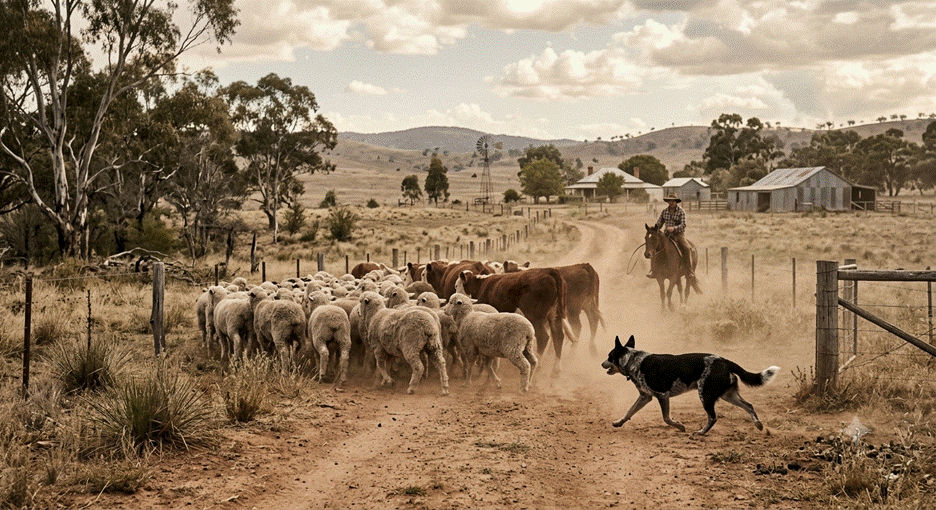
Here’s the short version: they’re all the same dog. The Australian Cattle Dog is a medium-sized herding breed built in 19th-century Australia to move stubborn cattle across brutal terrain, and it still carries that working history in almost everything it does, from how it thinks to how much exercise it needs to how it relates to the people and animals around it.
This guide draws on what the American Kennel Club, veterinary sources, and the breed’s own parent club say about the Australian Cattle Dog, and lays it out in one place: temperament, health, training, cost, and an honest answer to the question everyone’s really asking — is this the right dog for me?
Quick Facts
| Category | Details |
| Breed Group | Herding Group (AKC) / Pastoral Group (UK) |
| FCI Group | Group 1 |
| Origin | Australia (19th century) |
| Height | 17–20 inches |
| Weight | 30–50 lbs |
| Life Expectancy | 12–16 years |
| Temperament | Alert, loyal, independent, watchful |
| Energy Level | Very high |
| Trainability | High, but requires consistency |
| Shedding | Moderate year-round, heavy twice a year |
| Grooming | Low-to-moderate (weekly brushing) |
| Good With Children | Best with older, considerate kids |
| Good With Dogs | Good with early socialization |
| Good With Cats | Needs socialization; strong herding drive |
| Apartment Friendly | Not ideal without serious exercise commitment |
| Climate Adaptability | Good in both heat and cold with shelter |
| Beginner Friendly | Moderate — best for committed first-timers |
| Working Role | Cattle herding, guard dog, dog sports |
| AKC Recognition | 1980 (Herding Group since 1983) |
Breed Overview
Every trait this breed has today traces back to one job: moving cattle across huge distances of rough, hot, unforgiving land, sometimes for days at a stretch.
Purpose and original job. Nineteenth-century Australian ranchers needed a dog that could handle heat, distance, and half-wild cattle without losing its nerve or its focus. The dogs that could do that became the foundation of the breed.
What makes this breed unique. Few herding breeds combine this much physical toughness with this much independent thinking. An Australian Cattle Dog isn’t just obedient — it’s often smarter than its handler gives it credit for, which is exactly why it was so good at making split-second decisions around dangerous livestock.
Who should own this breed. Active people who want a real partner, not a couch companion, tend to do best here: runners, hikers, dog-sport competitors, rural families, and anyone with the time and patience to give a smart dog something to do, even if that something is just a well-structured daily training session.
History and Origin
The story starts with a problem. English herding dogs brought to Australia in the early 1800s weren’t built for the outback’s heat, distance, or half-wild cattle, and ranchers needed something tougher.
A New South Wales stockman named Thomas Hall is generally credited with laying the breed’s foundation. He crossed imported Blue Smooth Highland Collies with the native Dingo, producing what became known as “Hall’s Heelers” — dogs tough enough to drive cattle over long, punishing distances.
Later in the century, Sydney breeders Jack and Harry Bagust refined the temperament further by introducing Dalmatian and Black-and-Tan Kelpie bloodlines. That cross is a big part of why the modern Australian Cattle Dog is steadier and more companionable than its earliest working ancestors, while still holding onto serious drive.
A formal breed standard followed in the early 1900s, and around that time the dog took the name it carries today, having previously gone mostly by “Queensland Blue Heeler.” The American Kennel Club recognized the breed in 1980, and it moved into the newly formed Herding Group in 1983.
Did You Know?: Some Australian Cattle Dogs still carry a small white “star” on the forehead — a trait traced back to an early breeder named Thomas Bentley and still nicknamed “Bentley’s Mark” by breed enthusiasts today.
The Two Strains — Working Line vs. Companion/Show Line
Here’s something most guides skip entirely: there isn’t just one “type” of Australian Cattle Dog.
The older, 19th-century working strain is still common on working cattle stations in rural Australia. These dogs tend to be sturdier and boxier, with thicker bone and a more square build, traits selected purely for toughness and stamina rather than appearance.
The refined strain that emerged after the Dalmatian and Kelpie crosses is the type most familiar to companion owners and show competitors today. It’s generally a touch more polished in structure and, breeders say, a bit steadier in temperament, though still very much a working dog underneath.
Why does this matter to you? If you’re buying from a working-line breeder rather than a show-line one, you may end up with a dog that has noticeably higher drive and a stronger need for an actual job. It’s worth asking any breeder which line their dogs come from before you commit.
Appearance
Body
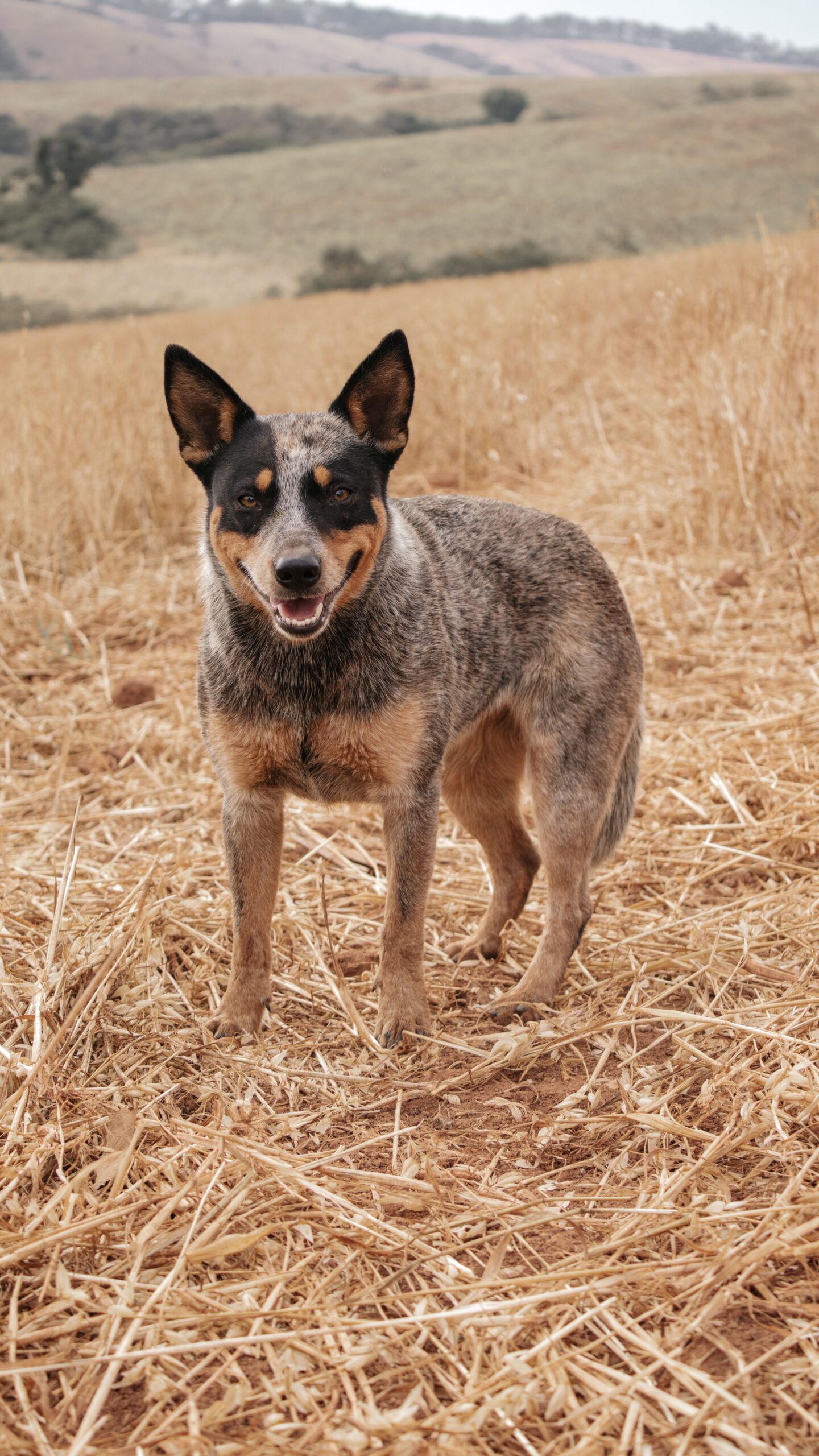
Compact, muscular, and built for endurance rather than speed. The chest is deep, the shoulders broad, and the overall look is one of coiled, efficient power, with nothing wasted and nothing delicate about it.
Head
A broad skull that flattens between the eyes, paired with muscular cheeks and a deep, powerful muzzle — features that hint at the Dingo in the breed’s ancestry.
Eyes
Oval-shaped and dark, with an alert, watchful expression that’s almost a breed signature. You can usually tell when an Australian Cattle Dog is quietly sizing up a situation.
Ears
Medium-sized, pricked, and set wide apart, with a bit of hair on the inside. They’re always upright and always tracking whatever has caught the dog’s attention.
Tail
Set moderately low, with a slight natural curve at rest, and left undocked.
Coat
A true double coat: a short, dense undercoat for insulation beneath a straight, weather-resistant outer coat that sheds rain and dirt with ease.
Colors
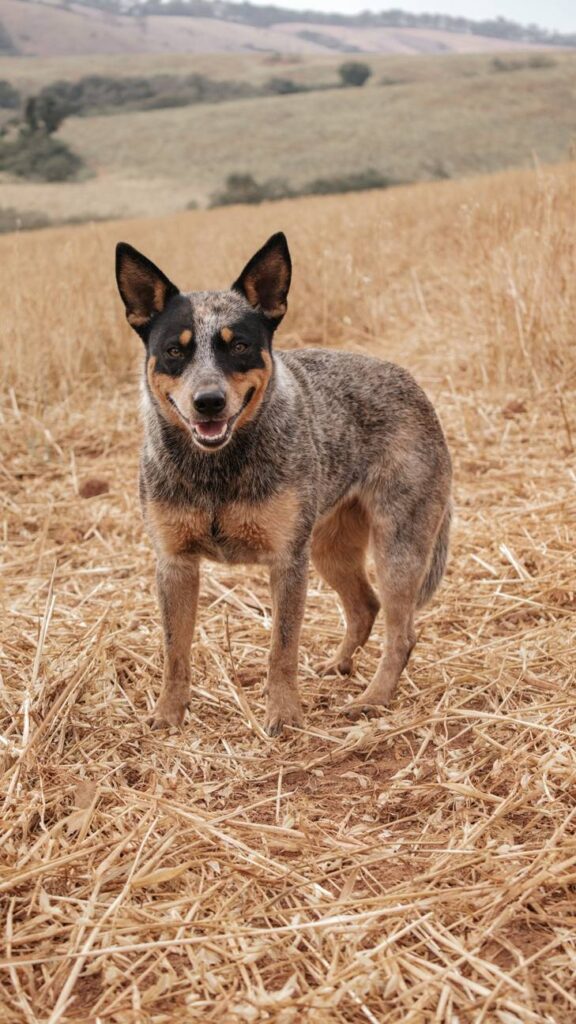
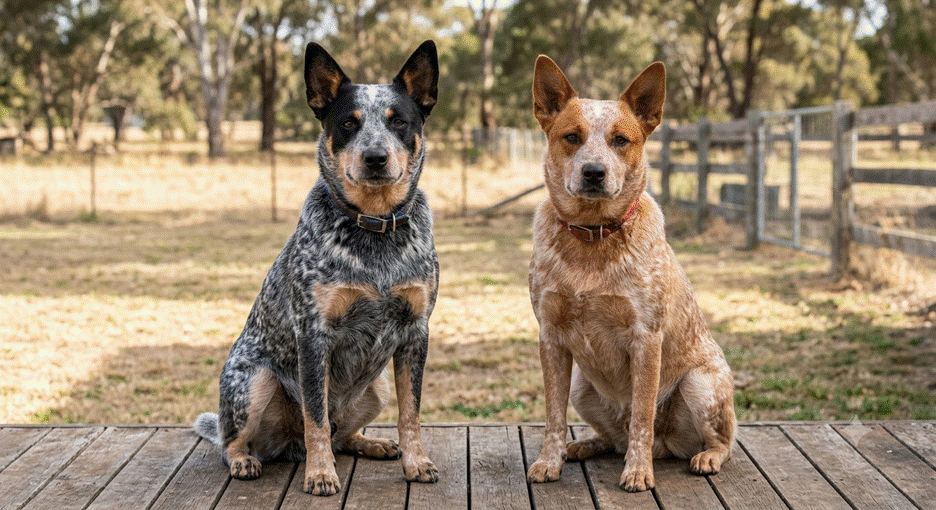
Blue (including blue mottled and blue speckled, sometimes with black or tan markings) and red speckle (with or without darker red head markings). Every puppy is born white or very pale, and true adult coloring shows up by around three weeks of age.
Unique Physical Traits
The “roan” appearance of the coat, dark hairs mixed evenly through white, is sometimes mistaken for merle patterning. It isn’t. Roan coloring in this breed doesn’t carry the same health risks associated with breeding two merle dogs together.
Size
Adult Australian Cattle Dogs stand roughly 17 to 20 inches at the shoulder, with males typically running a bit larger than females. It’s a genuinely medium-sized dog: solid and dense, but nowhere near as large as, say, a Labrador or German Shepherd.
Weight
Most adults weigh between 30 and 50 pounds. A healthy Australian Cattle Dog should look lean and muscled rather than stocky. Extra weight puts real strain on a breed already prone to joint issues, so keeping them trim matters more here than in many other breeds.
Coat Types
There’s really only one coat type recognized in this breed: the short, dense double coat described above. Unlike some herding breeds, there’s no long-haired variety in the standard.
Coat Colors
To recap in one place: blue, blue mottled, blue speckled, red mottled, and red speckled, each with the possibility of tan or darker head markings. Coat color has zero effect on temperament. A “Blue Heeler” and a “Red Heeler” are simply two color patterns of the exact same breed, nothing more.
| Nickname | What It Refers To |
| Blue Heeler | Australian Cattle Dog with a blue, blue-mottled, or blue-speckled coat |
| Red Heeler | Australian Cattle Dog with a red-mottled or red-speckled coat |
| Queensland Heeler | Regional nickname for the Australian Cattle Dog, either coat color |
| Australian Heeler | Alternate name for the Australian Cattle Dog |
Temperament
A lot of online guides quietly contradict each other on this point, so let’s be straightforward about it.
Australian Cattle Dogs are deeply loyal and often quite affectionate with their own family. Many owners describe them as “velcro dogs” that want to be near their people constantly. At the same time, the official breed standard and most experienced sources describe them as naturally reserved, even wary, with strangers. Both things are true at once. This isn’t a breed that greets every visitor like a long-lost friend, and that’s by design: it made them excellent watchdogs on isolated cattle stations, where a dog’s suspicion of strangers was a genuine asset.
Add in a strong independent streak, since these dogs were bred to make decisions on their own without waiting for instructions from a rider a quarter-mile away, and you get a dog that’s brilliant but not always easy. Stanley Coren’s well-known intelligence rankings place the breed 10th among all dogs for working and obedience intelligence: smart enough to learn fast, and just as likely to get bored fast if nothing’s asked of it.
Expert Tip: A watchful, slightly aloof reaction to a new person isn’t aggression. It’s this breed doing exactly what it was bred to do. Give your dog space and time to assess new people rather than forcing an interaction.
Is an Australian Cattle Dog Good With Kids?
Generally, yes, with real caveats. This breed tends to do best with older children who already understand how to interact calmly with a dog. The herding instinct that makes them nip at cattle heels doesn’t disappear around small, fast-moving, squealing kids; it just finds a new target.
Warning: Never leave an Australian Cattle Dog unsupervised with very young children, especially children who run and shriek during play. The nipping instinct is genetic rather than a training failure, and it needs active, ongoing management from day one.
Is an Australian Cattle Dog Good With Other Pets?
With early, consistent socialization, most Australian Cattle Dogs can live peacefully alongside other dogs and even cats. Skip that step, though, and the same herding drive that targets kids can turn into chasing, nipping, or outright conflict with smaller animals. Introduce this breed to other pets young, and keep introductions calm and supervised well into adulthood.
Personality
Ask ten Australian Cattle Dog owners to describe their dog’s personality and you’ll hear the same handful of words come up: busy, clever, devoted, stubborn. This is a dog with opinions. It will absolutely try to negotiate the rules with you, not out of defiance exactly, but because it’s genuinely always thinking about how to get what it wants.
The upside is real affection and loyalty that runs deep once trust is established. The tradeoff is a dog that doesn’t switch off easily and won’t thrive being ignored for long stretches.
Intelligence
Few breeds combine working intelligence and problem-solving drive quite like this one. That intelligence cuts both ways: it makes training genuinely rewarding, but it also means a bored Australian Cattle Dog will find its own “job,” and you probably won’t like the job it picks. Chewed furniture, dug-up yards, and relentless barking are common results.
Trainability
Difficulty Level
Moderate to advanced. Not because the breed struggles to learn, quite the opposite, but because its intelligence and independence call for a confident, consistent handler rather than a permissive one.
Positive Reinforcement
This breed responds best to reward-based training: treats, praise, and play used to mark and reinforce good choices. Harsh corrections tend to backfire, making an already wary dog even more suspicious or shut down.
Common Mistakes
New owners often under-train early on, assuming a smart dog will “just figure it out.” In reality, this breed needs structured, consistent rules from puppyhood, or it will happily set its own.
Common Mistake: Treating basic obedience as optional because the dog seems to “get it” quickly. Fast learning doesn’t mean training is finished; it just means you can move on to harder, more interesting challenges before boredom sets in.
Training Timeline
Basic obedience, including sit, stay, come, and loose-leash walking, typically clicks within the first few months of consistent, short training sessions. Bite inhibition and nipping control should start the day you bring a puppy home and continue actively through at least the first year. Advanced work such as agility, herding trials, and advanced obedience can continue for the dog’s entire working life, and honestly, most Australian Cattle Dogs are happiest when it does.
Exercise Needs
Daily
Plan on 60 to 120 minutes of real exercise every day for an adult. That means genuine physical output, not a leisurely stroll: brisk walking, running, fetch, or structured play.
Weekly
Beyond the daily walks, try to work in a few higher-intensity sessions each week, whether that’s a longer hike, an agility class, a swim, or herding-style games, to keep both body and brain engaged.
Mental Stimulation
Physical tiredness alone won’t satisfy this breed. Puzzle toys, scent games, trick training, and obedience work matter just as much as running the energy off.
Activities
- Running and hiking
- Fetch and frisbee
- Agility, obedience, and rally
- Dock diving and flyball
- Herding work, where access allows
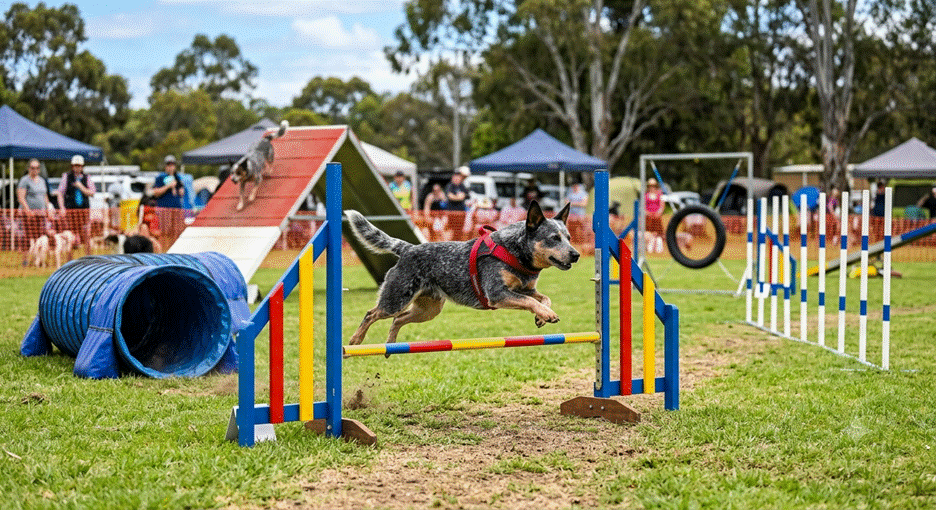
Common Mistake: Assuming a walk around the block covers this breed’s exercise needs. For a dog built to work cattle from sunrise to sunset, that’s barely a warm-up.
Grooming Guide
Brushing
Once a week is usually enough to manage everyday shedding, increasing to several times a week during the two annual shedding seasons, spring and fall, when the undercoat “blows” heavily.
Bathing
This breed is naturally low-odor and doesn’t need frequent baths. Every couple of months, or after a genuinely muddy adventure, is typically plenty. Bathing too often can strip protective coat oils.
Nails
Check every few weeks and trim as needed, though active dogs that spend a lot of time on hard surfaces may wear their nails down naturally.
Ears
Check regularly for wax buildup or debris, especially after swimming or time outdoors, and clean gently as your veterinarian recommends.
Dental Care
Brush several times a week with a dog-safe toothpaste, and schedule professional cleanings as your vet advises.
Seasonal Shedding
Expect two noticeably heavier shedding periods a year, usually spring and fall, when the dense undercoat releases in much larger amounts than usual.
Quick Fact: Australian Cattle Dogs are not a hypoallergenic breed. Their shedding, especially during seasonal coat blow, releases dander that can trigger allergies.
Nutrition
Puppy
A large-breed puppy formula is generally the right call, since it’s designed to moderate growth rate and reduce strain on developing joints, an important consideration given the breed’s risk of hip dysplasia.
Adult
Look for an AAFCO-approved, complete-and-balanced adult formula suited to an active, working-type breed. Given their energy output, many Australian Cattle Dogs do well on calorically dense, high-quality diets split into two meals a day.
Senior
As activity naturally slows with age, senior dogs often need adjusted calorie intake and may benefit from joint-support supplements like glucosamine and chondroitin.
Water Needs
Fresh water should be available at all times, which matters even more for a breed that runs hot during heavy exercise.
Treat Recommendations
Use treats strategically for training, and keep overall treat calories to a small share of daily intake to avoid weight gain in a breed already prone to joint stress.
Foods to Avoid
- Chocolate
- Grapes and raisins
- Onions and garlic
- Xylitol (found in many sugar-free products)
- Alcohol
Always check with your veterinarian before introducing any new supplement or homemade diet component.
Health
Australian Cattle Dogs are generally a hardy, long-lived breed, but like every purebred dog, they carry some known risks worth understanding before you buy or adopt.
| Condition | What It Is | Screening/Test | Management |
| Hip Dysplasia | Loose fit of the hip joint, can lead to arthritis | PennHIP X-ray screening | Weight management, joint supplements, medication, or surgery |
| Elbow Dysplasia | Malformation of the elbow joint | Veterinary orthopedic evaluation | Similar to hip dysplasia management |
| Progressive Retinal Atrophy (PRA) | Gradual retinal degeneration leading to blindness | Ophthalmologist eye exam, genetic testing | No cure; most dogs adapt well |
| Congenital/Hereditary Deafness | Inherited hearing loss, one or both ears | BAER test | No cure; training adaptations (hand signals) |
| Hereditary Polioencephalomyelopathy | Rare inherited neurological condition | Genetic screening where available | No treatment; extremely rare |
Vet Advice: Before buying a puppy, ask the breeder for documented PennHIP or OFA hip evaluations, current eye exam results, and BAER hearing test results on both parents. Reputable breeders will have this paperwork ready without hesitation.
Warning Signs
Keep an eye out for limping or reluctance to jump, which can point to joint issues, cloudiness or reduced night vision, which can signal early PRA, or a lack of response to sounds, which may indicate hearing loss, especially in puppies.
Preventive Care
Keep up with routine vaccinations, parasite prevention, and dental care, and maintain a lean body weight throughout the dog’s life. Extra pounds accelerate joint problems in this breed more than in many others.
Vet Check Schedule
Puppies need a series of wellness visits through their first year for vaccines and growth monitoring. Adults generally do well with annual exams, moving to twice-yearly checkups as dogs enter their senior years, typically around 8 to 10 for this breed.
Genetic Testing
DNA-based carrier and health-risk testing has become widely available and can flag a dog’s risk for several inherited conditions before symptoms ever appear. It’s not a substitute for physical screening tests like PennHIP or BAER, but it’s a valuable additional layer of information for anyone planning to breed, and useful peace of mind for pet owners too.
Lifespan
Most Australian Cattle Dogs live between 12 and 16 years, and many stay active and engaged well into their senior years. Interestingly, this breed holds the Guinness World Record for oldest dog ever documented: a cattle dog named Bluey, reportedly lived to 29. That’s a remarkable outlier rather than a realistic expectation, but it does speak to just how hardy this breed can be with good care.
Living With Children
Older, considerate kids and Australian Cattle Dogs are often a great match. The dog is playful, loyal, and up for adventure right alongside them. The relationship gets trickier with toddlers or very young children, whose sudden movements and high-pitched noise can trigger the breed’s herding instinct. Supervision and early training aren’t optional extras here; they’re the foundation the whole relationship rests on.
Living With Other Dogs
Socialized early, this breed generally does fine with other dogs, though its confident, sometimes bossy nature means introductions should be gradual and calm. Some individuals can be less tolerant of unfamiliar dogs, particularly ones of the same sex.
Living With Cats
Success here comes down almost entirely to early exposure. A cattle dog raised alongside a cat from puppyhood will often treat that specific cat as part of its “flock” to protect rather than chase. New cats introduced to an adult dog later in life need careful, gradual management instead.
Apartment Living
It’s possible, but genuinely hard to do well. This breed’s exercise and mental stimulation needs are high enough that apartment life only works with an owner who’s absolutely committed to multiple long, vigorous outings every single day, rain or shine.
Farm Life
This setting is much closer to the breed’s natural habitat. Access to space, jobs, and stimulation makes farm or rural life an easy, satisfying fit for an Australian Cattle Dog, assuming there’s still supervision around actual livestock if the dog isn’t specifically trained for herding work.
Hot Weather
Bred for the Australian Outback, this breed tolerates heat reasonably well, though the standard precautions still apply. Give them access to shade and water, avoid exercise during peak midday heat, and watch for signs of overheating during intense activity.
Cold Weather
The double coat provides solid insulation for a breed of this size, and most Australian Cattle Dogs handle cold weather, even snow, with real enthusiasm. That said, they’re not meant to live outdoors full-time in harsh climates. They do best sleeping indoors with their family.
Travel Tips
This breed generally travels well, thanks to its adaptable, work-anywhere temperament, but plan around its exercise needs on the road. A tired cattle dog is a good travel companion; a pent-up one is not. Crate training in advance makes car rides, hotel stays, and vet visits far less stressful for everyone involved.
Pros and Cons
| Pros | Cons |
| Extremely intelligent and trainable | Needs 1–2+ hours of real exercise daily |
| Deeply loyal and affectionate with family | Reserved, sometimes wary with strangers |
| Long lifespan for a medium-sized dog | Strong nipping/herding instinct needs active management |
| Low grooming maintenance | Not hypoallergenic; heavy seasonal shedding |
| Excellent watchdog instincts | Can become destructive if under-stimulated |
| Thrives in dog sports and working roles | Not well suited to apartment living or sedentary owners |
| Generally healthy, hardy breed | Prone to hip/elbow dysplasia and some hereditary conditions |
Is This Breed Right for You?
Lifestyle
If your week already includes regular running, hiking, or active outdoor time, this breed can genuinely enhance that lifestyle. If your ideal evening is the couch and a show, this probably isn’t the right match, at least not without a serious, honest look at how you’ll meet its needs.
Budget
Beyond the purchase or adoption cost, budget for quality food, routine and emergency veterinary care, training, and joint-support supplements as the dog ages. You’ll find the full cost breakdown below.
Experience Level
First-time owners can absolutely succeed with this breed, but only with real commitment to training, socialization, and daily exercise from day one. This isn’t a “figure it out as you go” breed for a casual or hands-off owner.
Living Space
A securely fenced yard is a major asset. It’s not strictly required, but without one, you’ll need to be even more disciplined about structured daily exercise.
Time Commitment
Plan on real, active time with this dog every single day, and not just physical exercise, but training and engagement too. This is a relationship-based breed, not a “let it out in the yard” breed.
Who Should NOT Get an Australian Cattle Dog
- You work long hours away from home with no plan for exercise, a dog walker, or daycare.
- You live in a small apartment and aren’t prepared to commit to multiple vigorous outings daily.
- You want a low-maintenance, easygoing dog that doesn’t need daily training and mental engagement.
- Your household includes only very young children with no realistic plan for supervision.
- You’re not prepared to manage nipping and herding behavior with consistent, patient training.
Checklist: Is This Breed Right for You?
- ☐ I can commit to 1–2 hours of real exercise daily, every day, indefinitely.
- ☐ I’m prepared to socialize and train consistently from puppyhood onward.
- ☐ I understand this breed may always be reserved with strangers.
- ☐ I have a plan for supervising young children or other pets around the dog.
- ☐ I’ve budgeted for both routine and breed-specific emergency veterinary costs.
Weekly Care Checklist
- ☐ Daily exercise: 60–120 minutes of vigorous activity
- ☐ Daily mental stimulation: training, puzzle toy, or trick session
- ☐ Brush coat 1–2x (more during shedding season)
- ☐ Check ears for debris or odor
- ☐ Brush teeth several times through the week
- ☐ Check nails; trim if needed
- ☐ Review training goals and practice new skills
- ☐ Confirm fresh water and appropriate food portions daily
Temperament Ratings
| Trait | Score (1–5) |
| Family Friendliness | 4 |
| Trainability | 5 |
| Energy Level | 5 |
| Guarding Instinct | 4 |
| Affection | 4 |
| Playfulness | 5 |
| Drooling | 1 |
| Shedding | 3 |
| Barking | 2 |
| Adaptability | 3 |
| Apartment Suitability | 2 |
Puppy Growth Timeline
| Age | Development Milestones |
| 8–12 weeks | Home arrival, basic house training, early socialization, gentle bite-inhibition work begins |
| 3–4 months | First vaccination series completing, basic cues introduced, short structured exercise only |
| 5–6 months | Adult teeth coming in, continued socialization, leash manners, energy increasing |
| 6–12 months | Adolescence — testing boundaries, consistent training reinforcement needed |
| 12–18 months | Approaching physical maturity, full exercise capacity developing |
| 18–24 months | Generally physically and behaviorally mature; true adult temperament settling in |
[ INSERT IMAGE HERE ]
Caption: Australian Cattle Dog puppies are born white and develop their true coat color by about three weeks.
Alt Text: Australian Cattle Dog puppy with light/white coat
Suggested File Name: australian-cattle-dog-puppy-white-coat.jpg
Feeding Guide
| Life Stage | Meals/Day | Food Type | Notes |
| Puppy (8 wks–6 mo) | 3–4 | Large-breed puppy formula | Controlled growth rate protects joints |
| Puppy (6–12 mo) | 2–3 | Large-breed puppy formula | Transition toward adult schedule |
| Adult | 2 | AAFCO-approved adult formula | Adjust portions to activity level |
| Senior | 2 | Senior or joint-support formula | Monitor weight; consider supplements |
Grooming Schedule
| Task | Frequency |
| Brushing (normal season) | Weekly |
| Brushing (shedding season) | 3–4x per week |
| Bathing | Every 2–3 months, or as needed |
| Nail trim | Every 3–4 weeks (or as needed) |
| Ear check | Weekly |
| Teeth brushing | 3–5x per week |
| Professional dental cleaning | As recommended by your vet |
Exercise Schedule
| Life Stage | Daily Exercise |
| Puppy (under 6 months) | Short, frequent sessions (avoid overexertion on joints) |
| Young adult (6–24 months) | 45–90 minutes, building gradually |
| Adult | 60–120 minutes of vigorous activity |
| Senior | 30–60 minutes, moderate intensity, adjusted to comfort |
Cost of Ownership
| Category | Estimated Cost |
| Puppy purchase price | $800–$1,500 (reputable breeder); adoption fees typically lower |
| First-year costs | Roughly $3,000–$4,000 |
| Food (monthly) | $30–$60 |
| Pet insurance (monthly) | Roughly $35–$85 |
| Routine vet care (annual) | $200–$500 |
| Grooming supplies/services (annual) | $100–$300 |
| Training classes | $50–$250 per session/course |
| Estimated lifetime cost (12–16 yrs) | Roughly $20,000–$28,000+ |
These figures are general estimates based on national averages as of 2026 and will vary by region, breeder, and individual dog’s health needs. Emergency veterinary costs aren’t included and can add significantly to lifetime totals.
Warning: Be cautious of puppies priced far below the typical range. Unusually cheap puppies are a common red flag for puppy mills or backyard breeders who skip essential health testing, savings up front that often cost far more later in vet bills.
Common Mistakes New Owners Make
- Underestimating daily exercise needs and ending up with a bored, destructive dog.
- Skipping early socialization, leading to an adult dog that’s overly wary or reactive.
- Allowing nipping “because it’s cute” as a puppy, then struggling to correct it later.
- Choosing this breed based on looks or a favorite TV character without researching its real energy and training needs.
- Not asking breeders for health-screening documentation before buying.
Expert Tips
- Start structured training and socialization the very first week home. Don’t wait for “bad habits” to appear before addressing them.
- Give this breed a literal or figurative job every day. A task-oriented mind left idle will invent its own tasks, usually ones you won’t appreciate.
- Use food puzzles and scent games on low-exercise days, like during bad weather or travel, to keep mental engagement consistent.
- Ask breeders directly which strain, working or show line, their dogs descend from, since it affects real-world energy level.
- Build a relationship with a veterinarian familiar with the breed’s specific screening needs (hips, eyes, hearing) from puppyhood onward.
Myths vs Facts
| Myth | Fact |
| Blue Heelers and Australian Cattle Dogs are different breeds. | They’re the same breed; the nicknames simply describe coat color. |
| This breed is naturally aggressive. | It’s naturally reserved and watchful, which is different from aggressive. |
| A big backyard alone meets this breed’s exercise needs. | Mental stimulation and active engagement matter just as much as space. |
| Roan coat coloring is a form of merle. | Roan and merle are genetically and visually distinct traits. |
| This breed is hypoallergenic because its coat is short. | It sheds significantly, especially seasonally, and isn’t hypoallergenic. |
| Any active family can handle this breed easily. | Activity alone isn’t enough; training and socialization are equally essential. |
Interesting Facts
- Every Australian Cattle Dog puppy is born white or very pale, developing its true blue or red coloring over the following weeks.
- The breed’s nickname “heeler” comes directly from its working technique: nipping at the heels of cattle to move them along.
- A cattle dog named Bluey holds the Guinness World Record for the oldest dog ever documented, reportedly living to 29 years old.
- The breed’s forehead “star” marking, seen in some individuals, is nicknamed “Bentley’s Mark” after an early breeder.
- The children’s animated series Bluey features a family of Australian Cattle Dogs, introducing an entirely new generation to the breed, though the show’s gentle depiction understates just how much exercise and structure these dogs need in real life.
Frequently Asked Questions
Is an Australian Cattle Dog a good family dog?
Yes, for the right family. They’re loyal and affectionate with their own household, but they do best with older, considerate children and owners committed to consistent training and exercise.
How much exercise does an Australian Cattle Dog need per day?
Adults generally need 60 to 120 minutes of real physical activity daily, combined with mental stimulation like training or puzzle toys.
Are Australian Cattle Dogs hypoallergenic?
No. They shed moderately year-round and heavily during two seasonal periods each year, which makes them unsuitable for most people with dog allergies.
Why do Australian Cattle Dogs nip or bite?
Nipping is rooted in the breed’s herding instinct, historically used to move cattle by nipping at their heels. Without training, that instinct can transfer to people, especially fast-moving children.
How long do Australian Cattle Dogs live?
Most live between 12 and 16 years, and the breed is known for its overall hardiness.
What is the difference between a Blue Heeler and an Australian Cattle Dog?
None. A Blue Heeler is simply an Australian Cattle Dog with a blue-toned coat. They’re the same breed.
What is the difference between a Blue Heeler and a Red Heeler?
Only coat color. Blue Heelers have blue, blue-mottled, or blue-speckled coats; Red Heelers have red-mottled or red-speckled coats. Temperament and health needs are identical.
Are Australian Cattle Dogs good with other pets, like cats?
They can be, especially when raised with a cat from puppyhood. Without early socialization, their herding instinct can lead to chasing behavior.
Are Australian Cattle Dogs aggressive?
Not inherently. They’re naturally reserved and watchful with strangers, which can be mistaken for aggression, but proper socialization typically produces a confident, non-aggressive adult.
Can an Australian Cattle Dog be left alone during the day?
For short periods, yes, especially once well exercised beforehand. Extended, regular isolation without adequate exercise or enrichment often leads to anxiety and destructive behavior in this breed.
How much does an Australian Cattle Dog puppy cost?
Typically $800 to $1,500 from a reputable breeder, though prices vary by region and bloodline. Adoption fees from rescues are usually lower.
What health problems are common in Australian Cattle Dogs?
The main concerns are hip and elbow dysplasia, progressive retinal atrophy, and hereditary deafness. Reputable breeders screen for all three.
Are Australian Cattle Dogs good for first-time dog owners?
They can be, but only for first-time owners who are genuinely prepared for a high-energy, intelligent dog that needs daily structure, training, and exercise from day one.
Is Bluey (from the TV show) an accurate representation of the breed?
Partially. The show captures the breed’s playful, loyal spirit, but real Australian Cattle Dogs need considerably more structured exercise and training than the cartoon depicts.
What is the difference between an Australian Cattle Dog and an Australian Shepherd?
They’re different breeds with different origins. The Australian Cattle Dog descends from Dingo and Collie crosses developed in Australia, while the Australian Shepherd was actually developed in the United States despite its name.
Conclusion
The Australian Cattle Dog isn’t a breed that fits quietly into just any household, and that’s exactly the point. It was built to think independently, work hard, and stay devoted to the people it trusts, and it brings all of that intensity home with it. For an active owner willing to match that energy with consistent training, daily exercise, and genuine engagement, few breeds offer this much intelligence, loyalty, and personality in return.
If your lifestyle already has room for long walks, regular training sessions, and a dog that wants to be part of everything you do, an Australian Cattle Dog can be one of the most rewarding companions you’ll ever own. If you’re looking for a low-key, low-maintenance pet that’s happy being left alone for long stretches, this probably isn’t your breed, and knowing that now, before you bring one home, is the kindest thing you can do for both of you.