Afghan Hound: The Complete Guide to This Regal, High-Maintenance Sighthound
Afghan Hound
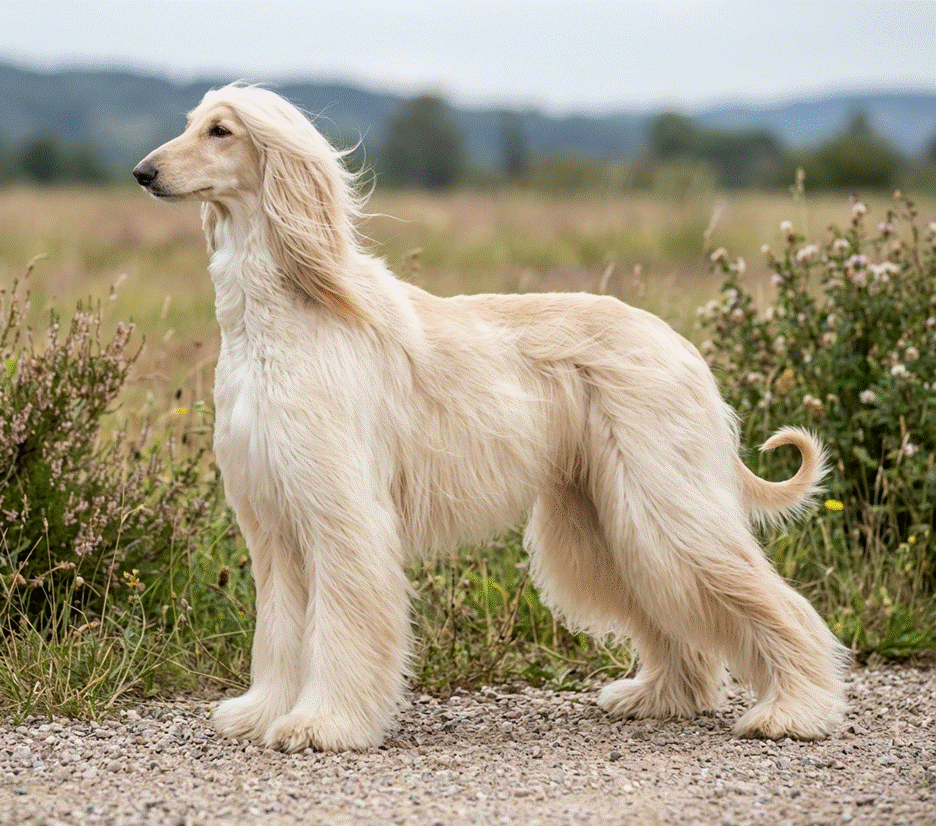
Few breeds turn heads quite like the Afghan Hound. With its flowing silky coat, narrow aristocratic face, and effortlessly elegant gait, it looks like it walked straight out of a royal court rather than off a mountainside. That mountain heritage is exactly where the breed comes from, though — the Afghan Hound was built by necessity in the harsh terrain of Afghanistan, long before it became a fixture of dog shows and glossy photo shoots. This guide walks through what the breed is really like to live with, including the grooming commitment most articles gloss over, so you can decide honestly whether it’s the right fit.
Afghan Hound Quick Facts
| Attribute | Detail |
| AKC Group | Hound Group |
| FCI Group | Group 10, Section 1 (Long-haired or fringed Sighthounds), Standard No. 228 |
| Country of Origin | Afghanistan |
| Height | 25–27 in at the shoulder |
| Weight | 50–60 lb |
| Lifespan | 12–15 years |
| Coat | Long, silky, dense |
| Colors | Black, cream, blue, tan, red, brindle, and combinations |
| Temperament | Independent, dignified, aloof, loyal |
What Is an Afghan Hound?
Origins in the Mountains of Afghanistan
The Afghan Hound’s history stretches back thousands of years, making it one of the oldest known dog breeds. It was developed by the Bedouin people of Afghanistan to hunt gazelle and other fast game across the rugged, high-altitude terrain of the Hindu Kush. That environment shaped nearly everything about the dog: its long coat evolved as protection against brutal mountain cold, while its speed, keen sight, and independent hunting instincts let it chase prey across terrain no human could follow closely.
From Hunter to Show Dog
The breed’s introduction to the Western world came through British army officers who brought various sighthounds back from Afghanistan and India in the 1800s, where they were exhibited under names like “Barukzy hounds.” The American Kennel Club formally recognized the Afghan Hound in 1926, placing it in the Hound Group [Internal Link: Hound Group], where it has remained ever since. The Afghan Hound Club of America joined the AKC in 1940 and continues to serve as the breed’s primary steward in the US today.
Appearance & Coat
Size and Build
Adult Afghan Hounds stand a substantial 25 to 27 inches at the shoulder and typically weigh between 50 and 60 pounds, making this a large breed with the lean, long-legged build characteristic of sighthounds bred for speed over open terrain.
The Famous Silky Coat and Colors
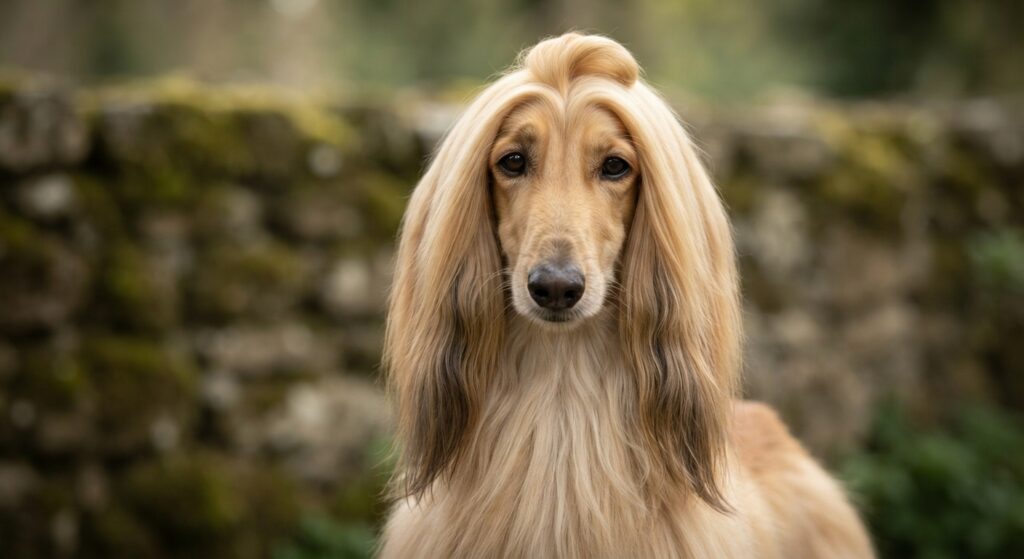
The coat is the Afghan Hound’s signature feature: long, fine, and silky, falling in flowing layers over the body while staying short along the back in what’s known as the “saddle.” It comes in an unusually wide color range, including black, cream, blue, tan, red, and brindle, along with various combinations — the breed standard treats all colors equally, so choosing one is purely a matter of personal preference.
Temperament and Personality
Afghan Hounds carry themselves with a kind of aristocratic reserve that owners often describe as aloof or dignified. This isn’t unfriendliness so much as independence: the breed was built to think for itself while chasing game across mountainous terrain far from human direction, and that self-reliant instinct is still very much intact.
Underneath the composed exterior, though, most Afghan Hounds have a genuinely affectionate, even silly side that comes out around family, paired with real loyalty. They tend to be reserved with strangers rather than outgoing, and they’re notably quiet dogs that rarely bark, which surprises people who expect a large hound to be vocal.
Is an Afghan Hound Right for You?
First-Time Owners
This is a breed that experienced dog people generally recommend against as a first dog. The combination of independent thinking, a serious grooming workload, and a temperament that doesn’t respond to heavy-handed correction means new owners often find themselves overwhelmed. Afghan Hounds do best with owners who already understand patient, positive training and are prepared for the coat-care routine described below.
Families and Children
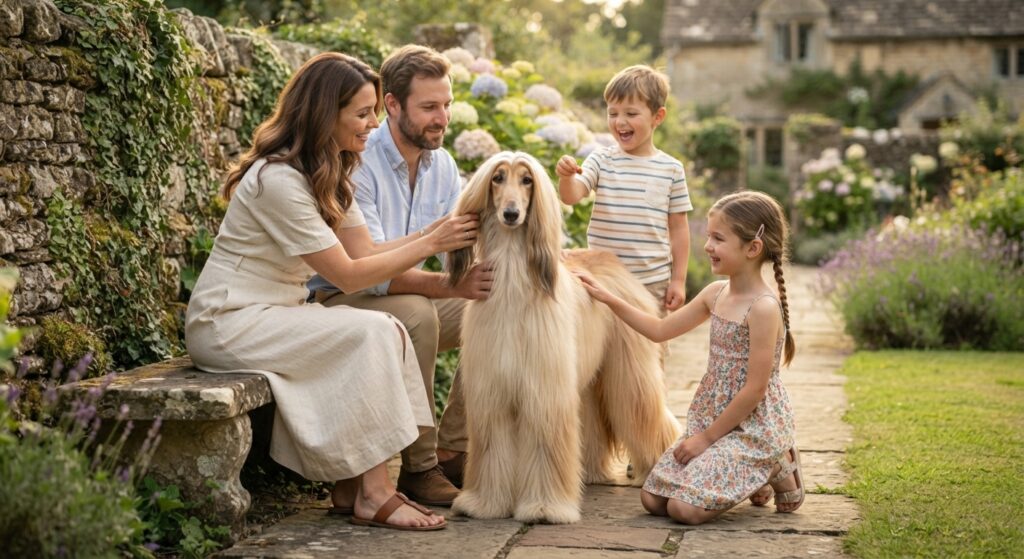
Afghan Hounds can be affectionate family companions, particularly with children who are calm and respectful of the dog’s space, since the breed’s reserved nature doesn’t always mesh well with boisterous, unpredictable play.
Other Pets
The breed’s strong prey drive — a direct legacy of its hunting background — means caution is warranted around cats, small dogs, and other small animals unless the Afghan Hound has been carefully socialized with them from a young age.
Apartment and Climate Considerations
Given their size and exercise needs, Afghan Hounds generally do better with more space than a small apartment provides, though a fenced yard is more important than square footage. Their coat offers real protection in cold weather, a holdover from their mountain origins, but they can struggle in intense heat and need shade and water management during summer activity.
Training an Afghan Hound
Training an Afghan Hound tests an owner’s patience more than most breeds. It’s an independent thinker by design — bred for centuries to make hunting decisions on its own — and that instinct doesn’t disappear just because the dog now lives in a house instead of the Hindu Kush. Commands that other breeds pick up in a few repetitions might take an Afghan Hound considerably longer, not from lack of intelligence but from a genuine lack of interest in instant obedience.
Gentle, consistent, positive-reinforcement training works far better than corrections, which tend to shut the breed down rather than motivate it. Short, engaging sessions with high-value rewards, combined with realistic expectations about pace, tend to produce the best long-term results.
Exercise Needs
Afghan Hounds need real daily exercise, not just a short stroll around the block. A long walk or jog is a good baseline, but the breed’s sighthound instincts are best satisfied by regular sprints in a securely fenced area, where quality of movement matters more than sheer distance covered.
Safety Note: Because of an intense prey drive, Afghan Hounds should never be let off-leash in an unfenced or unsecured space. A sighthound in pursuit of something that catches its eye can cover ground faster than most owners can react.
Grooming: The Real Time Commitment
This is the section prospective owners most need to read carefully. An Afghan Hound’s silky coat requires daily brushing with a proper pin brush to prevent mats and tangles from forming in the long hair. Beyond daily maintenance, most owners and breeders recommend a more thorough grooming and bathing session at least twice a week, and dogs kept in full show coat may need even more.
Grooming Tip: Start the grooming routine in puppyhood. Afghan Hound Club of America grooming guidance emphasizes that dogs acclimated to frequent brushing and handling from a young age tolerate the lifelong routine far better than dogs introduced to it as adults.
Altogether, this adds up to a genuine daily and weekly time commitment — realistically an hour or more of dedicated grooming multiple times per week — that should factor heavily into anyone’s decision to bring one home.
Health and Lifespan
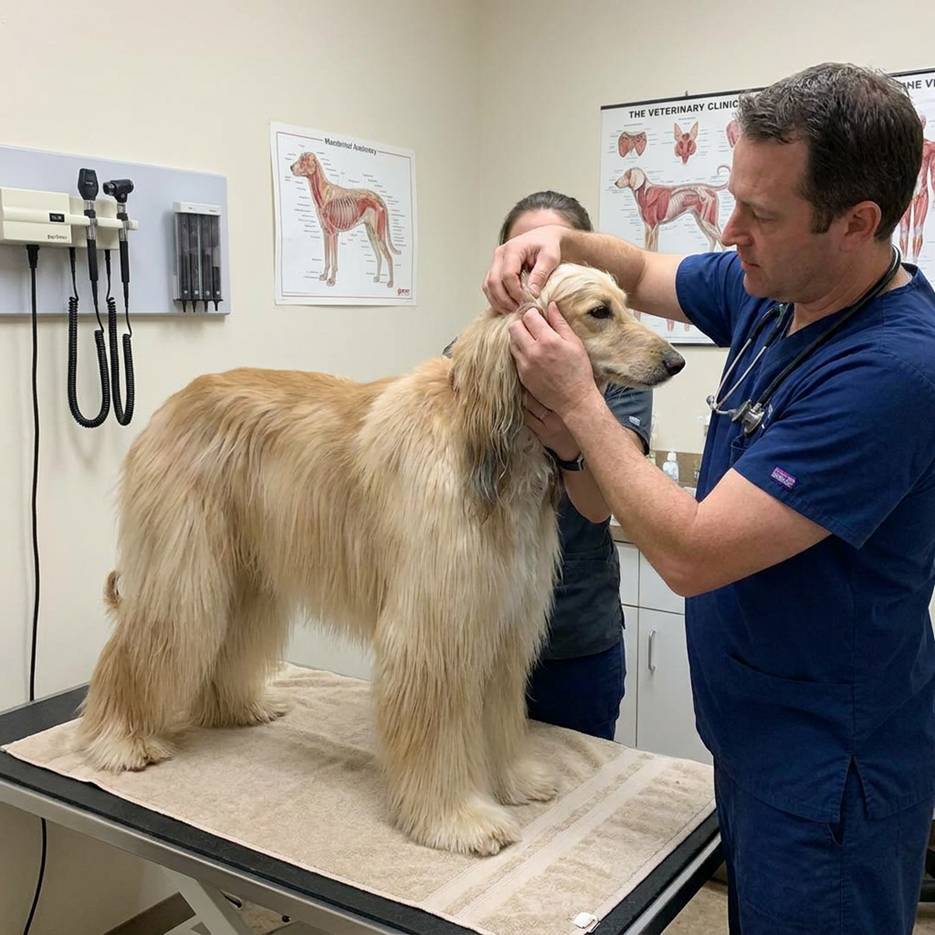
Most Afghan Hounds live between 12 and 15 years, though outcomes vary by individual health and care. A number of breed-associated conditions are worth understanding before ownership.
| Condition | What It Is | What Owners Should Watch For |
| Bloat (GDV) | Life-threatening stomach distension/twisting, more common in deep-chested breeds | Restlessness, distended abdomen, unproductive retching — emergency care |
| Anesthesia sensitivity | Sighthounds process certain anesthetic drugs differently due to low body fat | Requires a vet experienced with sighthound-safe protocols |
| Hypothyroidism | Underactive thyroid affecting metabolism and weight | Weight gain, lethargy, coat changes — manageable with medication |
| Progressive retinal atrophy (PRA) | Inherited, gradual loss of vision | Night vision loss progressing over time |
| Cataracts / Glaucoma | Age-related eye conditions | Cloudy eyes, vision changes, eye pain |
| Hip dysplasia | Improperly formed hip joint | Limping, stiffness, reduced activity |
| Panosteitis | Painful bone condition in young, growing dogs | Shifting-leg lameness in adolescence |
| Laryngeal paralysis | Airway muscle weakness affecting breathing | Noisy breathing, exercise intolerance, worsens over time |
| Afghan Hound myelopathy | Breed-specific spinal cord degeneration | Progressive hind-limb weakness or coordination loss |
The anesthesia sensitivity point deserves special attention: because sighthounds like the Afghan Hound carry less body fat than many other breeds, they metabolize certain anesthetic drugs differently, and it’s worth confirming with any vet ahead of a procedure that they’re familiar with sighthound-appropriate protocols. [Internal Link: sighthound anesthesia sensitivity]
Nutrition
A high-quality large-breed formula suited to an active dog is generally appropriate for an Afghan Hound, ideally one that supports lean muscle without packing on excess weight that would strain a frame built for speed rather than bulk. Because the breed is at elevated risk for bloat, feeding practices matter as much as food quality: smaller, more frequent meals rather than one large feeding, slow-feeder bowls to reduce gulping, and avoiding vigorous exercise immediately before or after eating are all commonly recommended precautions.
Fresh water should be available at all times, and owners who notice their dog gulping food or water unusually fast may want to talk to their vet about additional bloat-prevention strategies, given how serious and fast-moving the condition can become once it starts.
Cost and Finding a Breeder
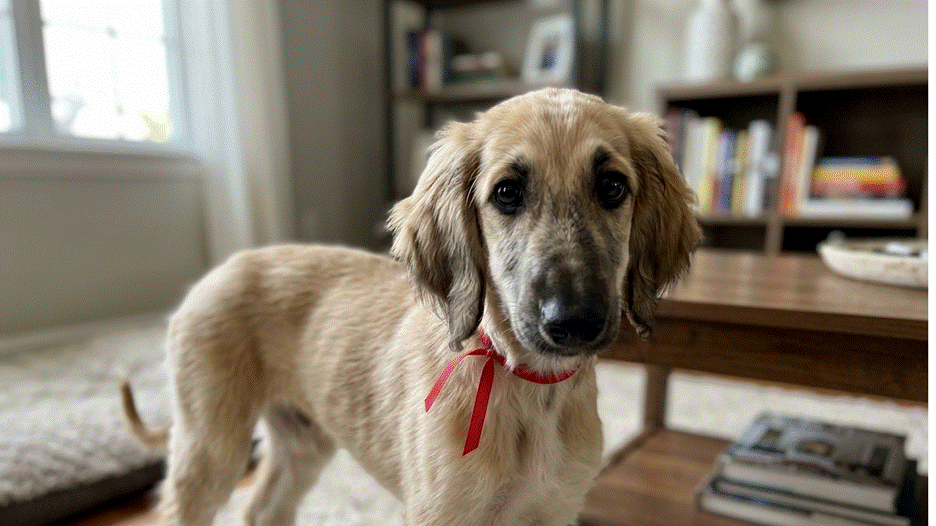
Afghan Hound puppy prices vary widely — reported figures across breeders and regions range from roughly $1,000 to $3,000 or more, depending on lineage, show potential, and breeder reputation, so this should be treated as a broad guide rather than a fixed number. Adoption through breed-specific rescue is typically far less expensive.
Given the breed’s specialized grooming and temperament needs, working with a reputable breeder [Internal Link: reputable breeder] connected to the Afghan Hound Club of America is worth the extra effort. Ask about health testing on the parents, temperament of the line, and whether the breeder provides grooming guidance and ongoing support after the puppy goes home.
Related Sighthound Breeds
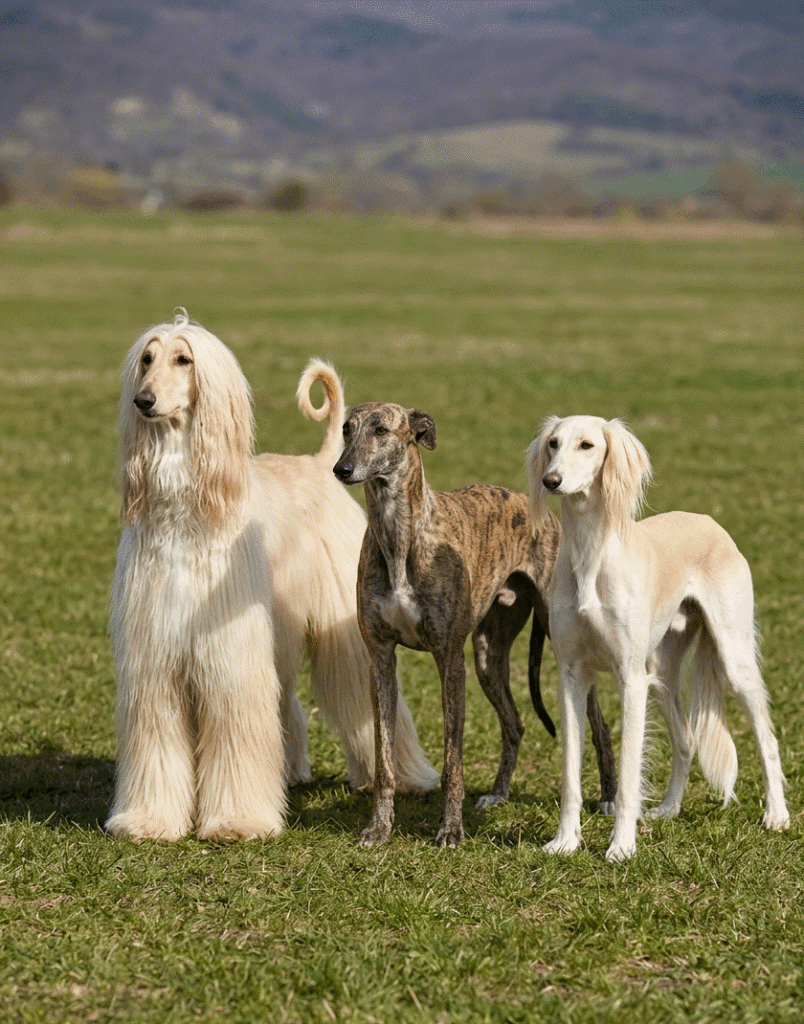
The Afghan Hound belongs to the broader sighthound family alongside the Greyhound, Saluki [Internal Links], and Borzoi — a group of breeds built for speed and independent hunting rather than close cooperation with handlers.
| Breed | Size | Coat | Notable Trait |
| Greyhound | 27–30 in, leaner build | Short, smooth | Faster sprint, much lower grooming needs |
| Saluki | Similar height, lighter frame | Smooth or lightly feathered | Ancient hunting companion, less coat maintenance |
| Borzoi | 26–28 in, larger frame | Long, silky | Closest coat-care comparison to the Afghan Hound |
Frequently Asked Questions
What is an Afghan Hound?
The Afghan Hound is an ancient, large sighthound breed from Afghanistan, known for its long silky coat, independent temperament, and history as a mountain hunting dog.
Are Afghan Hounds good for first-time owners?
Generally, no. Their independent, sometimes stubborn temperament and demanding grooming routine make them better suited to experienced owners who understand patient training and coat care.
Are Afghan Hounds good family dogs?
They can be affectionate with their own family, especially around calm children, but their reserved nature with strangers and strong prey drive around small pets require thoughtful management.
Do Afghan Hounds shed?
Afghan Hounds do shed, and their long coat sheds visibly if not maintained with daily brushing, which also helps control loose hair around the home.
How much grooming does an Afghan Hound need?
Plan on daily brushing plus a more thorough grooming and bathing session at least twice a week — realistically an hour or more of hands-on coat care multiple times weekly.
What health problems do Afghan Hounds have?
Notable concerns include bloat, anesthesia sensitivity, hypothyroidism, progressive retinal atrophy, hip dysplasia, and the breed-specific condition Afghan Hound myelopathy.
How much does an Afghan Hound cost?
Puppy prices vary widely, roughly $1,000 to $3,000 or more depending on breeder and lineage, with rescue adoption typically costing significantly less.
Conclusion
The Afghan Hound is a genuinely striking, ancient breed, but its beauty comes with real responsibilities: a serious grooming schedule, an independent temperament that resists quick obedience, and health considerations — especially around anesthesia — that owners need to understand ahead of time. For experienced owners who can meet that commitment, the reward is a loyal, quietly affectionate companion with a presence unlike almost any other dog. For anyone considering one, the honest question isn’t just “do I love how they look,” but “can I realistically keep up with what they need.”